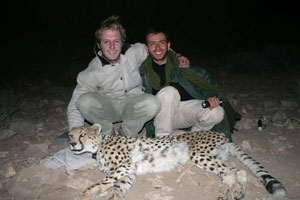
I received an irate email the other day from Luke Hunter, who is the (taking a deep breath) Global Carnivore Program Coordinator for the Wildlife Conservation Society and an Associate Conservation Scientist in the Science and Exploration Program.
Apparently, somebody ratted me out and sent him a copy of one of my posts where I made a passing comment about the absurd amount of darting and radio collaring that is now going on in this human-dominated world:
Here is another article where two proud researchers first trapped, then darted, then radio collared cheetahs in Iran. The process will of course be repeated over and over again until their grant money runs out.
An excerpt from the email:
Ordinarily I wouldn't bother contacting you but I have copied my comment below for your edification. Had you bothered to find out more, as a serious journalist would, you might not be so flippant and poorly educated as your comments suggest. I find it ironic that your profile says that you "very much want [your] grandchildren to live on a planet where lions, tigers, and bears have not joined the long and growing list of creatures that used to be." While you apparently spend your time posting poorly informed, un-reviewed comments online, I am spending my life attempting to achieve that in the field. You'd do better to educate yourself a little about why & how we do what we do.
I think he might have overreacted, just a tad. We are very much on the same side. What we have here is your stereotypical angry, spewing, insulting, derogatory, rant, devoid of any meaningful content and serving no useful purpose. Crap like that isn't going to do much for the image of his organization. Luke's male primate hormones grabbed him by his nose and dragged him to his keyboard to do their bidding. I always keep a paper towel handy to wipe the spittle off my monitor when my hormones win out over my intellect.
Here is a link that explains how and why they are trapping and sticking radio collars on the cheetahs. And if you are of a mind to make a donation to preserve biodiversity, may I suggest that the Wildlife Conservation Society is a worthy candidate.
I was pointing out, as I have on several occasions, that because it's an adventurous and exciting thing to do, there is a hell of a lot of unnecessary darting and collaring going on in the world of wildlife biology. Take a look at the faces of those two proud young bucks. Are they having fun or what? Some of the remaining cougars in Florida have probably been darted dozens of times in their lives. A bear was killed by a dart just a few blocks from my house last year.
Luke is of course painfully aware that capturing and darting wildlife entails a certain amount of risk but in this case he felt it was worth taking that risk. I am certainly not qualified to second-guess his decision, and that wasn't my intent. He knows that if they manage to inadvertently kill, say, the mother of this band of cheetahs it will be a disaster on several fronts. Time will tell and I really do wish them luck.
Comments
View as Flat
Whiskerfish Posted 4:33 am
06 Apr 2007
I think your comment was ignorant and out of order. As a sometime biologist who, every year, goes out and marks birds of prey, I am painfully aware of the risks involved. Every time you go out and trap an animal you run the risk of hurting or killing it. Your comment demonstrated an unfortunate ignorance of field biology in general and of the Asiatic Cheetah project in particular.
Radio tracking/collaring and other forms of marking like bird banding or patagial tagging or whatever deliver data that we wouldn't be able to get otherwise, faster and more accurately than other methods. There are doubtless a few 'bad apple' biologists who don't care enough for the welfare of the animals they study (I have met one or two out of the hundreds I have interacted with), but the vast, vast majority of biologists spend ages thinking about how to affix tracking or marking devices without causing the animal distress or harm. Uncaring and unprofessional biologists tend to get ostracised from the community pretty quickly.
In the case of the Asiatic Cheetah you have a highly endangered animal that ranges over massive distances and is impossible to follow. You need to find out where it goes and how it hunts etc. to conserve it. It is unfortunate that a few animals are temporarily stressed and inconvenienced while being collared - but it's better than the taxon going extinct.
Put your ego in your pocket and apologise. In an unqualified fashion.
Cheers
Whiskerfish
Permalink
Biodiversivist Posted 8:04 am
06 Apr 2007
Me:
"There is no doubt that my one sentence was misplaced with respect to your project. Amends have been made as is appropriate and in the end we have increased public awareness of excessive darting practices and given your project a PR boost."
Luke:
"An entertaining read. You're probably right that I over-reacted. I even agree with that, of course, there is unnecessary darting at times; as I mentioned in my explanation on bigcats.com, some biologists are better than others. And I'm opposed as anyone to darting for the wrong reasons or by the wrong people."
There was some more head butting and face saving, we stopped short of hugging, but that I think is the gist of it. The practice of academic sniping is centuries old. The internet just speeds the process up. I hope I can be of service to his project in the future.
In the end, it all comes down to biodiversity. Poison Darts--Protecting the biodiversity of our world
Permalink
caniscandida Posted 6:24 pm
06 Apr 2007
It is not entirely beyond controversy, though. Some promoters of animal rights, I expect, would protest that sort of thing. And they would at least be right to inquire. But on balance they have much more important issues to worry about; and the activity of these biologists seems not to amount to anything that could be considered abuse.
By the same token, BioD, it is not impossible that Luke Hunter reacted as he did to your suggestion that too much darting is taking place (aside from all that male primate business and young-buckihood that you so love to talk about), because the animal rights people, whether PETA or others, have already attacked him and his colleagues, and he thought that your comment was just more of the same.
Regarding the safety of his cheetahs, it is interesting that he spends so much time describing the leg-holding traps that he needs in order to be able to approach and dart them. Apparently the design of the trap is such that the cats are very unlikely to injure themselves in them.
But I think it is fair to say that traps like that would not be ethical in Africa, where the presence of large predators would put any animal that could not escape from them in great danger. The fauna of Iran is presumably not so complicated in that regard. Hunter says that the cheetahs are usually trapped for a good couple of hours before he can get to them. I doubt he would tolerate the trapping method, if there were serious danger of a bear, or a leopard, or dogs finding the cheetah first.
An interesting risk that the biologists who collar Florida panthers have to deal with, according to those field notes from 2002, is catching them, when they are in trees and the tranquilizer takes effect, so as to break their fall. Talk about a heroic adventure that a young buck of a certain sort would relish! In one case the writer mentioned that "only two of us" were present in time beneath the tree to catch the falling cat. Wow! One imagines one could easily come away from that sort of close contact showing off some interesting scars.
On the other hand, it can happen that there are not enough cat-catchers, or they miss. There is a note on one poor panther who broke its leg in the course of capture, and needed to be kept in captivity for 15 months until its leg healed and it could be released.
Presumably it is the standard ethical procedure never to abandon an animal in a tranquilized state. The biologists must not leave the vicinity until they see the animal recover full mobility. If the period of tranquilization is likely to be long, I believe they can inject an agent that counters the effect of the tranquilizer and speeds recovery.
Perhaps Whiskerfish can comment on methods that are used in Africa.
As for the bear that was killed in northern Seattle last May, we should observe that it was darted twice, the first time apparently not successfully. Also, it was zapped twice with Taser guns. Those nasty inventions definitely can cause death, even though their purpose is to obviate the need to resort to real guns, the kind with bullets. The bear weighed only 150 lbs., like a largish woman or a smallish man. If I were that WA wildlife biologist (I think his name is Chandler), I would have wanted to have an autopsy performed. Instead, he just dumped the bear's body in the woods, "to let nature take its course." That is a bit ironic, because there was little that was "natural" in the way the bear died.
Chickens are our cousins!
So are other sensitive animals!
Enough is enough!
No more factory farms!
Permalink
Biodiversivist Posted 2:49 am
07 Apr 2007
If we can't find ways to grant E.O.Wilson his wish, to provide and protect habitat and corridors between those habitats, the extinction event will burn through what is left. Wild places are rapidly becoming open air zoos.
In any case, controversy can be good. Valid critique stings but it usually has an effect, delayed and subtle.
This article also demonstrates how passionate conservationists (biocentrists) can be. Preserving chunks of the planet for the sake of biodiversity will take some serious power brokering, innovative ideas, and critique of said ideas. There are a large number of people under the environmentalist umbrella who don't put biodiversity preservation very high on their list of priorities, reflecting the attitude of the general populace.
In the end, it all comes down to biodiversity. Poison Darts--Protecting the biodiversity of our world
Permalink