Dear Umbra,
What can I do about washing my car in a more eco-friendly way? Is phosphate-free soap enough, or should I just suck it up and go to the drive-through car wash every time?
Katie
North Carolina
Dearest Katie,
You are one of those fastidious people I see busily washing their cars on Saturdays. I always wonder why some people are driven to go to such lengths, while others consider washing their cars somewhere below replacing their toothbrush on life's long list of things to conveniently forget about. One of the little mysteries.
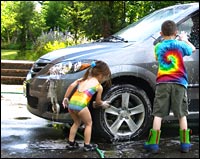
Fun for the kids, bad for the planet.
Photo: iStockphoto
Washing the car at home might be cheaper and handier, but I'm afraid you have to suck it up. It's nearly always better to go to the commercial car wash. They use less water, and in the U.S. they are required to send their used water off for treatment, or to take other measures that lessen the impacts of their discharge. Some of them even reuse their water. Home washes, on the other hand, usually drain directly to storm sewers that eventually empty into streams, lakes, rivers, or bays, affecting our fish friends and the health of the water.
A survey a few years ago by the International Carwash Association (really!) found that a little under half of Americans prefer to suds up in the driveway, though. So if you do decide to keep washing the car at home, here are a few tips. Try not to do it very often. When you do it, park the car on your lawn, which acts as a natural filter for the soap, dirt, oil, and other gunk that would otherwise run down your driveway and straight into the drains. (Of course, you might not want that stuff on your lawn, either, if you stop to think about it.)
Next, consider the biggest problem with washing at home: water usage. One estimate says the average home wash uses 116 gallons of water. You don't want to be a water-waster, do you? Use less by buying a nozzle that controls the flow from your hose, or by using a bucket -- this will help you keep an eye on how much you're using. You might even collect rainwater or gray water from your house and wash with that. Guess what commercial car washes do? Mix air and water half and half, so they get pressure without volume. Smart. And as a result, most commercial washes use 60 percent less water in the entire process than you use just rinsing off your car.
When it comes to soap, you might try an eco-friendly soap like Dr. Bronner's, or no soap at all. The detergents in regular car cleaners hurt our fish friends by destroying a mucus layer that protects them from bacteria and parasites. They can also cause trouble by reducing the surface tension of water, which makes it easier for fish to absorb organic chemicals such as pesticides. Even the smallest amount of soap can make our fish friends unhappy -- including those labeled biodegradable and low-phosphate.
Here's a final idea: you could park your car and never drive again. After all, a parked car is a clean car, right? Just a thought.
Buffly,
Umbra
Comments
View as Flat
Saucerman Posted 7:49 am
21 Aug 2006
Falcon Water-free Urinals claims that one urinal saves 40,000 gallons of water per year. That's 25,000 flushes at 1.6 gal, or 68 leaks a day, 7 days a week. That is a whole lotta piss!
It doesn't do the conservation case any good at all to grossly exaggerate these baseline usage numbers. It merely adds fodder for the skeptics. I would ask Umbra and others to be more careful about these things...
Permalink
bstimer Posted 4:49 am
22 Aug 2006
AVERAGES - The estimated savings that we cite is based on an average of the life cycle cost analyses that have been conducted for thousands of facilities around the world. These facilities consist of every imaginable type of urinal and amount of "customer" traffic. Some facilities average less than 40,000 gallons per urinal per year, while others such as airport terminals demonstrate higher than average savings.
FACT - The Colorado Springs Airport installed water meters on the feed lines that served their flush urinals as part of their feasibility study for waterfree urinals. After three months of normal traffic, the average water use was determined to be 46,223 gallons per urinal per year.
REGULATION - The U.S. Energy Policy Act of 1992 requires that new urinals must not exceed 1 gallon per flush, but does not require that high-volume flushers be replaced. As a result, urinal flush volumes in the United States range from one gallon or less to several gallons per flush.
JIMMIED VALVES - Low volume flush valves normally cannot generate enough velocity and volume to create a good flush in high volume urinal fixtures. To remedy this, the valves are often adjusted to allow a greater volume of water in each flush.
LEAKS - One drop per second is estimated to waste 3,000 gallons per year. A small stream = 60,000. A flush valve or flapper than is stuck open = 600,000 gallons per year. According to the Third World Centre for Water Management in Mexico City, "In nearly all the megacities nearly 40 to 60 percent (of water) never reaches the consumer" because of leaks and poor maintenance (http://www.enn.com/today.html?id=11106). It's uncommon for a leak to run on for an entire year, but numerous small leaks in a large facility can accumulate tremendous waste.
DOUBLE FLUSHERS confound us, but they exist. Some guys flush the urinal before they start to use it and again when they're done. Maybe they like that moisturizing mist of the bacteria laden flush plume.
Regardless of the stated average water savings, we guarantee that Falcon Waterfree urinals will save 100% of the water that is needlessly flushed away by water-fed urinals and we stand by the results that our customers experience.
Permalink
lyrivyzy Posted 7:14 am
22 Aug 2006
happiness,
Lizzzzzz
Permalink
bookerly Posted 10:06 am
22 Aug 2006
I generally don't wash my bicycle, let the rain wash it, or use a piece of dry paper to rub off the loose dirt. Works pretty well.
Of course, I don't get those high status thrills from my transportation mode. (LOL).
patrick
Permalink
cleanfreakchemicalfree Posted 12:22 pm
31 Aug 2006
in regions that have a water shortage, or for those who care about water usage and our world...pull your car onto your lawn, hose it down, use an ENJO garage glove [cleans better than any car wash and takes half the time], dry it off, pull your car back onto the street or driveway and there...you've watered your lawn and cleaned your car...and since you're not using ANY chemicals, you've wasted nothing, you've bought nothing, you';ve thrown away nothing and you can let your kids help without exposing them also to harmful chemicals.
Yes, I do sell the product. But, my motivation is pure. You can visit http://www.enjo.net to read all about the fibres for yourself. And - the US is still serviced from Canada...but not for long as the buzz is growing!
Permalink
cleanfreakchemicalfree Posted 12:24 pm
31 Aug 2006
Permalink
athada Posted 11:36 am
19 Apr 2007
On car washing, for example, here we're worrying mostly about 2 environmental impacts of car-washing: water use and soap contamination. A huge factor that was never mentioned is the construction of car wash facilities! At least at home most people already have most of the materials to wash a car (a concrete slab, a hose), whereas at a car wash you have an entire facility built to serve one purpose - a facility that needs maintenance, electricity, etc.
As for soap suds going to the waste water plant, yes the water isn't contaminated by the plant is also sucking electricity, polluting, etc.
I know for the sake of our collective sanity we have to simplify sometimes, but we have to face the troubling facts and not allow enviro-critics to point out our oversimplification.
Permalink