Meat wagon

Why the USDA has no business overseeing conditions on factory farms, and more 17

In Meat Wagon, we round up the latest outrages from the meat and livestock industries.

———

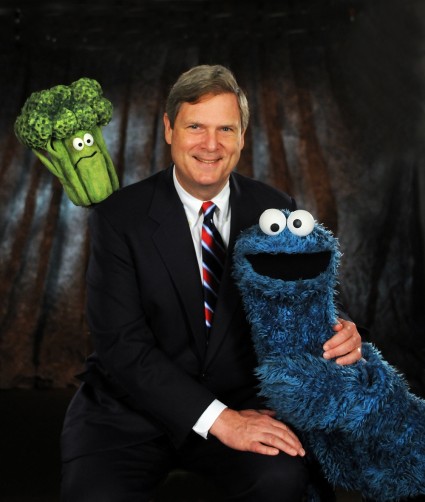
vilsackUSDA chief Tom Vilsack, with special friends: Will this guy ever get serious about the swine flu/swine farm link? Why isn’t the federal government seriously investigating the possible CAFO-swine flu link?

I’ve posed that question several times recently, most recently here. Now let me venture an answer.

The USDA is the federal agency tasked with ensuring that practices on farms, including factory animal farms, are safe. But it’s also the agency that exists to promote U.S. agricultural interests. In other words, the USDA has an inherent conflict around overseeing conditions on factory-style farms. For example, training a cold eye on the systemic safety hazards of factory farming isn’t likely to do much to promote the pork industry.

And from the start of the novel H1N1 outbreak, the USDA has tilted decidedly in the direction of promoting U.S. ag interests. Even though virologists and veterinary scientists have been warning for years that large hog farms create ideal conditions for the generation of dangerous new flu viruses—as this Environmental Health Perspectives article definitively shows—-the USDA still isn’t systematically testing swine herds for H1N1. It continues to rely on a voluntary—and little used—testing program.

Nor is it doing much, from what I can tell, on the problem of MRSA, the antibiotic-resistent staph infection that claims more lives every year than AIDS. MRSA has been pretty definitively linked to factory hog farms—specifically the dubious practice of dosing pigs daily with antibiotics.

If the USDA has been limp in its attempts to examine safety conditions on factory farms, it’s been downright zealous in its efforts to promote the pork industry.

The latest: The USDA spent a cool $50 million on pork last week, in an explicit attempt to “assist ... struggling producers.” That brings total 2009 federal spending on pork—the “other white meat,” that is, not pet projects for cronies—to $105 million. The latest $50 million worth of pork will be shunted into the National School Lunch Program, playing its traditional role of sinkhole for unwanted ag commodities.

Now, there are instances when the federal government should aid struggling producers by taking excess product of the market, and the school lunch program is a fine place to send high-quality products. At the same time it dropped $50 million on pork, the USDA spent another $32 million on cherry, plum and apple products, also destined for the school system. You won’t find me protesting that.

But let’s take a harder look at this year’s $105 million pork expenditure. As Elanor Starmer showed in an excellent post on Ethicurean, these USDA pork purchases don’t really amount to a bailout for hog farmers—who are indeed hurting from high feed prices and low hog prices—but rather for the pork-processing industry, which is dominated by multinational giants: Smithfield, Tyson, Cargill, and JBS.

I would argue that if the USDA wanted to help hog farmers, it would bust up the meat trusts, aid the remaining independent CAFO operators in scaling down their resource-sucking, pathogen-incubating, pollution-spewing operations and send their pigs out to pasture, and reinvest in processing infrastructure. By snapping up excess CAFO pork, it’s just handing a sop to Smithfield and its ilk.

Dithering on the swine flu threat while intervening in markets on behalf of the swine industry serves no one’s interests—except those of the shareholders in the meat-industry giants.

Smithfield’s shares jump
Meanwhile, those shareholders are starting to cash in. The problem of consolidation within the hog industry is only intensifying—the economic crisis is sending smaller industrial players to bankruptcy court, leaving the likes of Smithfield with yet more market share in the hog production space.

To understand what’s going on here, you have to know that Smthfield isn’t just the globe’s largest hog processor—i.e., it slaughters million of hogs every year and sells tons of pork. It’s also the globe’s largest hog producer—i.e., it raises hogs on large factory farms.

It processes many more hogs than it raises, so it also buys hogs from other producers, most often on contract.

This is the so-called vertical-integration strategy: With its own vast herd and its contracts, Smithfield controls the process of pork production from piglet to pork chop.

Right now, there’s a vast oversupply of hogs, depressing prices for both live hogs and pork. That means both of Smithfield’s business units are hurting. But as a large and relatively cash-rich player, smithfield can withstand the pain better than its small competitors—who are now dropping like fattened hogs in a slaughterhouse kill line.
From CBS Marketwatch:

North Carolina’s Coharie Hog Farm filed for Chapter 11 bankruptcy protection on Nov. 6, joining fellow state producer Coastal Plains Pork, which sought bankruptcy protection Sept. 28, and Bunting Swine Farms LLC this past May.

Also recently, Minnesota’s MHF of Freeborn County Inc. declared Chapter 11 in October while Illinois-based Leading Edge Pork LLC filed for bankruptcy protection in September.

More could unfold. According to Stephens’ analysis, two of the nation’s top 25 pork producers are “on the brink of bankruptcy.”

As these smaller players fall away, they liquidate their herds—meaning fewer hogs on the market, and higher hog prices down the road. And the surviving players like Smithfield benefit. And that, in a nutshell, is why Smithfield shares jumped 20 percent last week.  The small fry fall away, and the big abide. Or to use a wonderful Biblical phrase highlighted by the great Flannery O’Connor, “the violent bear it away.”

Supersize me
Vibrant ecosystems thrive on diversity—lots of different varieties of critters provide a broad genetic base, bringing resilience in times of flux or shock.

The meat industry, by contrast, likes monocultures. It settles on just a few varieties of, say, chickens, and then aggressively breeds them for certain traits: mainly, the ability to fatten quickly on grain-heavy diets.

Cloning technology brings that dubious principle to its logical extreme: It takes the thin genetic band on which modern agriculture rests and reduces it to a microscopic line. Rather than endure the small random fluctuations of conventional breeding, livestock producers can now experience the precision of the Xerox machine.

The technology remains in its infancy—so much so that it costs $15,000 to clone a cow, reports Reuters in a recent article called “Welcome to the Clone Farm.”  But didn’t stop the FDA from approving meat from cloned animals for human use last year. The agency invoked the same principle it used in the 1980s to wave through GMOs from the lab to the plate: “substantial equivalence.” As Reuters puts it, the FDA ruled that “the products are indistinguishable from that of their non-clone counterparts.”

While the expense is holding down adoption of cloning as a breeding strategy, the technology is very much in use. According to Reuters, “[C]onsumers are likely already eating meat and drinking milk from the offspring of clones, which are technically not clones, without even knowing it.” Oh, yeah—did I mention that the FDA decided against requiring that meat from cloned animals be labeled?

Toward the end of the article, we find information that makes the “substantial equivalence” principle look really, really shaky for cloned meat. Let me ask you this: does conventional animal breeding regularly result in “large offspring syndrome”?

Here’s Reuters: 

Despite cloning’s gradually improving rate of success in producing healthy animals, the process still has a high rate of failure. Some animals are born with abnormalities and have to be euthanized and some have more health problems at birth than conventionally bred animals.

Large Offspring Syndrome also occurs more often with assisted breeding technologies like cloning. The syndrome causes the fetus to grow too large, causing problems for both the clone and the surrogate.

Currently, cloning technologies produce an (apparently) healthy animal in just 10-15 percent of attempts—and the rest of the time produce grotesquely flawed creatures that must be killed immediately.

Sounds like a technology that could use a bit more study—long-term, multi-generational studies, to be exact. Does saying so make me guilty of rank “denialism”? 

Grist food editor Tom Philpott farms and cooks at Maverick Farms, a sustainable-agriculture nonprofit and small farm in the Blue Ridge Mountains of North Carolina. Follow my Twitter feed; contact me at tphilpott[at]grist[dot]org.

Advertisement
Advertisement
  1. Matt D Posted 5:16 pm
    16 Nov 2009

    Be careful throwing around the word "monoculture." I don't know about swine, but in many crop species, heirloom and landrace varieties are actually LESS diverse than modern varieties (at least in terms of the pest resistance alleles that are the whole justification for polycultures).

    Here's a recent peer-reviewed article that shows greater genetic diversity in modern than traditional tomatoes (though wild tomato species are more diverse than all domesticated ones)

    http://www.biomedcentral.com/1471-2164/10/466
  2. JMG3Y Posted 7:28 am
    17 Nov 2009

    Tom:
    IMO you are overlooking the pathway through which powerful interests drive these agencies. Yes, they are driven by powerful stakeholders but the pathway is through elected officials who control the agency budgets and have the power to call congressional hearings. In my limited experience, nothing drives agency administrators more than the fear of being summoned and drawn and quartered in front of a congressional hearing, their budgets cut or being given another large but unfunded mandate. Nothing. Agency mandates already considerably exceed their budgets so agency administrators have to carefully pick and choose what the agency does. Congressmen get political benefits from passing enabling legislation but not from raising taxes (funding the mandate).

    IMO when regulatory authority is moved from one agency to another, the powerful stakeholders simply move their influence (money) to the members of a different congressional committee. Congressmen compete for these different committees based on the powerful interests in their district and their sources of campaign contributions.

    This event proves my point:

    Uh oh. Industry forces FDA to drop oyster safety plan
    http://www.foodpolitics.com/2009/11/uh-oh-industry-forces-fda-to-drop-oyster-safety-plan/

    From what I've observed from my limited interactions at a policy level with administrators from both agencies, the USDA functions better in many respects than does the FDA. The number one priority of the FDA is human pharmaceuticals and biologicals because that is where they can experience the greatest damage (think congressional hearings, sound bites and budgets) from a "wreck" and the stakeholders are the most powerful. Because the agency's risk from food "wrecks" is lower, that part of the agency will always be more underfunded relative to its mission than will those parts of the agency with higher priority missions.
    1. Tom Philpott's avatar

      Tom Philpott Posted 7:52 am
      17 Nov 2009

      JMG3Y,
      Your point is well taken and your analysis is pungent. You're essentially saying that the situation is even more screwed up than I'm portraying it; "regulatory capture" has prevailed fully, through what amounts to leveraged buyouts of Congressional committees. I don't really have an answer for that, except, damn. But I still think that charging the USDA with overseeing CAFOs and charging them with promoting the interests of the meat industry is insane. Maybe the focus should be attacking the second function, not trying to remove the first?
    2. Catmoves Posted 2:17 pm
      17 Nov 2009

      I agree that the Federal elected officials are our target in order to get action that will help protect the American consumer. And I can't think of anyone in a better position to "put the heat on" than Tom Philpott.
      How about it? Will you start the loyal opposition?
  3. Lajaw Posted 2:53 pm
    17 Nov 2009

    Where does the Federal government have a part in anything to do with food production. You see, the big government lovers and the unfettered corporatism folks are both responsible for CAFO's. When a local community can no longer have a say in what type of industry it wants in it's back yard, we have lost our individual liberties. I know, because I have been forced to move because of a CAFO put up 1000 foot from my house. I moved, but will likely never be able to sell my property because of said CAFO. The states rely on the USDA and the EPA to write rules for the CAFO's. And we all know that they favor the corporations over the individuals/communities.
  4. mm510 Posted 12:18 am
    18 Nov 2009

    On the USDA's conflict of interest: The USDA's Strategic Plan for 2005-2010 contains the following Strategic Goals:

    Strategic Goal 1: Enhance International Competitiveness of American Agriculture
    Strategic Goal 2: Enhance the Competitiveness and Sustainability of Rural Farm Economics
    Strategic Goal 3: Support Increased Economic Opportunities and Improved Quality of Life in Rural America
    Strategic Goal 4: Enhance Protection and Safety of the Nation's Agriculture and Food Supply
    Strategic Goal 5: Improve the Nation's Health and Nutrition
    Strategic Goal 6: Protect and Enhance the Nation's Natural Resource Base and Environment

    Trade is at the top of the list, food safety and nutrition are lower. Although there is no indication that these are in order by priority, somebody made the decision to put trade at the top of the list. I'm not sure if the USDA has any official policies about what to do when strategic goals are in conflict, but it seems that they typically choose Big Ag over Little Eater. With 2010 almost here, I wonder if they are working on a new plan for 2010-2015.

    On clones: Has anyone conducted a blind taste-test of the meat from cloned animals vs. traditionally bred animals? Does the cloned meat live up to the hype, or is nuture (feed, pathenogenic environment, antibiotic regimen, weather), more important than nature (DNA)? How about careful studies of milk production from clones and progeny of cloned dairy cows? Does it really offer any benefit, or are we being hoodwinked? One reason I ask is that during the last burst of articles about clones, an article about cloning in the Journal Sentinal had this counter intuitive item: "'Our clones weren't identical,' he says. 'Genetically, they were. Some weren't as tall as Blackrose [a champion dairy cow that was cloned]; one was huge, but the markings were different. The Lord is still in charge.'" Huh? Isn't the point of cloning to make identical animals? If a clone of Blackrose isn't as tall or has different markings, isn't it logical to think that the animal's milk output would be different? (nature vs. nuture...)
  5. jonnyappleseed's avatar

    jonnyappleseed Posted 1:52 pm
    18 Nov 2009

    A simple question: if not the USDA, then who?
    Also, Smithfield's share price jumped on the outlook for feed grains, not Coharie. Most of those sows will move/have already moved 'laterally' - into other people's production.
  6. foodprovider's avatar

    foodprovider Posted 7:04 am
    19 Nov 2009

    Tom...

    Who would you suggest to oversee the agrucultural industry if it is not the USDA? How would you develop a regulating agency that would be 100% impartial to the industry itself? Could that even be accomplished?
  7. askantik's avatar

    askantik Posted 6:46 am
    20 Nov 2009

    A couple people act like Tom is making a crazy proposal (omg, who will regulate it if not the USDA!?), when I think the main point is that it's fundamentally counter-intuitive and counter-productive to have an agency whose job is to promote these industries and also regulate them.

    Our government should be promoting intelligent farming (i.e., not CAFOs, not subsidizing a select few crops heavily, etc.), but more importantly, they shouldn't be so caught up in helping the business aspect of these industries that they become unable to responsibly oversee them because they have a vested interest in NOT analyzing their practices.
    1. jonnyappleseed's avatar

      jonnyappleseed Posted 6:59 am
      20 Nov 2009

      My question wasn't a trap - and I'm not either in favor of or opposed to the proposal, but I do want to know what the rest of the proposal is...if not the USDA, then......
      1. Tom Philpott's avatar

        Tom Philpott Posted 7:05 am
        20 Nov 2009

        The FDA would make logical sense--if it got a proper budget increase. Or maybe meat is different and requires an independent entity answering to the FDA. Right now, Obama can't even manage to appoint a director to FSIS--the USDA subagency that oversees meat safety.
      2. askantik's avatar

        askantik Posted 7:06 am
        20 Nov 2009

        I don't think Tom is necessarily saying we need to pull some new agency out of our ass, I just think he's saying we need to recognize that the USDA in their very core have a conflict of interest. I don't see how they will have much of an incentive to properly and responsible oversee an industry if they also think they are supposed to be giving it a boost.

        As far as I'm concerned, we can stop giving my tax money to "help" gigantic corporations that create jobs, but these jobs are very low-paying, dangerous, high-turnover jobs that ruin the small communities they show up in and exude all sorts of bad stuff into the environment. But at the very least, we need to have a separation of business interests and public interests (public interests being primarily safety).
    2. Tom Philpott's avatar

      Tom Philpott Posted 6:59 am
      20 Nov 2009

      Thank you, askantick. I can not always be bothered to get into silly back-and-forths with the likes of "food provider." Oh my God! Who will regulate CAFOs if not the USDA!!!!!!!!! [faints.] If Food Provider would trouble himself with engaging with the argument being made, conversations might actually be productive around here. Yes, regulatory capture is vexing; yes, the FDA is shamefully compromised by Big Pharma; but its role in life isn't to promote Big Pharma. It's got big problems overseeing the drug industry, but those problems don't lie in its very DNA. The USDA clearly has no business overseeing conditions on factory farms. It's like tasking an 8-year-old with overseeing the cookie jar.
      1. jonnyappleseed's avatar

        jonnyappleseed Posted 9:14 am
        20 Nov 2009

        Well, I think I'd start by asking just what it is you want to regulate here. Worker safety? Shouldn't that be OSHA? Environmental pollution? That ought to be EPA. The actual process of raising meat? Is that about animal welfare? Or is it about the inputs (feed, drugs) ? Or the death process? Or meat quality? Pretty big mess to coordinate all that - unless you did one or both of the following: Create a "Department of Feed & Food" ; require food producers to be licensed.
        Just sayin'
      2. foodprovider's avatar

        foodprovider Posted 7:10 am
        23 Nov 2009

        Oh Tom, Stop with the drama please. My question was just as it was stated. I may not agree with alot of your views, but I am curiuous as to what the your solution may be, and how it would work. No matter which agency is cahrged (or crated) with oversite, I am afraid that there will be industry influencers involved. I get the feeling that you would like to see industry not involved in the regulation process. Without some industry input, the agricultural industry could be so over regulated that productivity could decline (due to high costs of regulation) to the point that we could become a net food importer.
  8. CyberBrook's avatar

    CyberBrook Posted 11:34 am
    20 Nov 2009

    Please visit

    http://www.FactoryFarming.org

    and

    Eco-Eating at http://www.brook.com/veg

    for more info

Add a Comment

You are not logged in. Thus, you cannot post a comment. If you have an account, log in. If you don't have an account, well, by all means go make one! Meet you back here in five.

Hello, Visitor!    Why not register?

Advertisement