Denialism and H1N1

Time for the mainstream media to face the factory farm-swine flu link 23

“Since last spring and the onset of the 2009 pandemic H1N1 influenza outbreak in humans, USDA has consistently asked that the media stop calling this “novel” pandemic virus “swine flu.” By continuing to mislabel the 2009 pandemic H1N1 influenza virus that is affecting human populations around the world, the media is causing undue and undeserved harm to America’s agriculture industry, especially to pork producers.”
—From the USDA Website

—————————-
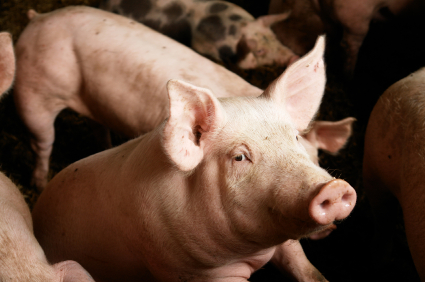
hogNovelist-turned-anti-meat-pamphleteer Jonathan Safran Foer made a stark claim about swine flu on The Ellen DeGeneres Show recenly:

This swine flu that’s now an epidemic, they’ve been able to trace it back to a farm in North Carolina… A hog farm. Nobody knows this. Nobody talks about it. We’ve been told this lie that it came from Mexico.

Well, the situation is even worse than Foer suggests. Authorities aren’t actually saying the novel strain of swine flu “came from Mexico.” That would be uncomfortable, because it first cropped up there a few miles from vast hog operations run by U.S. pork giant Smithfield.

But they are insisting that “pork is safe”—and doing little or nothing to monitor hog confinements for evidence of infection.

For years before the current outbreak, scientists openly worried that CAFOs (concentrated animal feedlot operations) provided excellent arenas for the generation and spread of dangerous new flu varieties.

Yet another bit of evidence on this score crossed my desk this week: a “News Focus” piece that ran in Science back in 2003 called “Chasing the Fickle Swine Flu.” (PDF) It’s jumping-off point is the very incident Foer pointed to on Ellen—the outbreak of a novel strain of flu, genetically related to the current strain, on a North Carolina farm in 1998. The opening is worth quoting at length:

One of the first signs of trouble was a barking cough that resounded through a North Carolina farm in August 1998.  Every pig in an operation of 2400 animals
sickened, with symptoms similar to those caused by the human flu: high fever, poor appetite, and lethargy. Pregnant sows were hit hardest, and almost 10% aborted
their litters, says veterinary virologist Gene Erickson of the Rollins Animal Disease Diagnostic Laboratory in Raleigh. Many piglets that survived in utero were later born small and weak, and some 50 sows died.

The culprit, a new strain of swine influenza to which the animals had little immunity, left veterinarians and virologists alike puzzled. Although related flu strains in birds, humans, and pigs outside North America constantly evolve, only one influenza subtype had sickened North American pigs since 1930. That spell was suddenly broken about 4 years ago, and a quick succession of new flu viruses has been sweeping through North America’s 100 million pigs ever since. This winter, for example, up to 15% of the 4- to 7-week-old piglets on a large Minnesota farm died, even though their mothers had been vaccinated against swine flu, says veterinary pathologist Kurt Rossow of the University of Minnesota, Twin Cities. [Emphasis added.]

Here we have a phenomenon I’ve written about before: the flu strains circulating through the U.S. swine herd didn’t mutate much after 1930—until 1998. The novel strain that emerged in a North Carolina CAFO then was devastating for pigs, whose immune systems did not recognize it; but luckily, it didn’t have the genetic chops to jump to humans.

By 2003, scientists were actively worried that would soon change, the Science article reveals.

“Within the swine population, we now have a mammalian-adapted virus that is extremely promiscuous,” one researcher told the magazine. “We could end up with a dangerous virus,” i.e., a mutation that jumps to humans.

And researchers were looking to the CAFO as the site where such a thing could rear up. In the 1990s, hog farming underwent an unprecedented process of intensification and consolidation. As Science put it:

In the past decade, big swine producers have gotten bigger, and many small producers have gone out of business. The percentage of farms with 5000 or more animals surged from 18% in 1993 to 53% in 2002, according to Rodger Ott, an agricultural statistician at the National Agricultural Statistics Service in Washington, D.C.

Back in 2003, there was no taboo about stating the obvious:

“With a group of 5000 animals, if a novel virus shows up, it will have more opportunity to replicate and potentially spread than in a group of 100 pigs on a small farm,” [University of Minnesota veterinary pathologist Kurt] Rossow says.

But giant hog confinements weren’t the only sites of concern: Another vet-science expert warned Science of the concern that small-scale, pasture-based operations are even more menacing than CAFOs, because “pigs in outside pens, as is common on small farms, can be exposed to the droppings of migratory waterfowl, which may contain infectious viruses; large-scale confinement agriculture may prevent such exposure.”

Right. But that particular expert happened to be the “director of veterinary science at the National Pork Board in Clive, Iowa.” Now, there may be risk associated with keeping pigs outdoors where they can come into contact with birds. But the small size of outdoor herds means much less opportunity for the kind of mixing and reassortment to create a high probability for jumping to humans. Can anyone name a vet-science expert seriously concerned about this factor—that is, who doesn’t draw a salary from the industry?

In addition to sheer numbers, the Science piece points to another factor linking CAFOs to the generation of new strains: an explosion in vaccinations.

In 1995, swine flu vaccination was so new that the National Swine Survey conducted by the United States Department of Agriculture didn’t bother to assess its extent. ... Today [i.e, back in 2003], more than half of all sows are vaccinated against both H1N1 and H3N2 viruses, says Robyn Fleck, a veterinarian at Schering-Plough, one of the nation’s three producers of swine influenza vaccine.

All those vaccines created concerns of a treadmill effect—when all the pigs in a buiilding are vaccinated, only vaccine-resistent flu mutations can survive, creating a constant need for new vaccines. Already in 2003, Science reported, researchers were finding flu in vaccinated pigs. “Flu is also showing up in piglets thought to be protected by maternal antibodies passed on from vaccinated sows,” the article states. Here’s a choice bit:

Widespread vaccination may actually be selecting for new viral types. If vaccination develops populations with uniform immunity to certain virus genotypes, say H1N1 and H3N2, then other viral mutants would be favored. [Molecular virologist Richard] Webby suggests that the combination of avian polymerase genes generating errors in the genetic sequence and immunologic pressure from vaccination may be selecting for unique variants.

Now, that same virologist, Richard Webby, goes on argue that mass vaccination is important, drawbacks aside. The “benefits of vaccination outweigh this side effect,” Webby told Science, because “If you can decrease the amount of virus, you can reduce the chances of interspecies transmission.”

To me, this statement illuminates a gaping dilemma presented by industrial-scale hog farming: we’re forced to choose between a vaccination treadmill, which reduces the incidence level of flu in CAFOs but predictably generates novel, vaccine-resistant strains; or not vaccinating at all, which would allow flu to run rampant among millions of hogs.

Even a veterinary expert for Schering-Plough, the pharmaceutical giant (now owned by Merck) with a large position in the swine-vaccine market, seemed a little concerned about the situation—not just the vaccine treadmill, but the whole game of factory hog farming.

Schering-Plough veterinarian Terri Wasmoen acknowledges that vaccines “may be pressuring change.” But she also notes that larger hog confinement operations and more shipping from state to state may play a role. “We need epidemiological work to understand these issues, and there is no funding now,” she says. [Emphasis added.]

That last bit is jaw-dropping for several reasons. Here are two: 1) With a known and obvious public-health threat brewing, public-health authorities had zero political will to even muster funding to study it; and 2) a multi-billion-dollar pharmaceutical company was minting profits from a growing market it knew contained a serious public-health risk, yet could itself find “no funding” to research it.

Well, here we are, six years later. The scenario that scientists feared and predicted would unfold has unfolded: a novel strain of H1N1 has jumped to humans, and is now spreading rapidly. Scientists are now hoping the strain won’t mutate into one that’s more difficult to shake off. But as we know now, hope doesn’t do much to stop the evolution of flu strains. There remains no large-scale effort to investigate CAFOs as engines of new swine flu strains—or even monitor them for infections.

“[T]here is no systematic monitoring of [human] populations where there may be interspecies transmission between humans, birds, and pigs,” a CDC epidemiologist complained to Science six years ago, referring to the lack of monitoring of CAFO workers for infection. Amazingly, that remains true today.

Our political culture has proven itself incapable of challenging the multibillion-dollar pork industry. But what about our media culture—the watchdogs who keep democratic society safe from unaccountable power?

As Foer says, nobody—besides him, me, and a few others—is talking about this link. The Washington Post made a game try a few weeks ago, but not before ludicrously taking pains to stress the “pathogen-free” nature of CAFOs.

Who will be the first mainstream journalist to train a sharp eye—and stake the prestige of big-name publication—on this question? Perhaps the New Yorker staff writer Michael Specter, who recently published a book on scientific “denialism,” will raise his voice against the systematic denial of evidence that CAFOs generate dangerous flu strains.

Grist food editor Tom Philpott farms and cooks at Maverick Farms, a sustainable-agriculture nonprofit and small farm in the Blue Ridge Mountains of North Carolina. Follow my Twitter feed; contact me at tphilpott[at]grist[dot]org.

Advertisement
Advertisement
  1. Farm Bill Girl Posted 12:24 pm
    11 Nov 2009

    hopefully it'd be good to acknowledge those family farm and citizens groups that have been battling the CAFO menace for decades now, and trying to raise public awareness. 90% of our nation's independent hog farmers are now gone, thanks to all the consolidation in the industry and trend towards factory farms. The National Family Farm Coalition has been one of the few in DC raising awareness of this, but we're never called to testify at hearings and instead, it's the National Pork Producers Council who gets to be the "voice of farmers".

    FOR IMMEDIATE RELEASE


    Contact: Katherine Ozer (202) 543-5675

    Cell: (202) 421-4544


    HOUSE AGRICULTURE SUBCOMMITTEE FAILS TO LOOK AT REAL CAUSES BEHIND PORK CRISIS

    Hearing Featured Solely Corporate Agriculture Witnesses and no Family Farmer Voice


    Washington D.C. (October 23, 2009) – The National Family Farm Coalition denounced yesterday’s hearing of the House Agriculture Subcommittee on Livestock, Dairy and Poultry on the “U.S. Pork Industry Economic Crisis” for featuring a stacked panel of corporate hog producers and failing to offer real solutions to the current crisis. Rhonda Perry, a Missouri livestock farmer said, “The hearing featured the same tired solutions of more free trade and pork buyouts from the voices of corporate agribusiness and failed to look at the real problems behind the pork crisis. When four companies control 66% of the hog industry, it’s no wonder why we’ve lost 90% of our hog farmers since 1980!”

    The stacked panel featured a representative from the National Pork Producers Council and one of the state affiliates, the Iowa Pork Producers Association and the CEO of Seaboard Foods. There were no voices representing independent hog producers. Instead of blaming swine flu and the collapse in export markets, NFFC believes USDA must look at issues of market structure and access and the continued subsidizing of specialized hog facilities that are contributing to overproduction. Perry said, “This cycle of promoting the expansion of corporate livestock production with taxpayer money, then bailing out the industry because of overproduction with taxpayer money is an irresponsible practice and must come to an end. You can’t justify loans for new operations and more livestock when the current hog farmers are barely treading water or are going out of business all together.” This issue was ignored by the Committee.

    Over the past two years, USDA has spent $264 million on direct and guaranteed loans. NFFC has called for Farm Service Agency to suspend direct and guaranteed loans to new or expanding specialized hog facilities. A petition with over 25,000 signatures calling on the loan suspension was delivered to Secretary of Agriculture Tom Vilsack this week.

    To view the letter go to http://www.iowacci.org/whatcanido/stopUSDAloan.html

    To view the cover letter to Secretary Vilsack click here.

    NFFC Executive Director Katherine Ozer also urged the House Agriculture Subcommittee to look at the issue of consolidation in the pork markets and noted that USDA would soon be issuing rules designed to provide fairer markets for independent hog farmers. “The National Pork Producers Council fails to represent America’s hog farmers with its misplaced focus on exports, more free trade agreements and blaming swine flu instead of addressing the real reason why hog farmers can’t get a fair price for their meat. Without real captive supply reform of the markets to ensure agribusinesses like Seaboard pay farmers a fair price, America’s hog producers will continue to suffer.”
  2. vwg123 Posted 8:40 pm
    11 Nov 2009

    thanks for posting the truth!
  3. amazingdrx's avatar

    amazingdrx Posted 10:57 pm
    11 Nov 2009

    These viruses appear to have a rat vector, namely corpo-RATS. The rats that run the corps(e) and their rat friends in government
    that are killing the biosphere.

    Great article Tom! Great comment farm girl!

    Tune in, turn on, drop out. Get as much of your food as possible from local farmers. Corporate ag and corporate government need to feel the cold reality of a massive boycott of their so-called food products.
  4. jonnyappleseed's avatar

    jonnyappleseed Posted 1:05 pm
    12 Nov 2009

    So, it has come to this: Mr Philpott quotes a novelist on the Ellen show talking about something that nobody, except the novelist apparently, knows. Yes I know that he has written a 'non-fiction' book about eating meat, but if he thinks nobody knows about this, he didn't do his research, as this, as well as previous swine viral diseases (mystery disease, SMEDI, PRRS) were well-known and talked about in the industry, from the early 1980's on or whenever they surfaced. Not content with this silly lead, Mr Philpott slams the integrity of a DVM who works for the pork industry, simply because he works for the industry and didn't fit Mr Philpott's sense of who should be listened to. Might Mr Philpott want to check out the Nipah virus, or documented cases of ducks as a spreading vector? Probably not. Or, he might have added this quote from Dr. Russow as well::"Do pigs contribute to the flu gene pool? Yeah, and so do people and so do wild birds," said Dr. Kurt Rossow of the University of Minnesota, who studies diseases in people who handle pigs. "I just don't agree that pigs are an evil mixing vessel just boiling over with flu that's pumping out to people on a regular basis." Or why not mention that the Flu Epidemic of 1918, the "Spanish Flu" the killed, in about 2 years anywhere from 50 to 100 million people was an 'A virus strain of subtype H1N1'....let's see: 1918, wouldn't that have been before CAFOs ?
    Or this quote from Vincent Racaniello's (PhD Professor of Microbiology at Columbia University Medical Center)web site
    "The theory on why pigs are infected with different types of influenza virus - mainly avian and human - is that the respiratory tract of the pig has receptors for both types of virus. It has nothing to do with 'living in filth' or unsanitary living conditions. Influenza virus entered pigs in 1918 - probably when an infected human gave the virus to a pig on a farm - and has been in pigs ever since, transmitted not only among pigs raised for food, but also among feral pigs. The virus is transmitted in the same way as it is among humans - mainly by respiratory aerosol, some contact."
    By now it is apparent that, regardless of facts, Philpott will write most anything that supports his opposition to CAFO's. Why bother with facts or research or presenting opposing views in a rational discussion when you only need listen to Ellen?
    1. Stolen Foodcart's avatar

      Stolen Foodcart Posted 3:57 pm
      17 Nov 2009

      It's hard to get through the personal attacks and muck in this comment to reach the meat of what you are trying to say.

      Regardless of whether the H1N1 virus existed prior to CAFOs, the fact still remains that the conditions in CAFOs are prime for both bacterial and virulent infections.

      Anyone whose payroll comes from the side they support is subject to bias and therefore not as reliable. That is simple fact. It does not necessarily imply that that individual will definitely be biased and unreliable, but it is a strong suggestion of such. The rest of your comment is simply slew with personal attacks. I don't know how you expect anyone to take you seriously. So viruses are spread naturally in pigs, both domestic and feral, as they are in humans? Good point. Glad you brought it up. In fact, this supports Mr. Philpott's point. Human-based viruses spread through contact occur most prominently where people are clumped together or are in close contact. This is why teachers, college students living in dorms, and hospital residents and workers are particularly vulnerable to viruses. Dispute this? So, where feral swine can transmit viruses just as humans living in a rural area can transmit viruses through contact, CAFOs (where the swine are packed into extremely cramped holding facilities and are often not kept as clean as they should be -- i.e. essentially wading through their own filth) represent a concentrated population density wherein viruses are more easily transmitted, incubated, and are thus given prime opportunity for reassortment, regardless of and even a result of vaccination.

      THAT is Mr. Philpott's point.
      1. foodprovider's avatar

        foodprovider Posted 7:00 am
        18 Nov 2009

        I don't know what experience you may have with animal agriculture. There are definatly some negatives with animals in a (as you call it) CAFO, but thera are also positives. One of them actually being animal health. These animals are under constant supervision and quite often there is also a veterinarian on staff on some of the most modern operations. In the hog business, those barns are very carefully guarded so no human can bring a disease into the herd. Many have protocal that all personel and visitors are showered in and out. In this system, if and when a disease happens to infect the herd, it is then contained in that herd and can be dealt with appropiately. In the case of the system that Mr. Philpott would like to see the industry go back to, it was and still is much more difficult to detect and remedy a disease as those animals may not have the level of surveilence that takes place in the modern facility. It is not the pig that is the problem, it is the people that spread the disease.
        Mr Philpott does seem to have quite the fetish to blast the modern animal ag practices. I personally deal with large animal units, I can tell you that the bio security levels on these operations are extremely high. They fall under the strictest rules (set by the DNR) on how, where and when they can apply their manures to the lands.
        I have NEVER seen conditions in a modern hog operation where the pigs are "wading through teir own filth" I have seen that situation in a few operations where modern practices were not being used. Most notably where the grower has some of the same convictions against CAFOs as some on here do. The modern facilities keep the manure away from the animals.
      2. jonnyappleseed's avatar

        jonnyappleseed Posted 1:04 pm
        18 Nov 2009

        I have no personal disagreement with Mr Philpott -I have never met him - but I disagree with his column. He does not present two -or more! -sides of the story. He is not a journalist, he writes opinion pieces, and some are not just speculative but contain misinformation. Ok, fine. In fact, if you actually had read my response, I'm not disputing the potential problems that CAFOs represent, I just object to the idea that its all the fault of 'factory farming' . The quotes I offered were from non-industry sources - neither of whom write fiction for a living or are likely to get interviewed on Ellen. Take me seriously or not, I don't much care. But really, put the cart back.
  5. MoFarmFamily Posted 6:56 pm
    12 Nov 2009

    It is never good for anyone company to have to much power. There are somethings that could be changed in agriculture to make them better, but what about Wal-Mart don't they have to much power. If we are going to bash one thing we should look at others as well. Another thing is why are we always harping on the meat producers? Why wasn't there more press coverage on the out break of e-coli in peanut butter? We sure didn't try to destroy the peanut producers. As for virus, well there is always one major virus outbreak in every generation. No matter what technology we come up with there will always be something else NO MATTER WHAT. We can't be a sterile world.
    '
  6. mskellyann's avatar

    mskellyann Posted 10:11 am
    13 Nov 2009

    Um, what about Philpott's references to the science of the matter? This is NOT about people catching swine flu from pigs. It is about CAFOs creating the perfect environment for the development of a virus like this. Read the whole article, folks!
    1. jonnyappleseed's avatar

      jonnyappleseed Posted 11:16 am
      13 Nov 2009

      Long before CAFOs existed, virulent and lethal (flu)virus existed, reassorted, crossed species lines, etc. A CAFO might indeed be a 'perfect environment for the development of a virus like this'......but the same can be said for school buses, airplanes (I just got off a flight, and I'm sure to be sick soon: the amount of hacking/snarfling/snorting was appalling. If they'd all been pigs, I'd called the vet to put'em down...)movie theaters, offices, etc. As the real scientists said: " It has nothing to do with 'living in filth' or unsanitary living conditions." Or: " "I just don't agree that pigs are an evil mixing vessel just boiling over with flu that's pumping out to people on a regular basis." Mr Philpotts cry for someone to raise a voice about 'systematic denial' is a pretty whiney cheap shot: if he actually knew something about this he would know that large animal vets and the producers that use their services are not only acutely aware of disease potential and reality, these issues are openly discussed and designed for, to the extent that one can. Why do they do this ? Because it is how they make a living - for Philpotts it is just some ink he spends, a column he writes without much chance of being held accountable for mistakes, let alone pay for them.
      1. mskellyann's avatar

        mskellyann Posted 1:15 pm
        13 Nov 2009

        Yes, we've had flu epidemics before this. However, I can't even dignify your line of reasoning with the name of "logic." Just because flu epidemics have existed in the past does NOT mean that CAFOs can't be contributing to new strains of flu virus. In fact, it was probably CAFO-like human dwellings, including poor sanitation, that contributed to the terrible epidemics of the past. (Read a description of Manhattan in the first decades of the 20th century to get an idea of the conditions.) Airplanes and other places where humans are packed in together with recycled air certainly help spread disease, but because they are temporary, they do not make good places for new strains to form.

        Again, the possibility that CAFOs may be contribuing to new viral strains does not mean that CAFOs are the only potential causes of new strains. Just because we've had epidemics in the past does not rule out the role CAFOs may be playing in new viruses.

        Please - think before you spew. Thank you.
    2. jonnyappleseed's avatar

      jonnyappleseed Posted 8:04 am
      14 Nov 2009

      Yes, swine CAFO could/can be a source for (new) viral strains. Never denied it. Perhaps my writing wasn't clear enough for you, or perhaps you, like Philpotts are in such a hurry to demonize CAFOs that you missed the point and the quotes from the scientists etc.. Mr Philpotts article is misleading, and, like many of his posts on this subject, wanders down the line between illogic, misinformation and intellectual dishonesty. When you respond in kind, or in support, then,mskellyann, be careful that the spew isn't you. Thank you and you're welcome.
      1. mskellyann's avatar

        mskellyann Posted 11:04 am
        16 Nov 2009

        Well, since I majored in biology and philosophy in college, I think I'm capable of following your attempt at an argument, as incoherent and closed-minded as it is. You can't expect anyone to take your argument seriously when you keep repeating the same two quotes from the same two scientists, over and over. On top of that, your precious quotes do not actually address the issues Mr. Philpott raises, or the scientists to which he refers. He is saying that we need to look at our practices, which is eminently sensible given the huge problems with CAFOs and industrial-scale agriculture. (Also, industrial pork can barely be termed "meat;" it bears little resemblance to organic, free-range pork.) Your posts are repetitive, ad hominem, and do not address the complexities raised in the original posts. If I were you I would hesitate to describe someone else as "wander[ing] down the line between illogic, misinformation and intellectual dishonesty." (Also, I'd like to see the line that can meander through three discrete areas!)

        That's all I have to say to you. May we meet again when you can be less reactionary!

        Goodbye.
    3. jonnyappleseed's avatar

      jonnyappleseed Posted 1:14 pm
      18 Nov 2009

      Wow. Two majors!?! You must be tired. No wonder you're irritable. Let's see, the last time someone called me 'reactionary'....was it at an IWW meeting, or SDS. Can't recall. But I do remember raising a lot of natural/organic pork and beef and chicken, and not thinking that made me holy, or better than my neighbors.
  7. jtgirl Posted 3:47 pm
    13 Nov 2009

    I am sorry...This article is littered with false information. Our food production is the safest form of food production around the world. Furthermore, the claim made by some that the novel 2009 H1N1 virus originally came from swine farms in North Carolina starting back in the 1990s is erroneous. Researchers at that time did find an H3N2 flu virus in pigs there, but it was not the current H1N1 pandemic virus circulating around the world. That virus had a different genetic architecture because it only had components from two species, (people and pigs) not three like novel H1N1. In addition, that virus was found to have died out years ago.

    Assertions that modern swine facilities are most likely to blame for viruses reassorting and changing into novel ones are not correct. This biological process can occur in humans, birds or animals. Modern swine facilities actually help protect pigs from coming into contact with other species such as birds that may carry the genetic component needed to create a novel virus. Pigs in these facilities also are protected from many environmental stresses and disease-carrying vectors, thereby limiting the genetic ability of viruses to alter themselves into novel forms.
    1. Stolen Foodcart's avatar

      Stolen Foodcart Posted 3:41 pm
      17 Nov 2009

      "Our food production is the safest form of food production around the world." To be honest, I had to force myself to continue to read your comment beyond that point. To go from claiming that Philcott's article is "littered with false information" to making that erroneous of an assertion is too despicable to pass up.

      Pushing aside the fact that this is a false statement, we can assume for a moment that this were true, that according to global standards, the U.S. stands at the peak. I cannot through any stretch of the imagination believe that an individual who has even an inkling of an idea of what CAFOs are or who has seen what goes on inside of them -- or really in any food production branch -- can assume that the U.S. is a shining example of food production safety. If we represent the "safest," then the global whole is in a sorry state.

      To say that a building that houses thousands of members of a species, with very specific genetic traits to make them ideal to "appeal" to the consumers (regardless of nutritional benefit, or for the bleeding hearts, regardless of morality in genetic tampering), crowded into an area that grants only a miniscule fraction of the species' natural wandering area and fed antibiotics and given vaccines that are shown to only result in new strains and subject day in and day out to their own filth.. To have that situation, to look at it, and to say (knowing full well that viruses by nature evolve and can hit a population that exists in close quarters and in filthy conditions hardest) that this does NOT represent a breeding ground for potential viral pandemics is an assertion that seems far beyond the rationally thinking human being.

      The fact that viruses can reassort in many species is one that is separate from the statements in this article. If the swine were in an outdoor and natural setting, granted ample enough roaming room so as not to be cramped or subjected constantly to its own waste, coming in contact with a virus would be far less impactful on the population. Anyone can tell you that.

      The suggestion by this article is not that viruses cannot reassort on their own in a natural situation but that these unnatural situations created knowningly, not unwittingly, by human beings when alternative methods are available set the species' population up to be more vulnerable to virulent attack and much more likely to breed reassortments when vaccines are introduced. This is not speculation. This observable anywhere.
      1. jtgirl Posted 3:56 pm
        17 Nov 2009

        Well fortunately Stolen Food cart, I do understand what a CAFO is. I work in one daily. I take care of my animals very well and I do produce the worlds safest food for you to consume. I am a very healthy person. So are my animals. I would suggest that people that are looking for food production facts to stop listening to people that read about producing food and start listening to the people that ACTUALLY produce your food.
      2. Stolen Foodcart's avatar

        Stolen Foodcart Posted 4:10 pm
        17 Nov 2009

        It is great that you have that experience and that perspective to share, even better that you are one of the few providing healthful food to the masses (or so you claim, which is not a personal attack, just an assertion that word from one does not necessarily imply fact.)
        On the flipside, however, I am from a southern state. I live two minutes away from the nearest farms, most of which extend and are replicated all through the north and northeast of where I live for well over fifteen miles. I am well acquainted with the conditions of the crop farms, the "chicken coops," and the dairy farms. There are a few who are commendable, but there are many who do not care for their animals properly, in large part due to the massive scale to which they are expected to adhere, housing thousands of animals on little pay and expected to maintain the animals' health and food consumption and output.

        Again, it is great that your animals are taken care of and that the food is safely prepared, according to your standards, but there are many that would say otherwise about the thousands of other producers in the market. Also, it is important to note that one healthy CAFO population does little to make a statement against the fact (yes, Fact) that CAFO situations are prime breeding grounds for bacterial and virulent infections. The same is true for any species in any similar situation. Cramped situations where a species is bred for very specific traits creates conditions that causes that population to be particularly vulnerable to viruses. That's just the way it is.
    2. jonnyappleseed's avatar

      jonnyappleseed Posted 1:31 pm
      18 Nov 2009

      I do agree with JTGirl about the safety of our food system, but we really need to settle on the right measurement for that claim. So, should it be per capita deaths due to food poisoning ? Could we then segment those deaths into 'home' caused (the chicken salad, etc.) or 'industrial' (e.coli or listeria contamination) ? Should we also include non-fatal illness? Are we comparing to different time periods and/or different countries? What other 'food system' can we measure against? Whatever Wikipedia tells us about that, here is a compelling fact - globally, over 4,000 kids die every day from dirty water.
      1. MoFarmFamily Posted 8:20 am
        23 Nov 2009

        I agree with JTGirl on the safety of the American food chain. It seems that all the environmentalist are pushing for America to go back to the early 1900s for food production, yet want us to feed the same amount of people we are now with 2009 technology. CAFOs are not a evil thing. They feed millions of people on a daily basis. Without CAFOs we won't be raising as many animals as we do. If we where to try and raise the same amount of animals, as we do in CAFOs, on pasture we would not have enought land to raise crops which feed the animals and people. You call CAFOs "Factory Farms" yet I know lots of FAMILYs that run large scale turkey, hog, and chicken farms and run them as a FAMILY farms. Family farms are 85% of total production in the United States. Producers want to produce the highest quality food for all consumers! If they didn't they won't be in the business. Mr. Philpotts is not an expert on agriculture nor will he every will be. Was he every raises on a farm? Or ever worked on one for longer the a day? Don't forget to ask yourself these questions when reading articles.
  8. Former Ag Teacher Posted 5:01 pm
    19 Nov 2009

    Dr. Cate Dewey with the Ontario Veterinary College discusses "Zoonotics-How Safe Are Hog Farms?"
    Feature runs 7:10

    Link: http://www.farmscape.ca/2009/11/dewey-091118.mp3

    Cut and paste the url.
  9. Mikey400's avatar

    Mikey400 Posted 9:51 am
    22 Nov 2009

    Another great story!

Add a Comment

You are not logged in. Thus, you cannot post a comment. If you have an account, log in. If you don't have an account, well, by all means go make one! Meet you back here in five.

Hello, Visitor!    Why not register?

Advertisement