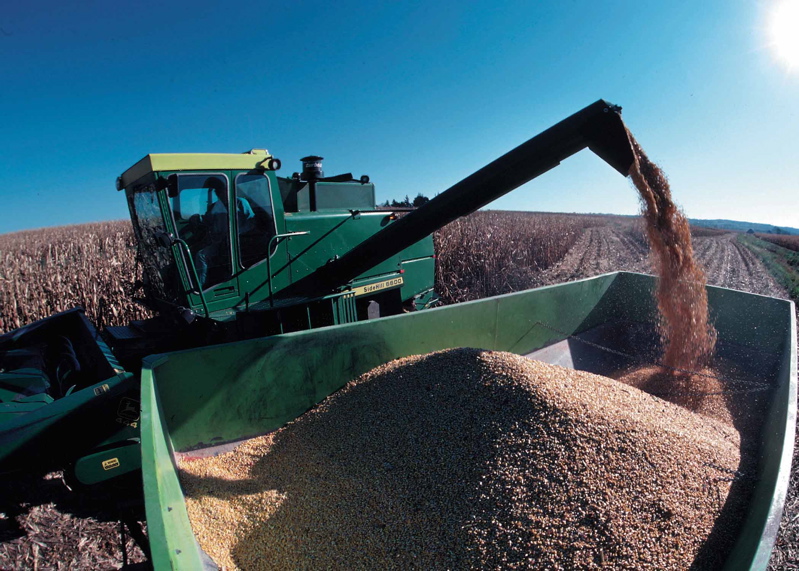
Corn harvest in Iowa. Would you like that in your Big Mac, your gas tank, or both?Photo courtesy of USDA NRCS. What do industrially produced meat and corn-based ethanol have in common?
Well, they both thrive on the assumption that it’s good idea to devote vast swaths of land to an incredibly resource-intensive crop—corn—and then run that crop through an energy-sucking process to create a product of dubious value.
And ... they both got tagged as major drivers of climate change this past week.
Ethanol took the harder blow of the two, I think. It came wrapped in the Oct. 23 issue of Science. In a concise and devastating “policy forum” piece, a team of authors led by University of Minnesota researcher Tim Searchinger fingered a gaping defect in existing European and pending U.S. climate policy: biofuel gets treated as carbon-neutral, ignoring carbon emissions from land-use change. According to the paper ($ub req’d), the Kyoto Protocol, the European Union’s cap-and-trade law, and the final version of Waxman-Markey (the House climate bill that passed over the summer) all contain the a “far-reaching but fixable flaw”:
[They] does not count CO2 emitted from tailpipes and smokestacks when bioenergy is being used, but it also does not count changes in emissions from land use when biomass for energy is harvested or grown. This accounting erroneously treats all bioenergy as carbon neutral regardless of the source of the biomass, which may cause large differences in net emissions. For example, the clearing of long-established forests to burn wood or to grow energy crops is counted as a 100% reduction in energy emissions despite causing large releases of carbon.
Or, as Searchinger put it to a Wall Street Journal reporter, “Literally, in theory, if you chopped up the Amazon, turned it into a parking lot, and burned the wood in a power plant, that would be treated as a carbon-emissions reduction strategy.”
The implications of the flaw are staggering: existing climate law, coupled with U.S. and European biofuel mandates, could lead to vast forest clearing—unleashing a gusher of greenhouse gases in the name of ... averting climate change. That’s sort of like trying to save your sight by gouging out your eyes. The authors state:
One study estimated that a global CO2 target of 450 ppm under this accounting would cause bioenergy crops to expand to displace virtually all the world’s natural forests and savannahs by 2065, releasing up to 37 gigatons (Gt) of CO2 per year (comparable to total human CO2 emissions today). Another study predicts that, based solely on economic considerations, bioenergy could displace 59% of the world’s natural forest cover and release an additional 9 Gt of CO2 per year to achieve a 50% “cut” in greenhouse gases by 2050. The reason: When bioenergy from any biomass is counted as carbon neutral, economics favor large-scale land conversion for bioenergy regardless of the actual net emissions. [Emphasis added.]
It should be noted that this “flaw” in U.S. climate policy is no accident. House Ag committee chair Collin Peterson fought like a pitbull to enshrine it in Waxman-Markey. To the agribusiness lobby Pererson represents, tarnishing the good name of ethanol is tantamount to setting fire to a Bible during Sunday school.
Another article in the same Science issue explores another massive problem with biofuels: water scarcity. As the author puts it: “A widespread shift toward biofuels could pinch water supplies and worsen water pollution. In short, an increased reliance on biofuel trades an oil problem for a water problem.” (Emphasis added.) According to the author, it takes between 90 and 190 liters of water to extract a kilowat-hour worth of oil. To get thhe same amount of energy from corn-based ethanol? Try 2.2 and 8.6 million liters of water. Ouch.
As for meat, get this: two researchers associated with the World Bank claim in a new World Watch piece (PDF) that meat production is responsible for more than half of global greenhouse gas emissions. Previously, the most widely cited estimate came from the FAO, which reckoned meat contributes an already-stunning 18 percent.
So why the difference in assessments? The biggest factor is respiration—the breathing out of C02—by livestock. According to the authors, livestock respiration adds massive carbon to the atmosphere—that factor alone, they claim, is equal to 13 percent of global annual GHG emissions.
I don’t have the scientific chops to assess their reasoning. I do wonder if the vast number if the C02 breathed into the air by farm animals isn’t partially offset by the vast number of wild animals elimainated by meat production. It’s not a pretty thoughtm but think of the habitat swallowed up by corn and soy fields globally—and the billions of animals who now monger exist to breathe out carbon.
However, I agree that meat production is deeply implicated in climate change—and must be cut dramatically. But I find these authors’ conclusion stunning: They want to replace industrially raised meat with industrially raised soy. In place of a chicken in every pot, they want to see a “chicken” in every pot. They call on the food industry to dramatically scale up the production of highly processed fake meat—and even offer marketing advice. They declare:
A successful campaign would avoid negative themes and stress positive ones. For instance, recommending that meat not be eaten one day per week suggests deprivation. Instead, the campaign should pitch the theme of eating all week long a line of food products that is tasty, easy to prepare, and includes a “superfood,” such as soy, that will enrich their lives.
They also express enthusiasm for “artificial meat cultivated in laboratories from cells originating from livestock, sometimes called ‘in vitro’ meat.”
Sorry, but given ideas like that, I’m not ready to let a couple of World Bank guys dictate the future of cuisine. Getting a carnivorous culture to reduce meat consumption is going to be tricky no matter what. Rather than push folks to embrace soy weenies and test-tube “shmeat,” I’d rather see a revival of minimally processed rice and beans, a move toward meat as a side dish, and a return to diversified farming that uses manageable amounts of manure to nourish cropland. Let’s ban the CAFO—but not eviscerate what’s left of our palates.

Comments
View as Flat
foodprovider Posted 4:29 pm
23 Oct 2009
Permalink
memeri Posted 5:16 pm
23 Oct 2009
Permalink
Des Emery Posted 9:23 pm
23 Oct 2009
Permalink
foodprovider Posted 9:46 pm
23 Oct 2009
Some farmers do push high amounts of grain to their cattle to finish them out quickly. I can taste the differnce too, and I prefer my own raised beef over alot of restaraunt beef. It is a practice brought about by trying to be profitable. A greater share of farmers feed their cattle a balanced ration of grass and legume silages mixed with corn (as an energy source, soybeans (as a protein source), and other grains depending on the balance of that ration. I bet a higher percentage of livestock are under the direct supervision of trained nutritionists than people are. Btw Des, I assume that when you use the term "Big Ag" you are talking about the companies that either supply the farmer with supplies or process the farmers raw materials into foos stuffs. If that is the case, please try to diferentiate the farmer from the place he sells to or buys from. Thank you.
Permalink
Des Emery Posted 6:35 pm
24 Oct 2009
2) Big Ag is composed of the very few large international companies whose purpose is to maximize returns to their owners (investors) and managers, not the individual farm operators, like you, whose demise allows those companies to convert more land into enterprises which generate profits rather than healthy food products.
3) The generation of CO2 takes two elements (one atom of carbon, two atoms of oxygen) out of animal life as a waste product. The CO2 is required by vegetable life, photosynthesis capturing and holding the carbon atoms and releasing the oxygen back into the atmosphere in a fine balancing act. The number of elemental atoms in Earth's history does not vary, but the number of CO2 molecules is influenced by that balance. The consequences of undue pressure on that balance is like the "weight" of the butcher's thumb on the scale when he's measuring the cost of a pound of hamburg. We'll all pay.
Permalink
ejd Posted 9:42 am
25 Oct 2009
1. Unhealthy Omega-6/Omega-3 fatty acid ratio in beef. Grass fed beef is higher in Omega-3 fatty acids.
2. Corn-fed cattle tend to have the more harmful strains of e-coli in their digestive tracts.
What cattle are fed does matter.
Permalink
jonnyappleseed Posted 10:47 am
24 Oct 2009
Permalink
ejd Posted 9:34 am
25 Oct 2009
http://nffc.net/Learn/Fact Sheets/King Corn Fact Sheet.pdf
This distorts the market and the price signals that we react to when we get out our wallets.
Permalink
drfredc Posted 9:26 pm
23 Oct 2009
Some related overlooked issues are how a gallon of cornahol requires the use of nearly a gallon of oil energy (in one form or another).
This in turn creates a shortage in gasoline supplies roughly equal to the amount of cornahol in gas (10%), which raises the price of gas, as well as ethanol gas cuts the MPG by perhaps 10% without offering cleaner output in modern vehicles.
IMHO, cornahol is all a huge political boondoggle that exceeds the tobacco subsidies of past decades in scope and negative impacts, complete with all of the negative horse-trading pork, political and fiscal distortions one can imagine. There's all sorts of better things one might do with the cornahol subsidies, in addition to eliminating the distortions this boondoggle creates on our legislative and regulatory processes.
Permalink
foodprovider Posted 9:50 pm
23 Oct 2009
Permalink
ejd Posted 2:23 pm
25 Oct 2009
Permalink
human power Posted 10:39 pm
23 Oct 2009
I like the other implications of Foodprovider's first comment. It would be nice to see the land that is given over to cars (fossil-fool powered wheelchairs) converted to greenspace. In fact, a recent article on the BBC site pointed out that proximity to large green spaces dramatically improves both the mental a physical health of people.
Permalink
ejd Posted 2:26 pm
25 Oct 2009
Permalink
Jeremy O'Wheel Posted 11:49 pm
23 Oct 2009
Real contributions to global warming are emissions that occur outside of the carbon cycle, which is either burning fossil fuels and land clearing or disruption (such as deforestation, but also replacing native forests with plantation cycles).
Direct emissions from livestock would be a significant contribution if they were higher than the amount of carbon absorbed by their food, but I'm not sure if this is the case.
However meat does significantly contribute to greenhouse gas emissions, like bio fuels, by contributing to land clearing to grow "fuel." Obviously the processing and transportation also involves fossil fuels, as does the fertilizer production.
Permalink
drfredc Posted 7:43 pm
24 Oct 2009
Unless one adds a temporal requirement to the carbon cycle, fossil fuels would seem to be C02 neutral in the BIG picture as far as GEIA carbon life cycles go. One must also figure in how there are natural GAIA processes that fix C02 into various non-fuel inorganic repositories.
If one does add a temporal component to C02, when is the cut off? The last ice age, the warm period about 1000 years ago, some asteroid hit that took out dinosaurs, the birth of Christ, the oldest trees, the average tree life, first Earth day, or just pull some arbitrary the definition out of what ever orifice meets your desire?
Permalink
Des Emery Posted 8:32 pm
24 Oct 2009
Permalink
drfredc Posted 5:42 pm
25 Oct 2009
http://earthguide.ucsd.edu/virtualmuseum/images/CO2History.jpg
Also, one shouldn't just assume that contemporary ecosystems can't easily respond to higher C02 levels. If you take two identical sealable terrariums, drop a small chunk of dry ice in one, and seal both, the one with a rapid C02 increase will do better, all other things equal.
Apparently you believe that earth's carbon cycle must remain roughly constant in size and dynamics to some arbitrary 'ideal' point in recent history. Which is all fine and good, except a large part of earth's dynamic evolution of life forms may in part be related to adaptation to variations in C02 and carbon cycle dynamics. What makes having a static amount of carbon good, and dynamic carbon cycle bad? Aren't you dooming evolutionary dynamics by defining a static amount of C02 and limited carbon? What if this is a horribly wrong decision in terms of defining static unadaptable ecosystems and life forms when earth has a long more dynamic history?
Permalink
Des Emery Posted 7:16 pm
25 Oct 2009
You said it, the rapid increase of CO2 from dry ice changed the environment quite observably. All I want is a slow-down of AGW so that we can contend with the change that is happening, letting us adapt by making small incremental adjustments, like moving coastal cities inland or developing desalination processes or engineering food crops to produce crops under desert conditions, et al. I said "small" which those enterprises could be when undertaken over several centuries. Right now, AGW is thundering down the racetrack towards us and we haven't got enough sense to get out of the way.
Permalink
grussell Posted 10:45 pm
24 Oct 2009
posts about changing CO2 into CH4 (methane). Also meat is the major driver of
deforestation, and deforestation definitely isn't carbon neutral. There are
plenty of other parts of the meat production/consumption chain that also aren't carbon
neutral ... right through to building hospitals for heart surgery, the
manufacture of statins and other pharmaceuticals to treat blood pressure driven
up by saturated fat ... etc. etc.
Permalink
foodprovider Posted 7:20 am
25 Oct 2009
Permalink
askantik Posted 7:17 am
26 Oct 2009
ftp.fao.org/docrep/fao/010/a0262e/a0262e00.pdf
http://web.mit.edu/12.000/www/m2006/final/threats/threat_agg.html
http://www.nytimes.com/2009/10/07/world/americas/07deforest.html
http://www.greenpeace.org/usa/news/cattle-ranching-biggest-driver
http://www.causecast.org/news_items/9088-cattle-industry-drives-brazilian-amazon-deforestation
http://www.treehugger.com/files/2009/01/cattle-pastures-amazon-deforestation-iceland.php
Permalink
foodprovider Posted 8:01 am
27 Oct 2009
Your refences are either written by Greenpeace, Treehugger, Causecast, etc. Wouldn't that info be considered slanted? If I were to put info by an industry company out there, you would shoot me down so fast it would make your head spin.
There is always 2 sides to every story and there are always a devil in the details. Toss the devil out and look at things with a little common sense too.
Permalink
askantik Posted 8:09 am
27 Oct 2009
Permalink
foodprovider Posted 8:18 am
27 Oct 2009
We all know that certain "news" outlets write for sensationalism. Why do you think some of the authors here write such stuff? Who is to say that NY Times didn't get their info from the Greenpeace people or the Treehugger people.
Permalink
askantik Posted 8:25 am
27 Oct 2009
Permalink
amazingdrx Posted 10:12 am
24 Oct 2009
Under that reasoning, switching from burning fossil fuels to burning wood, garbage, waste stream biomass, and liquid fuels made from biomass would magically cure GHG climate change.
Of course the glaring problem with that idea is that it uses biomass that would normally go into the soil and sequester carbon into fuel, that instead releases all it's carbon into the atmosphere.
Using crops like corn, that take huge amounts of fossil fuel to grow using chemical ag, that strips carbon stored for millenia back out of the soil, doubles or triples the usual GHG release of consuming biomass for energy.
Any product, like chemical ag meat or dairy, takes many times the GHG release of veggie food products like soy, in the food cycle. Organic veggie and meat or dairy protein really is carbon neutral or can even be carbon offsetting by using waste biomass for organic fertilizer and biogas energy production.
Animal or human respiration or flatulence is an insignifigant, unavoidable GHG release, compared to the huge GHG problem created by fossil fuel energy and agriculture. Consider nitrous oxide (300 times the GHG effect of cO2) released by ammonia fertilzer derived from natural gas, this product is now being imported on tankers from Russia.
Food production based on imported fertilizer and imported oil? How is that a safe and sound financially secure plan?
Permalink
foodprovider Posted 10:19 am
24 Oct 2009
What is the difference in GHG emissions from agriculture vs other industries? Does the EPA have anything on that I wonder.
Permalink
amazingdrx Posted 11:39 pm
24 Oct 2009
And I'm not sure if that takes into account nitrous oxide (300 times the GHG effect of CO2) released in the application of chemical fertilizer and from non-biodigested manure.
I know that natural prairie plants and soil sequesters 1.8 tons of CO2 per acre per year, that is from a Minnesota university study. How much GHG was released over the century of chemical ag as 20 to 30 foot deep living organic prairie soil was turned to a few inches of toxic dust ready to blow away on the wind in the first severe drought?
I think it could be calculated, the good news is that returning biomass in the form of organic fertilizer and soil ammendment back into the soil ecosystem could recapture all that GHG over the next century. Organic ag could take the excess carbon back out of the atmosphere and restore real prosperity to farmers. Prosperity not based on government subsidies and imported fuel and fertilizer, but on good old small business/family farm capitalism.
Permalink
foodprovider Posted 7:34 am
25 Oct 2009
40% of what come from Chemical ag? Do they actually break it down to organic ag vs chemical ag? Or is this a figure that say of the GHG emmitted by ag, 40% comes from normal ag practices? (I wonder about the devil in the deatials).
You looked up what a prairie soil can sequester, what about a no-till rotation or an organic rotaion that would use intensive tillage when a grain crop would be planted? I have a hard time understanding how organics can claim that they would nbe sequestering C02 when they would be constantly tilliging the soil, thus emitting more C02. How would organic ag be putting the crop biomass back into the soil? (Organic livstock/dairy farms remove the crop resiue doe animal bedding.) The decompsition process that the bedding goes through with manures added does add to the soil, but does it add the same organic material as was removed by residue removal? Farmers who no-til (they would not be organoc) leave virtually all their residue (biomass)in place, removing none.
Permalink
amazingdrx Posted 9:40 am
25 Oct 2009
http://amazngdrx.blogharbor.com/blog/_archives/2009/2/18/4097423.html
No til and organic ag are not mutually exclusive. Straw and wood chips used for animal bedding and manure go into biodigestion in some farms here in Wisconsin provider. What's left over is returned to the soil as organic soil amendment and fertilizer. That's how biomass is added back into the soil.
Would it aproach the 1.8 ton per acre per year figure of the prairie soil where all the plant material goes back into the soil? It might because crops are selected for maximum growth, and that means maximum photosynthesis, the process that takes cO2 out of the air.
Forestry and farming side by side here in our state have a powerful potential for biogas energy backup for the grid and organic fertilizer production. And we have huge wind power potential from great lakes and great plains wind. Solar cogeneration (heat & electricty) mounted on suitable roofspace and over parking lots are our other renewable source here.
With all these sources coordinated by smart grid technology we will have an energy surplus to zaaap to cities and industrial areas given a high voltage direct current electron highway.
I'm looking for a future where robotics applies mulch, cultivates (removing weeds), and injects water, organic fertilizer, and soil amendment in no til fields. With the advent of superweeds resistant to herbicides, GMO herbicide resistant crops won't be feasible anymore.
Do we get on this and make it happen, creating a whole new industrial manufacturing sector, or should we wait and let China do it? I say we need the jobs ourselves right now.
Robotic planting could drill the seeds or seedlings into the living orgabnic soil, tilling a very small circle right around the seedling and injecting organic soil amendment right around each plant. At automated speed.
Then whenever water levels drop, the robots would come back to inject water and more organic fertilizer as indicated by soil sampling probes. Any weeds that do asurvive would be mown and turned into muclch at the emergence stage, before any weed seeds are produced. Beat that superweeds.
Permalink
drfredc Posted 9:01 pm
24 Oct 2009
As noted in a previous post, it seems that fossil fuels by are definition carbon neutral, unless one adds some arbitrary temporal defintion. Fossil fuels came from life forms absorbing C02, which were then sequestered (for mega-eons), and then released back into the C02 cycle by one means or another by modern energy uses... Seems sort of arbitrary to say fossil fuels aren't carbon neutral in the BIG picture of what the earth's ecosystems have clearly handled in the past in robust fashion.
Permalink
ejd Posted 2:22 pm
25 Oct 2009
Human burning of large quantities of fossil fuels has occurred over an extremely short time frame, geologically speaking. It has caused an abnormal spike in the concentration of CO2 in the atmosphere (and the ocean too). In other words, we've messed up the Earth's carbon cycle. That's why fossil fuels aren't carbon neutral.
Permalink
Des Emery Posted 7:39 pm
25 Oct 2009
Permalink
jonnyappleseed Posted 10:44 am
24 Oct 2009
The article goes on, does a great deal of (speculative) math, pretty much recommends soybeans as the solution (not showing much understanding of soy cultivation) and so forth. Well, ok. Here are some other stats they should do the math with: there are maybe 6 million horses in the US; there are about 75 million dogs and about the same number of cats in the US. They need to be eliminated too, I'd guess. 'No more natural...etc'
Permalink
foodprovider Posted 12:21 pm
24 Oct 2009
Permalink
jonnyappleseed Posted 12:28 pm
24 Oct 2009
Permalink
grussell Posted 2:32 pm
25 Oct 2009
over the past few decades a rise in industrial lot feeding (mainly chicken and cattle)
has meant that during bad years we now import grain for livestock. So we
now eat 2 million tonnes directly, feed about 12 million to livestock and
export any excess ... so basically we used to provide 12 million tonnes of good
food for people, and now that food goes to produce chicken, pork and beef. We
export the beef to rich people overseas and the poorer people that used to
get our wheat have to look elsewhere. This is a major factor in the
current world food crisis. Once the CAFOs are established, they easily outbid
the world's poor for grain ... and biofuel makers can outbid them also! Something
similar is happening in Brazil. There grain production has doubled since about
1990, but the proportion going to livestock has increased massively, so they
still have plenty of malnourished people.
Permalink
grussell Posted 4:06 pm
24 Oct 2009
the carbon in CO2 from tail pipes comes from fossil fuels (ignoring biofuel for now).
So the WorldWatch paper (despite having many good points) is simply wrong
on that one. If you cut down the Amazon turn it into a biofuel cropping area then
there are 4 things going on, 1) huge emissions of CO2 and other greenhouse gases
during the fires (most would end up being burned after the valuable logs were
removed). 2) there after the growing biofuel crop would pull some CO2 from
the air and 3) using the biofuel would release the same carbon back to the air,
4) the harvesting of the biofuel would use energy and the carbon involved
needs to be accounted for. 2),3) and 4) could possibly balance, leaving a
net huge positive forcing from 1).
As for meat. The carbon in the feed comes from the air, and eventually returns, but
some of it returns as methane with a 72 times higher global warming potential than
co2 during the next 20 years. i.e., global meat production changes the ratio
of methane (CH4) to carbon dioxide (CO2) by converting some of the latter to the
former, even if it doesn't introduce new carbon into the air.
Plug: I explain this stuff in great detail in my book "CSIRO Perfidy" (http://perfidy.com.au ... also available on Amazon). As a vegan,
I'd love to think the World Watch paper was
correct about livestock respiration ... but it isn't.
Permalink
grussell Posted 6:59 pm
24 Oct 2009
It pays not to guess but to actually measure:
http://jas.fass.org/cgi/reprint/77/6/1392.pdf
These researchers found that grass fed cattle emitted MORE, 3 times more,
methane than feedlot cattle.
Permalink
Des Emery Posted 8:49 pm
24 Oct 2009
Permalink
grussell Posted 10:40 pm
24 Oct 2009
is yes, first a grass trial and then 10 days to adapt to grain prior to
the grain measurements.
Judging by your question about "passing it on", you don't know any
chemistry, which is fine, my chemical knowledge is pretty bloody thin, but
I'll try and explain. CH4 is the chemical formula for methane, 4 hydrogen atoms
with one carbon. CO2 is the formula for carbon dioxide, 2 oxygen atoms with 1
carbon atom.
Ruminants like cattle have microbes in their guts which generate methane (CH4)
during the digestion of food. The Cs and Hs are in the food, but the microbes
rearrange them. Even if you don't add any carbon to the atmosphere you could
heat up the planet quite well by just changing enough CO2 molecules to CH4. Think
of it this way. Dive into a swimming pool. Easy. Now freeze the water. Try the
diving thing again ... no? No water has been added but the change of state
has altered the resistance. Similarly the more CO2 that is changed into CH4
(by livestock ... or us) the more trouble we are in. Methane from coal mines is
slightly worse because it adds new carbon to the atmosphere.
The CH4 eventually turns back into CO2 with about half of
any tonne of methane emitted reverting in about 8 years.
Permalink
jonnyappleseed Posted 7:48 am
25 Oct 2009
Permalink
Clifford Wells Posted 9:18 pm
24 Oct 2009
The truth is, most corn goes into making corn fructose syrup and bulk foods like cereal for humans and animal food. The corn fructose business is HUGE, and is used as sweeteners for about every processed food or beverage you can name, even cheap beer. True, some is diverted for fermenting into ethanol to be used as motor vehicle fuel, a tired old industry that is sorely upside down in its economics these days as people lose millions on that gamble. For those that export corn, given a horrendously weak dollar, they do pretty good. The rest of the corn business pretty much sucks.
If you want to talk corn, talk corn. There is sweet corn for eating, cow corn for cows, popcorn corn for popcorn, export corn, ethanol corn, fructose corn, corn for baiting deer for the hunters, corn with too much nasty fungus to market, Mexican corn that has fungus good to eat, and well, just plain old corn.
Sorry, but ethanol corn and cow corn are pretty small parts of the pie, and often ethanol mash bottoms are fed to cows so they are one and the same. I see a Twitter Fail Whale on the entire argument here.
Permalink
jonnyappleseed Posted 7:59 am
25 Oct 2009
Permalink
Biodiversivist Posted 9:58 pm
24 Oct 2009
Not to worry, the Renewable Fuels Association, Growth Energy--America's Ethanol Producers, and The American Coalition for Ethanol have all officially refuted those studies ; )
There are 3 billion more humans on the way. That's a lot of CO2 respiration, not that CO2 is the only problem we have:
http://biodiversivist.blogspot.com/2009/10/transgressing-identified-and-quantified.html
Step back and wonder how the governments of Europe and the United States could make such an obvious oversight. Makes me wonder if our Democracy as organized is up to this challenge. Glad we have the internet for debating and disseminating information like this.
Permalink
foodprovider Posted 7:37 am
25 Oct 2009
Is n't Brazil energy independent? Didn'they do it by the use of bio fuels?
Also, don't most consider biofuels a stepping stone to the next generation of clean renewable fuels?
Permalink
ejd Posted 9:44 am
25 Oct 2009
Permalink
Biodiversivist Posted 12:41 pm
25 Oct 2009
America can't use Brazil as a model for energy independence. Brazil is energy independent for the following reasons:
1) They use a lot less. For every gallon of liquid fuel used by a Brazilian, an American uses just over six.
2) We don't have as much oil per person. 3/4 of Brazil's transportation fuel comes from their oil reserves. 1/4 is from ethanol.
3) Brazil is a tropical country and can grow vast amounts of sugarcane.
4) The net energy gain of sugarcane ethanol can be almost an order of magnitude more efficient than corn ethanol (8-10 times).
5) There are over 100 million fewer Brazilians.
Source: http://i-r-squared.blogspot.com/2009/04/more-brazilian-ethanol-whoppers.html
Oh, and keep in mind, America already produces about 25% more ethanol than Brazil. There are rumors we might even start exporting it to Brazil because sugar prices are at a three decade high and the cost of making ethanol out of it has become unprofitable (food producers battling biofuel producers for the same feedstock).
Source: http://www.reuters.com/article/latestCrisis/idUSN21494094
http://www.greentechmedia.com/green-light/post/brazilians-switch-to-gas-as-ethanol-prices-climb-a-dark-sign-of-things-to-c/
Permalink
onlinedatingservice Posted 4:21 am
25 Oct 2009
http://www.pangeadating.com/free-online-dating/can-free-dating-sites-help-you-find-companionship/
Permalink
Rosie B Posted 8:33 am
25 Oct 2009
Permalink
Clifford Wells Posted 10:09 am
25 Oct 2009
With respect to sugar cane ethanol, it is true that is a huge industry. However, it is blended with gasoline or methanol to denature it, and as the common practice is to siphon fuel by sucking on a plastic tube inserted into a jug, many Brazilians get incredibly sick or go blind from ingesting it.
For sugar cane, don't even go there even though it makes tons of sugar, ethanol, and bagasse (which is ahem, burned for fuel). The stuff doesn't grow very well in the US and only seems to be profitable with price supports such as 5 cents a pound on sugar. Then, it requires ... the tops to be burned off before harvesting! Hey great little "carbon sink" there huh? Have you ever seen a sugar can field set on fire prior to harvesting before? It can send a cloud of smoke and ash 15,000 feet into the air.
Meanwhile, Ford is looking at new ways to power electric vehicles from the nastiest coal-fired electric plants known to man. Ain't that something? I think our civilization has finally reach "peak thinking" and we're in for dramatically diminishing returns in the future.
Permalink
beez kpr Posted 1:00 pm
25 Oct 2009
However i have modified both of my gas vehicles to run on E-85 Reason being i like supporting my fellow farmers more than i like supporting Arab Oil & i use bio-diesel in my truck .We need to come up with celluloid manufacture of Ethanol Im waiting for wind Power! Go 4 it all the way!!!
Something needs to change the over all way we do business and power things. What im saying is I don't need tons of "STUFF" to be happy or as i put it I stopped being "JONESY "Years ago Thank You for reading my afternoon ramblings... Bill
Permalink
grussell Posted 2:21 pm
25 Oct 2009
is the prime driver. There is data in the 2006 UN report "Livestock's Long Shadow",
but briefly, about 70% of previously forested Amazon rainforest is now under
cattle. In my country, Australia, we were clearing about half a million hectares
per annum for cattle right through the 1990s until about 2004 when legislation
came in to stop it. Clearing has been reduced since then but is now been
renamed "fodder harvesting" ... the same bulldozers are dragging the same chains
however. Indonesia is about the same size as Queensland in Australia and has a
similar number of cattle ... and those in Queensland graze close on 150 million
hectares and those Indo cattle either graze or live on grain, and you need to
clear land for that also. Many Australian cattle farmers don't clear
land (because their grandfather, or great grandfather did that!), and argue
"well I don't clear land, therefore no cattle farmers anywhere on the planet
clear land and you can keep your international studies ... " etc.
Permalink
Biodiversivist Posted 3:18 pm
25 Oct 2009
I tend to agree with most of your comment. My family also treats animal products like a valued commodity to be used sparingly and efficiently, like the rest of the world does, even though we can afford to do otherwise. We are careful not to wear that fact on our sleeves (not trying to use it as a JONESY) as some people do, which tends to backfire.
Keep in mind that you are the benefactor of a 45-cent subsidy for every gallon of ethanol and a dollar for every gallon of biodiesel that you consume, which came from fellow American's wages. So, in a sense, you are at least in part, using fellow citizen's money to avoid giving money to an overseas trading partner, and also using it to support others in your line of business.
Also be careful for what you wish for. Commercially viable cellulosic ethanol would ruin the market for corn, which is presently selling for about $4.00 a bushel, a 100% increase over what it was averaging prior to our corn ethanol ramp up. Cellulosic ethanol is corn ethanol's worst nightmare.
Choosing to use food-based fuels to support your business and your fellow businessmen is a rational, even predictable decision.
However, choosing to use it to keep money out of the hands of "Arabs" is not rational. Biofuel front groups have been fanning the flames of xenophobia to hawk their product. You may be an unwitting recipient of their successful marketing.
Go to any comment thread and you will find God fearing American xenophobes motivated by their hatred for "camel jockeys" and "towel heads" to replace gasoline with moonshine in their gas hog poseur pickups and station wagons (cleverly marketed as sport utility vehicles). They think Iraq was connected to 9/11 and don't know that we haven't imported oil from Iran since 1979. They are unaware that Saudi Arabia and Kuwait were our allies in our last two wars (the oil kept flowing and they paid for over half of the cost of the Gulf war) or that the Twin Towers were brought down by hate-filled Koran-thumping religionist xenophobes--their counterparts.
1) If we don't buy oil from the Middle East someone else will (it's fungible). United States purchases cannot impact their income stream.
2) We have not bought oil from Iran for decades.
3) Extremist religious xenophobes brought down the Twin towers, not Iraq.
4) Extremist religious xenophobes require very little funding.
5) The best remedy for war is mutual trade interdependence.
I have yet to meet anyone who says that they seek status (keeping up with the Jones). I think that is in part because it is instinctive, not always at the conscious level. Hummers, Flex Fuel and Hybrid logos, as well as biodiesel stickers are all status displays, depending on monkey troop affiliation ; )
Permalink
foodprovider Posted 6:37 pm
25 Oct 2009
Permalink
Rosie B Posted 9:43 pm
25 Oct 2009
What I still find hard to imagine is how we are going to deal with the transportation system throughout this country. With such a huge amount of land and such a sprawling array of developments, we have a long ways to go in creating a more efficient means of transportation. We need to be investing in infrastructure that will make us less dependent on cars and, in turn, oil and biofuels. The change has to be more systemic.
Permalink
Rosie B Posted 3:29 pm
25 Oct 2009
Permalink
grussell Posted 4:04 pm
25 Oct 2009
logging". In the Amazon it is 70% cattle and 3% logging (Livestock's Long Shadow
report or mongabay.com), in Indonesia, see my previous comment, which shows
that livestock impacts will swamp palm oil which currently occupies about
4.1 million hectares:
http://www3.interscience.wiley.com/journal/120696728/abstract?CRETRY=1&SRETRY=0
Blaming deforestation on agriculture is obviously true but not very
informative. Its like attributing lung cancer to poor lifestyle
without mentioning smoking, or attributing
bowel cancer to poor diet and not mentioning red meat.
Permalink
beez kpr Posted 4:52 pm
25 Oct 2009
Now having stated the case for sickness of the entire planet I would like to make the case for the "Petro $" which will soon go to the way of the dinosaur, As long as the fuel is traded in USD the USA gets the so called coinage from there use This is handy for financing wars Soon as the world decides its sick or war it will shift off the petro dollar.this leaves the USA in a trick.China calls there debt the US is in deep kim chee. We need to be on our own an stop the use of foreign oil. We need electric power we make.
We can go on endlessly on this energy subject but all in all everything said we need our own energy source and not fossil fuel . CNG is good but it brings its problems with drinking water. Look at anyplace it is extracted. WY,CO etc??
AS i noted earlier this is complex an endless however i do believe it is a solvable problem. I am encouraged by the wireless electricity being developed by MIT. for the time being we need stop gap measures to get us off of imported oil,and in a twisted convoluted way will get us off of corn feed critters and back to things like grass fed beef/hogs, free ranging chickens ec, I do believe the Universe will deliver somehow a leveling mechanism. Some more evening ramblings on an extremely complex subject.Bill
Permalink
RogueIntellect Posted 7:43 pm
25 Oct 2009
With the intent of hoping to add to the conversation, I would like to make a few points.
1. The world population is closing in on 7 Billion humans much sooner than expected. This seems to be a taboo subject as no one wants to address it. Stemming the tide of overpopulation seems to be off limits. How dare we tell people not to exercise their 'right' to go forth and multiply. But yet all the world's problems can be traced to this one enormous issue.
2. In the USA were are losing farmland to the tune of 90 acres a minute to development and single family housing. We have out built our population growth by 23%. Yet farmers are expected to feed the ever growing world population. This loss of valuable farmland has to be made up somehow. Thus, the deforestation of rain forests.
3. Agriculture's is the only sector that has reduced its effect on the environment over the last 10 years. The biggest increase in pollution comes from the consumer and consumer transportation.
4. This article uses yellow journalism techniques to get your attention, from the title on. Written by a food editor and cook, (with all due respect) is not what I would call an expert in the field of science or economics.
5. It was noted when the Bush mandate for ethanol production went into effect that the US would have to put new acreage equivalent to the state of Kansas into corn production. Quite impossible unless new land was claimed for agriculture, instead we built houses and shopping centers (whose storm water run off contains more toxins and trash than anything that comes off of farms).
6. New farming technology has reduced pollutants and increased efficiency by no till methods, injecting of fertilizers, more accurate means of application. Most of this is to reduce cost but the result is less fertilizer use for greater yields.
7. I do feel that their are better ways to raise beef besides a feed lot. This is why my cattle are grass fed and direct marketed locally. I do not believe that the extra expense of injecting hormone and feeding grain (corn) or other byproducts is necessary. But I do understand why the majority of cattle and livestock are finished in a feed lot. It boils down to efficiency and available land.
8. The dairy industry must take some responsibility for problems in the beef industry. Canadian dairy cattle were responsible for the BSE issues that closed our exports to countries like Japan. All the damaging video I have seen about downer cattle and slaughter houses have been of dairy cows. Dairy is fond of dumping cattle onto the beef industry every time milk prices drop, forcing a drop in beef prices. Cheap Cargil hamburger comes from these old used up cows. They are mixed with the over fattened feed lot cattle to make the hamburger leaner (along with South American grass fed cattle).
9. The practices of the US beef industry as a whole keeps markets like Europe closed to US producers. Why they refuse to make simple changes to their practices and philosophies that would increase marketability is beyond me.
10. Making agriculture the scape goat for the problems of the world makes no sense to me. But I suppose it is easier than looking in the mirror. Ag. is faced with the daunting task of feeding the soon to be 7 Billion humans.
11. Soy, the most heavily processed, bad for you food in production. Treated with bases, acids, heat, and pressure to make something that is barely palatable. Soy consumption is connected with many modern ailments from thyroid conditions, to precocious pubescence in girls, to retarded pubescence in boy, to Alzheimer's, to food allergies. People complain about hormone use in livestock but yet eat soy products loaded with phyto estrogens.
12. To the gentleman who quoted corn at $4 a bushel. That is what it is trading for on the commodities market not what a farmer gets (between $2.30 to $3.25). Corn prices are still hovering around what farmers were getting 50 years ago. Beef prices are down 40% (going rate for a 12 month old steer is 75 cents a pound on average) what they were even two years ago. Dairies are dropping out of business at an alarming rate. Why? Because the farmer receives very little return for his efforts. Pennies on the dollar of what is paid at the grocer.
13. For all these reasons and more I have chosen to direct market my farm products. But I will say that it is a shame that people have chosen the very people that feed them as scape goats. If you don't like how food is produced buy from a local producer that follows practices that fit into your ideal. But as long as chickens can be shipped from Brazil to China for processing then to the US to be sold, and people buy them, the safety of our food supply will always be in question.
Ok, I have ranted long enough.
Permalink
Des Emery Posted 6:42 pm
26 Oct 2009
Permalink
askantik Posted 6:56 pm
26 Oct 2009
http://www.epa.gov/region7/water/cafo/index.htm
This gives the definition of an AFO and a CAFO (see the .PDF). A large CAFO can have 700+ dairy cows. The picture on the front page is a CAFO and I'm pretty certain those are Holsteins (though I'm no expert at cow breeds), but those are dairy cows. And of course they have to be confined-- if they roamed pasture all day, they couldn't take the calves from the mother within 24 hours of birth. Then the male calves get fattened up for a little bit and become veal. It's all about profit, and you can't make quite as much if you have all your cows out grazin' all the time.
Permalink
RogueIntellect Posted 7:35 pm
26 Oct 2009
http://www.cdc.gov/ncidod/dvrd/bse/bse_namerica_022008.htm
Sorry for spreading misinformation... that's what I get for watching TV news.
Permalink
Des Emery Posted 7:12 pm
27 Oct 2009
Askantik - those are Holstein dairy cows tied up all right, doing their 45 days confinement duty in CAFO. I can only hope they get their grazin' in later - unless they're just being fattened up in the CAFO for consumption.
BTW, as a kid growing up on a farm I used to wander out to the pasture to bring the cows home for milking, get their hay to keep them happy in their stalls, and help to lug the milk-pails from the barn to the separator. And that's where I learned why milking stools are always three-legged.
Permalink
RogueIntellect Posted 8:43 pm
25 Oct 2009
Article of interest regarding the differences of corn fed beef and grass fed.
Permalink
grussell Posted 9:01 pm
25 Oct 2009
science. The 150+ scientific authors of the World Cancer Research
Fund's 2007 report:
http://www.dietandcancerreport.org/?p=ER
were clear ... red meat causes bowel cancer. No ifs, no buts, no caveats. And
it has nothing to do with grass or grain feeding, its the heme iron that does
the damage.
Permalink
RogueIntellect Posted 10:04 pm
25 Oct 2009
Your sited study does not differentiate between grass fed beef and grain fed, only siting 'red meat'. Which makes it void when concerning my statement and the latest findings regarding grass fed meats.
Your study also mentioned other foods that were cancer risks. In many cases it only said that 'data was limited or incomplete'. I view it as irrelevant at best in regards to grass fed beef. Respectfully.
I will further my point by stating that I have not yet heard of anyone having a beef related food allergy. Look up the top 8 food allergies, legumes tops the list if you include all legumes (peanuts, soy, etc.).
There are many independent studies on the benefits of eating grass fed meats, all stating high Omega 3 to Omega 6 ratios. All stating high levels of CLA. All stating high levels of Beta-carotene,unsaturated fats, Vitamin A and E. All things that the study you sited said decreased cancer risk.
Permalink
grussell Posted 10:29 pm
25 Oct 2009
WCRF report before deciding what it says. e.g., The report finds NO other foods
(other than alchohol, if you count it as a food) for which there is
convincing evidence of cancer causality. If you read the definition of what
constitutes "convincing evidence" you will see that it requires a broad
range of evidence at various levels. First is the epidemiology, measure what
people eat, then wait and see who gets cancer. There are now studies from
around the world and they all show that people who eat more red meat have
higher rates of bowel cancer. In Australia, most of the local beef is grass
fed and our Cancer Council estimates that full half of the 12,000 new cases
each year are due to more than 1 serve of red meat per week (details
in my book http://perfidy.com.au).
You will be able to find plenty of 90 year old smokers
if you look, but that doesn't prove smoking doesn't cause lung cancer.
I mentioned the heme iron before, it is the causal factor which is
best understood ... but there
are multiple plausible causal mechanisms, but not all are well demonstrated in
people. But the heme iron mechanism is pretty well nailed down. Feed a person
red meat, collect their feces, examine the DNA in colon cells which can be
isolated from the feces (this has taken a decade to work out how to do), and you
find the same kind of damage you find in bowel cancer patients. In some
people (lucky genes), the damage is fixed and doesn't proceed to full blown
cancer, but in others it does. The damaged cell passes through various
stages before being full blown cancer and the process takes a long
time (10-20 years), this makes it tough to detect with epidemiology, but the
evidence is now in and clear. Like I said, a broad range of evidence, from
test-tube chemistry, through the ubiquitous rat studies, to clinical trials
and epidemiology. It's all in, and the WCRF judges that there is so much
evidence that the chances of any new study contradicting what's already
in is slim, very slim.
One of the most graphic and easily understood demonstrations is
to look at bowel cancer rates after the Japanese added red meat to their
diet. Two rising curves, separated by a couple of decades, exactly as anybody
could (now) predict.
Permalink
RogueIntellect Posted 4:39 am
26 Oct 2009
Of course you have a book.
Permalink
foodprovider Posted 8:18 am
26 Oct 2009
Permalink
jonnyappleseed Posted 2:43 pm
26 Oct 2009
I know that these are serious scientists trying to do good work, but....
Permalink
grussell Posted 3:51 pm
26 Oct 2009
really need to read the detail, plus some of the studies to understand that this
isn't just correlational, there are mechanisms (not entirely understood, but
getting clearer) behind these causes. Most people intuitively understand why
tall people get more back problems, but they also get more cancer, but the
reasons are way more complex. Farmers should undertand this intuitively, breeding
or feeding for maximum growth isn't the same as feeding and breeding for
maximum health and longevity.
Permalink
askantik Posted 7:24 pm
27 Oct 2009
It's available in book form, which I'm sure is a long but interesting read, but I've never sat down with it.
Permalink
foodprovider Posted 12:41 pm
26 Oct 2009
If my math is correct, Ag is responsible for 6% of the GHG emmisions. Look at pg ES-12.
Permalink
grussell Posted 3:56 pm
26 Oct 2009
Brazil. You have (in nice round numbers) 100 million cattle and 300 million
people, Brazil has 200 million of each and Australia has 22 million people and 28
million cattle.
Permalink
RogueIntellect Posted 5:33 pm
26 Oct 2009
In the Chesapeake watershed, land conversion is key. The six-state, 64,000 square-mile watershed that drains rainfall into the Bay brings runoff from new construction sites, homes, shopping centers and high rises — not to mention industry, logging, agriculture and other uses.
Urban sprawl can cause special problems, since urban-suburban development often results in large amounts of impervious surface — gathering rain from rooftops, parking lots, driveways and walkways, and sending it in concentrated conduits toward the Bay's tributaries."
http://www.mdsg.umd.edu/issues/watersheds/growth/
"Land Consumption --- Huge tracts of
land are cleared and locked-up to provide transportation corridors, removing these acres from constructive uses. As the corridors are widened and speed limits increase, it increases land development pressures and traffic congestion. Urban sprawl is rapidly spreading as more and more people move into the countryside to “get away from it all†while still commuting to nearby cities to work, shop, go to school and recreate. In the city, much of the land is devoted to streets and parking lots, rather than livable, walkable places for people to enjoy. Our quality of life declines as more green spaces are covered with concrete. Environmental Impacts of Transportation
Lost Farmland --- As more homes and businesses are built further afield, they chew-up and isolate farmlands at a rapid pace. Many thousands of acres of fertile farmland are lost forever under concrete, barren median strips and suburban lawns."
http://www.cwac.net/transportation/index.html
"Heat Island Effect
Many cities and suburbs experience a heat island effect, where the temperature increases in the area due to the increase in the amount of asphalt and buildings. In some areas, this increase in temperature could be as much as 7 degrees F.
It has become evident that the amount of environmental problems caused by urban sprawl is significant. Urban areas cannot continue to grow without sparking an environmental crisis beyond repair. Solutions to these problems must be explored and enacted through careful planning."
http://www.associatedcontent.com/article/195211/the_environmental_impact_of_urban_sprawl_pg2_pg2.html?cat=47
http://www.sprawlcity.org/
http://science.nasa.gov/headlines/y2002/11oct_sprawl.htm
http://www.nytimes.com/2008/10/07/opinion/07tue2.html
http://www.georgiaencyclopedia.org/nge/Article.jsp?id=h-763
http://www.cwac.net/landuse/index.html
Foodprovider... you will like some of these links as they relate directly to Wisconsin. BTW, my dad's side of the family is from the Sheboygan area.
Permalink
Clifford Wells Posted 8:30 am
27 Oct 2009
Permalink
foodprovider Posted 8:52 am
27 Oct 2009
Advanced Biofules stoke Global Warming
10/22 14:37 CDT UPDATE 1-Advanced biofuels will stoke global warming -study
10-22-2009 14:37 UPDATE 1-Advanced biofuels will stoke global warming -study
* New fuels seen emitting more CO2 than gasoline to 2030
* Advanced fuels to lead to deforestation to create farms
By Gerard Wynn and Timothy Gardner
LONDON/WASHINGTON, Oct 22 (Reuters) - A new generation of
biofuels, meant to be a low-carbon alternative, will on average
emit more carbon dioxide than burning gasoline over the next
few decades, a study published in Science found on Thursday.
Governments and companies are pouring billions of research
dollars into advanced fuels made from wood and grass, meant to
cut carbon emissions compared with gasoline, and not compete
with food as corn-based biofuels do now.
But such advanced, "cellulosic" biofuels will actually lead
to higher carbon emissions than gasoline per unit of energy,
averaged over the 2000-2030 time period, the study found.
That is because the land required to plant fast-growing
poplar trees and tropical grasses would displace food crops,
and so drive deforestation to create more farmland, a powerful
source of carbon emissions.
Biofuel crops also require nitrogen fertilizers, a source
of two greenhouse gases: carbon dioxide (CO2) and the more
powerful nitrous oxide.
"In the near-term I think, irrespective of how you go about
the cellulosic biofuels program, you're going to have
greenhouse gas emissions exacerbating the climate change
problem," said lead author, Jerry Melillo, from the U.S. Marine
Biological Laboratory.
U.S. ethanol industry group the Renewable Fuels Association
said biofuels are by definition emissions neutral because their
tailpipe carbon output is absorbed by growing plants.
Without steps to protect forests and cut fertilizer use,
gasoline out-performs biofuels from 2000-2050 as well.
The paper did not mean cellulosic biofuels had no place.
"It is not an obvious and easy win without thinking very
carefully about the problem," said Melillo. "We have to think
very carefully about both short and long-term consequences."
A related study, also published in the journal Science on
Thursday, said the United Nations had exaggerated carbon
savings from biofuels and biomass, in a mistake copied by the
European Union in its cap and trade law, by ignoring
deforestation and other land use changes.
The mistake was carried into U.S. climate legislation as
well, and would worsen as governments put a price on carbon,
driving more biofuel use, it said.
FOOD
"There will be increasing pressure to convert the biomass
of the world into an energy source," said Steve Hamburg, chief
scientist at green group the Environmental Defense Fund and
co-author of the second Science paper.
"Then it competes with agriculture, water protection,
biodiversity, a whole host of things, and that doesn't provide
benefits to the atmosphere," he told Reuters.
It was also important to take account of how the land had
been managed before it was grown with biofuels, said Hamburg. A
previous farming practice may have been better for the planet,
he said, underlining the complexity of calculating benefits.
Advocates hope that forthcoming talks to agree a new global
climate deal in Copenhagen in December will protect forests, by
rewarding land owners to store carbon in their trees.
The first paper did not explicitly consider the food
production impact of ramping up advanced biofuels. The U.N.'s
food agency says that global food output will have to increase
70 percent by 2050 to feed a growing, more affluent
population.
The world's forests, rather than farmland, would have to
make way for biofuels which would consume by 2100 more land
than all food crops now, the first study found.
"We think there is space on earth for both food crops and
the biofuels but there are consequences of using that space,"
in lost forest, Melillo said. "You've got to lose something."
(Writing by Gerard Wynn; Editing by Anthony Barker)
(For Reuters latest environment blogs click on:
http://blogs.reuters.com/environment/)
(((JavaScript must be enabled to view this email address)
//
var l=new Array();
var output = '';
l[0]='>';l[1]='a';l[2]='/';l[3]='';l[35]='\"';l[36]=' 109';l[37]=' 111';l[38]=' 99';l[39]=' 46';l[40]=' 115';l[41]=' 114';l[42]=' 101';l[43]=' 116';l[44]=' 117';l[45]=' 101';l[46]=' 114';l[47]=' 110';l[48]=' 111';l[49]=' 115';l[50]=' 109';l[51]=' 111';l[52]=' 104';l[53]=' 116';l[54]=' 64';l[55]=' 110';l[56]=' 110';l[57]=' 121';l[58]=' 119';l[59]=' 46';l[60]=' 100';l[61]=' 114';l[62]=' 97';l[63]=' 114';l[64]=' 101';l[65]=' 103';l[66]=':';l[67]='o';l[68]='t';l[69]='l';l[70]='i';l[71]='a';l[72]='m';l[73]='\"';l[74]='=';l[75]='f';l[76]='e';l[77]='r';l[78]='h';l[79]='a ';l[80]='
Permalink
Truly Scrumptious Posted 9:12 am
27 Oct 2009
Permalink
MKR Posted 2:09 pm
27 Oct 2009
Not to be a jerk, but we need every credible argument we can generate in the face of the interests ranged against changes to the food industry status quo. The unfortunate reality is that typos (like Bush's endless malapropisms and misuse of language)undermine the point being made and allow opponents to dismiss the relevance and importance of what is being said.
Please don't give them that advantage.
Permalink
askantik Posted 3:21 pm
27 Oct 2009
While I don't see how the typos can be helpful in any way, I don't think they completely detract from the entire meaning or base of the argument, as Bush's mess ups did.
Permalink
muellern Posted 5:30 pm
28 Oct 2009
Permalink
isaacschumann Posted 6:53 am
30 Oct 2009
ps. to those in favor of vigorous government action on renewables, a note of caution. i worked in biofuels throughout much of the corn ethanol "boom" and bust, and it was entirely the creation of government subsidies. those in government (nor anyone else for that matter) knows what technologies will be best as alternatives to fossil fuels. ten years ago, everyone thought that corn ethanol and hydrogen cars were the way to go and BILLIONS of dollars were thrown at these ventures to disasterous and wasteful results. just keep that in mind, eg. if we over-subsidize solar power before we can more efficiently produce the panels, the environmental damage caused by their construction will be greater than the benefit.(I dont mean to knock solar, its a great idea, it will just take time, just like biofuels)
Permalink
isaacschumann Posted 8:10 am
30 Oct 2009
ps. to those in favor of vigorous government action on renewables, a note of caution. i worked in biofuels throughout much of the corn ethanol "boom" and bust, and it was entirely the creation of government subsidies. those in government (nor anyone else for that matter) knows what technologies will be best as alternatives to fossil fuels. ten years ago, everyone thought that corn ethanol and hydrogen cars were the way to go and BILLIONS of dollars were thrown at these ventures to disasterous and wasteful results. just keep that in mind, eg. if we over-subsidize solar power before we can more efficiently produce the panels, the environmental damage caused by their construction will be greater than the benefit.(I dont mean to knock solar, its a great idea, it will just take time, just like biofuels)
Permalink
CyberBrook Posted 6:11 pm
02 Nov 2009
Permalink