In Checkout Line, Lou Bendrick cooks up answers to reader questions about how to green their food choices and other diet-related quandaries. Lettuce know what food worries keep you up at night.
—–
Dear Lou,
I hear that PETA has come out in favor of the development of test-tube meat. What’s up with that? I like to eat meat, and I try to be conscious about it — but I can’t tell if the prospect of test-tube meat should make me feel relieved or horrified.
Lisa
Dear Lisa,
You heard right. Earlier this year, People for the Ethical Treatment of Animals announced that it will offer a $1 million X Prize for the creation of affordable, humane, and “commercially viable” test-tube meat by 2012. This announcement, not at all surprisingly, piqued public curiosity (for starters, why is PETA endorsing anything with the word “meat” in it?).
I assure you that you are not alone in your ambivalence about test-tube meat. When I first read about test-tube meat, I experienced psychological delight at its humanitarian prospects coupled with a simultaneous gag reflex at the thought of actually eating it.
Test-tube meat is also known as in vitro meat, cultured meat, victimless meat, vat-grown meat, hydroponic meat, and, finally, shmeat. (Note to self: Be sure to apply for inevitable X Prize to rename this stuff.)
For now, let’s call it shmeat.
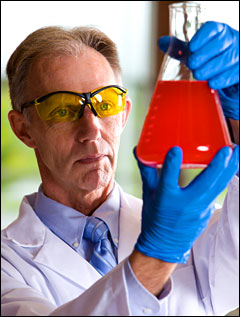
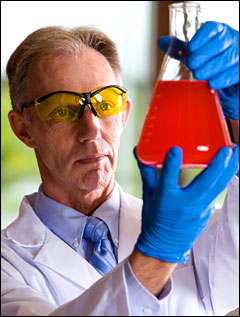
Shmeat is grown from a cell culture (hence the in vitro or cultured prefixes), not from a live animal. These harvested cells are taken from an animal, such as a pig, and placed in a “nutrient-rich medium” that mimics blood. Once the cells multiply they are attached to a spongy scaffold or sheet (sheet + meat = shmeat) that has been soaked with nutrients and stretched to increase cell size and protein content.
This shmeat could, in theory, be harvested in vast quantities and used in minced meat products: burgers, nuggety things, or potted meat-food products, etc. While scientists (they call themselves “tissue engineers”) admit that growing a pork chop with a bone without a real pig attached is not likely, the say also that affordable, palatable minced shmeat might be available at a grocery store near you within a decade.
To help you sort through your feelings, lie back on the couch while we take a look at some pros and cons of shmeat. (Most of these points are hypothetical, given that shmeat is in the experimental stages, but let’s take a novel approach and think seriously about a possibly harrowing technological advance before it becomes a widespread reality. Just a thought!)
Shmeat pros:
Proponents of shmeat say it might:
• Help meet the protein needs of a growing and protein-hungry world. Factoid to lose sleep over: In 2050 the world’s population will likely reach 9 billion.
Meanwhile, according to Jason Matheny, director of New Harvest, a nonprofit working to develop meat substitutes, “a single cell could theoretically produce the world’s annual meat supply.”
• Curtail the horrific animal suffering that comes with factory farming — hence the PETA endorsement. Unless we come up with other solutions fast, factory farming will likely expand to feed our future’s 9 billion people. To underscore the point that factory farming is a living hell, PETA created the video Meet Your Meat, narrated by that hunk of shmeef-cake, Alec Baldwin.
• Reduce the environmental impacts of factory farming (by eliminating or greatly reducing the farms themselves). These factories (it’s wrong to call them farms) use an enormous amount of fossil fuels, cause lots of air and water pollution, and create vast clouds of greenhouse gases. “I actually think the carbon footprint of this will be around 10 percent of the carbon footprint of conventional meat,” Matheny told me. But what about those industrial-scale bioreactors that will be needed to make this stuff? “The nice thing about those bioreactors is that most the energy from their operation comes from the biological processes themselves because things warm up when they’re growing.”
He added, “We could absolutely go without fossil fuels throughout the entire process and rely on solar energy or wind or geothermal or whatever.”
• Be healthier for you. Tissue engineers (a renaming X Prize is desperately need for them, too) could manipulate shmeat’s fat content or add Omega 3 fatty acids. Shmeat would also be free of the hormones, antibiotics, and diseases (salmonella, e-coli, Mad Cow, etc.) associated with CAFO meat.
• Be tasty. The yuck factor may be temporary and overblown. PETA co-founder and president Ingrid Newkirk told me that she attempted to serve vegetarian hot dogs at a baseball game in Virginia just 12 years ago. The baseball fans recoiled and reached for the real ones. “Do you know what’s in a real hot dog?” she asked in disbelief. “Pigs anuses, bits of their inner snouts, nipples, tail, and fecal matter?” The point is that a food’s acceptance is cultural. “So it’s not really that there’s a grossness factor [to test-tube meat],” she insists. “It’s a visceral reaction to something new. A new generation will come along and not believe that generations before them actually ate the decomposing corpses of tortured animals.”
• Be no less natural than, say, yogurt, cheese, or bread, which, according to a New Harvest FAQ, “all involve processing ingredients derived from natural sources. Arguably, the production of cultured meat is less unnatural than raising farm animals in intensive confinement systems, injecting them with synthetic hormones, and feeding them artificial diets made up of antibiotics and animal wastes.”
Shmeat cons
In the other camp, skeptics say shmeat might:
• Be too yucky. What shmeat needs, in addition to more research and venture capital, is a market of willing eaters. Skeptics say that Americans, some permanently spooked by Soylent Green, won’t eat it, especially in an era that is starting to embrace a local/organic/slow/artisanal food movement. When told that animals wouldn’t suffer for shmeat, San Francisco chef and pastured-meat enthusiast Chris Cosentino replied, “Yeah, but my fuckin’ taste buds will.” He went on: “That meat? It’s not meat. We’re talking about something that could have serious long-term effects. They want Star Trek food. They want to push a button and have it drop out, shovel and fill their tanks, and move on. There’s no enjoyment process of this. It’s not going to taste like real food. Why not just put everything in a blender and put it into your arm with an IV?”
• Be a safety risk, given all of the unintended and unforeseen consequences of tinkering with nature. After all, “History shows again and again how nature points out the folly of man.” (To see who wrote these immortal words, go here.) And in the words of holistic farmer and author Joel Salatin — whose farming practices were immortalized in Michael Pollan’s Omnivore’s Dilemma — “Even if we could make shmeat, how do we know that whatever we create is not going to become a technological master?” He also pointed out the unintended consequences of GMO foods. “As far as I know there is no genetically pure corn in the world because of pollen drift.”
• Not be environmentally friendly. Because shmeat is still a dream (or, to skeptics, a nightmare), its environmental effects cannot be measured. New Harvest has commissioned a lifecycle analysis by Oxford University that will compare shmeat to conventional meat in terms of energy use. It’s due out in February; stay tuned. In the meantime, Salatin says that his model of farming is humane, energy efficient, and can feed the world. “As we have demonstrated here on our farm, we can raise three times the beef per acre as any other farms in the whole region and we haven’t used a bag of fertilizer in 50 years. What we’re doing is going back to biomimicry,” he says. “I will not back down for a moment to say that our model can’t feed the world. I think that our model is the only one that can.”
• Create yet more distance between humans and nature, which is arguably the reason that factory farming came about in the first place. Josh Viertel, president of Slow Food USA, believes that problems in our food system have arisen because of a gap between people who grow food and people who eat food. “The problems with cruelty to animals are born of that gap. I see this [shmeat] as a solution that just increases that gap. The root cause of the problem is that we’re too far away from the way our food is grown. We don’t have a connection to the people who grow it. We don’t understand the story behind it. This is a technology that’s just going to give more to companies and create a larger distance between us.”
• Not be humane for animals. Scientists have yet to come up with a “nutrient-rich” solution that is both animal-free and economically feasible. Currently, this blood-like serum is made, at least by American scientists, from calf fetuses. The conundrum: European scientists have found a way to make veggie blood, but it’s expensive. They can make it more cheaply, but the cheap veggie blood comes from bacterium that has been genetically altered, a marketing downer.
• Will pass through the FDA approval process without public input. The government waved through genetically modified foods without listening to public concern and has refused to require processors to label GMOs. Likewise, shmeat will ease into the food system, where it will be easily assimilated, not labeled, and minimally regulated. Result: You’ll eat shmeat without even knowing it.
• Not be a health food. In all likelihood, shmeat will need additives and flavor enhancers to make it palatable. Also, it will be coming to us, at least at first, in the form of highly processed products. “Great, let’s process more processed crap food to make fat kids?” asks Cosentino. “That’s a fuckin’ righteous brilliant idea. I don’t get it.”
• Be very gross to vegetarian purists because it is still derived from animals, and consumes tons of precious research money perpetuating what PETA calls a “meat addiction.”
Phew! Lisa, I know this is a lot to, ahem, digest. Good luck sorting it out. My best guess is that shmeat, like it or not, will indeed come to a supermarket near you, and that it will become a part of the complex puzzle of feeding the planet. Although some of this is disturbing to think about, take heart in knowing that shmeat’s most passionate defenders and detractors agree on this point: that factory farming must end.
“I think it’s cool that [Ingrid Newkirk] doing that kind of activism,” says Slow Food’s Viertel. “But I think the next step is to find a positive solution that isn’t gross.”
Your source for interesting dinnertime conversation,
Lou
P.S. Pass the ketchup, would you?