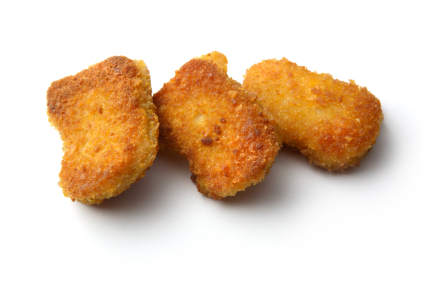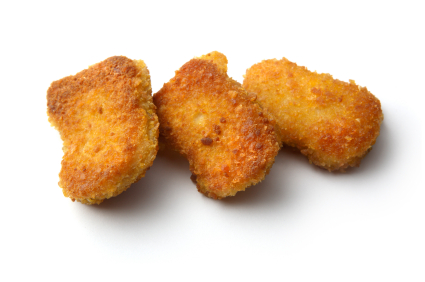
Choice nuggets

From Big Ag’s climate problem to Whole Foods’ latest snafu, tasty morsels from around the Web 5

 When my info-larder gets too packed, it’s time to serve up some choice nuggets from around the Web.

————————

chouice nuggetsGet ‘em while they’re hot.  • I’ve been writing a lot recently about how industrial agriculture is screwing up the climate (see here and here). I keep forgetting to add: a warmed-up climate will almost surely take its revenge against industrial ag.

• In my back-and-forth with Ezra Klein about whether organic veggies are more nutritious than ones grown with synthetic toxins (start here and work backwards, if you must), Klein basically argued: 1) I believe the British study that says they’re roughly equivalent (and ignore other studies that contradict it); and 2) I really don’t care that much; I just want people to eat more vegetables, and organics are more expensive and thus a harder sell.

But why not want people to eat more vegetables, but choose organic when they can? Because ... organics are more nutritious than conventional (and have lower levels of nitrogen, a possible toxin), according to a new study from the French Agency for Food Safety. (Interestingly, the British study came from the UK’s equivalent of the FDA; and the new study comes from France’s FDA.)

Better yet, rather than use one’s pundit cred to urge people to change personal behavior, why not agitate for policy change: more government R&D support for organic ag, less for conventional, etc.? If your beef with organic is that it’s more expense and prices low-income people out of the market, why not push policies that make it cheaper? After all, federal ag policy now makes highly processed food cheaper by subsidizing the two key inputs: corn and soy. An promoting organic ag would have benefits in multiple directions. For example, it would lower use of toxic pesticides and greenhouse gas-spewing (and fish-killing) synthetic nitrogen.

A brief note: in the blogosphere, the general reaction to my debate with Klein seemed to be: Philpott’s missing the point; there are many reasons to choose organic, so why focus on nutrition? (See here, for example.) My response: food and agriculture are endlessly complicated and contain a tangle of issues; nutrition is one of them; and it can and should be discussed without neglecting all the many others.

The Nation devoted its Sept. 21 issue, already available online, to food. This is the venerable magazine’s second food issue ever; the first came out three years ago, and I wrote about it here. I haven’t had a chance to dig in yet; looks like there’s some fantastic content. I’ll probably be commenting on some of it soon.

I haven’t read Ellen Ruppel Shell’s book Cheap yet either, but I doubt this LA Times op-ed hack job by Charlotte Allen does it justice.

Judging from this interview with Ruppel Shell by Grist’s own Vanessa Kerr, the author wants us to think about the hidden costs of the cheap stuff we blithely consume: the carbon- and mercury-rich coal that goes up in smoke to power China’s gadget factories, the farm workers who live in poverty to put lettuce on Big Macs.

Allen ignores all of this and simply asks, like a slack-jawed teenager defending some deplorable habit, “What’s wrong with low prices?”

• The blogger El Dragon of Fair Food Fight points to an obvious problem with low prices—maintaining them relies on a relentless attack on wages that leads in extreme cases to modern-day slavery, here in the United States.

El Dragon directs us to this disturbing report: the Justice Department has accused a Hawaiian vegetable farm called Aloun Farm with “conspiracy to commit forced labor and visa fraud.” That’s a nice way of saying slavery. According to the press release:

The charges arise from the defendants’ alleged scheme to coerce the labor and services of Thai nationals brought by the defendants to Hawaii to work under the federal agricultural guest worker program.

It should be noted that Aloun Farm markets itself as a locavore institution. From its website:

Aloun Farm’s mission is to provide the people of Hawaii with the highest quality of locally grown produce.

Given that Hawaii’s few working vegetable farms have to compete with produce shipped in from California—whose vast farms are also generally staffed by low-wage migrant workers—it’s not so surprising that this one resorted to slavery. And therein lies a major problem with an economic system predicated on driving down prices.

• Speaking of El Dragon, turns out his real name is Barth Anderson (not to be confused with sometime Grist blogger Bart Anderson), and he has a post up on HuffPo sparring with Michael Pollan over the Whole Foods/John Mackey/healthcare controversy. For those who haven’t followed the story: Whole Foods CEO John Mackey penned a Randian screed on the Wall Street Journal op-ed page promoting “personal responsibility” (by which I think he meant shopping at Whole Foods) as the best alternative to real healthcare reform. (Fetishizing the creed of personal responsibility is a bit much, coming from a man who once assumed an Internet identity to pump up his own firm’s share price and talk down that of a competitor, which he was simultaneously trying to buy.) A bunch of Whole Foods shoppers freaked out and launched a boycott. Michael Pollan publicly rebuked the boycott, arguing that Whole Foods’ support of farmers outweighs its CEO’s retrograde political views. I suppose Anderson’s riposte wins on points. My take: I reject Mackey’s warmed-over Ayn Rand take on healthcare and unions (do adults really take Rand seriously? I thought she wrote for disturbed teenagers). I deplore Whole Foods’ active lobbying to gut the Employee Free Choice Act. But I don’t shop there much anyway. I can’t be bothered to actively boycott Whole Foods—or denounce those who do.

Grist food editor Tom Philpott farms and cooks at Maverick Farms, a sustainable-agriculture nonprofit and small farm in the Blue Ridge Mountains of North Carolina. Follow my Twitter feed; contact me at tphilpott[at]grist[dot]org.

Advertisement
Advertisement
  1. spaceshaper's avatar

    spaceshaper Posted 5:32 am
    04 Sep 2009

    Michael Pollan's support for Whole Foods was certainly an odd call - the too-big-to-fail argument seems bizarrely out of place for the locavore champ. WFM may be a big player in (industrial scale) organics and global Fair Trade markets but as Pollan himself has repeatedly pointed out the chain has done little to support local foods and local agriculture. Last time I was in a Whole Foods store (admittedly this was a year or so ago) a large sign bragged about their $3m annual purchases from in-state suppliers. Not so impressive when you consider that annual sales at each store probably top $80m.
  2. foodprovider's avatar

    foodprovider Posted 1:53 pm
    04 Sep 2009

    Can anyone please tell me what you define "big ag" is? 
  3. EfrenN Posted 12:47 am
    05 Sep 2009

    I think BIG AG means Big Agriculture. Well, I like this idea, that rather than use one’s analyst credit to urge people to change personal behavior, why not work up for policy change: more government R&D support for organic agriculture, less for conventional, etc.? If your beef with organic is that it’s more expense and prices low-income people out of the market, why not push policies that make it cheaper? Then people will not go for fast cash just to buy foods that are essential for us to live. Did you know that most of our income goes to our food and daily necessities like water and shelter? Since I also believe that federal agriculture policy now makes highly processed food cheaper by subsidizing the two key inputs: corn and soy. And promoting organic agriculture would have benefits in multiple directions. I believe that using organic fertilizers/pesticides are healthier, safe, cheaper and very environmental friendly because it doesn’t use harmful chemicals that are present in most commercial pesticides and fertilizer right now.
    1. foodprovider's avatar

      foodprovider Posted 8:47 am
      05 Sep 2009

      Thanks for your opion.  I already figured out that big ag meant big agriculture.  But  What is big agriculture?  I have repeatedly asked this on a number of different sites, and you were the 1st to respond.  I do not have a beef with organic ag.  I have many neighbors that have been forced into organic practices becuase they could not survive on "conventional" practices.  The premiums paid for arganic practices looked enticing to them, but those premiums have eroded also.  There are a few Organic co-operatives who seem to follow the organic rules only when they find it convienient.  A few have been caught accepting non-organic products.  Another issue of eroding organic premiums is that more small producers are converting to either organic or transitional organic.  This has driven down the prices paid.  That is good for the consumer, bad for the producer.  What would make organically produced food cheaper?  More organic growers.  Then the organic producers have no incentive to remain organic.  THey went organic for the premiums, now they have very little and cannot survive.  As far as Gov't programs that subsidise corn and soybeans...Organic producers are afforded the same subsidies as the conventional producer.  That goes for milk and vegetable producers as well. (in the newest farm bill).  As far as the "Farm Bill" (The Food Securities Act as it is titled), Of the billions of dollars in the bill, less than 2% of those dollars actually go to farmers.  Some big subsity huh.  The majority of the dollars go to Food Stamps and WIC.  Other things that those dollars goto...Energy, rural developement, and conservation.  Conservation such as projects sanctioned by Ducks Unlimited, Trout Unlimited, Whitetails Unlimitted, etc.  And some does go to programs such as CSP (severly underfunded), and EQUIP.  So, tell me where the grain farmers are getting rich off the gov't.  As far as organic fertilizers and pesticides being cheaper and safer?  I'm trying not to laugh.  Lets take our favorite whipping post plant nutrient, nitrogen.  An element that is very essential to all life.  The (as many in here like to call it) synthetrically produced nitrogen is relatively chaep and widely produced.  most N forms do not require any hazardous materials endorsments.  They range in concentrations from 21% - 82% notrogen content.  Most can be and are produced in this country.  I do not have to hire anybody with special training to handle these products.  The cost to the farm is approximately 30 cents per lb of nutrient.  relatively inexpensive.  Now lets look at Chilean Nitrate, a 16% material (you have to use more!).  It is produced in Chile.  It is considered a Hazardous Material.  I have to hire special trucks and people to handle that product.  It costs approximately $2.50 per lb of nutrient.  Plus I have never witnessed an organically produced crop yield as much as a conventionally produced crop.  So, lets look at the economics. If using organic fertilizers and pesticides are safer, then why do the organic fertilzers I use require a HAZMAT edorsement while the others don't.  Besides that, organically produced food has never been proven to be more nutritious than conventioanlly produced. It costs more to produce organic products, organic production is less than conventional on a per acre or per cow basis.  So, that would mean that to purchase organically it will cost more.  Now, the cost of food.  I'm not sure what all you included in food for your figures, maybe you eat at the finest restaurants.  the latest figures that I have seen put the cost of our food at around 12% of income.  That is oe of the lowest, if not the lowest in the world.  Organically produced food also produce more GHG than conventionally produced foods.  So, moving to organic is good?  It is a choice.
  4. Nastarana Posted 10:26 am
    08 Sep 2009

    On low income folks buying organic Most low income folks use food stamps (EBT card) for food purchases.  Contrary to what you might suppose, many stores do not accept EBT.  For example, discount medium box Big Lots, which certainly depends on the spending of underclass and working class customers, won't accept EBT.  Neither will most health food stores.Adding injury to insult, so far as I know, only one store, Walmart, will accept EBT for purchases of vegetable plants and seeds.  So, in case you were wondering "Why don't they have gardens?"...  Tarjey, the discount snob store, will let you use your EBT card for food purchases but NOT for vegetable seeds and plants. There are some bright spots in this picture.  In  many communities, food stamps are being accepted at Farmer's Markets.  SSE and other seed saving organizations do make free seeds available to non-profit community gardens. 

Add a Comment

You are not logged in. Thus, you cannot post a comment. If you have an account, log in. If you don't have an account, well, by all means go make one! Meet you back here in five.

Hello, Visitor!    Why not register?

Advertisement