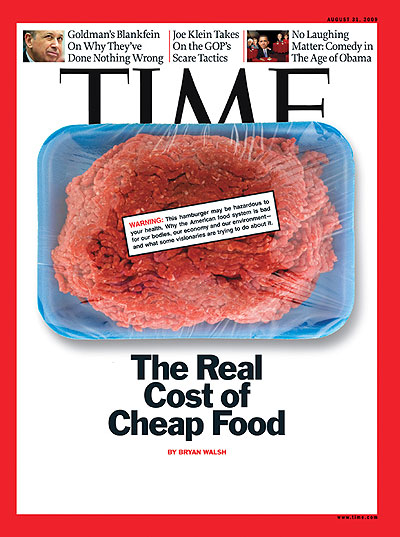
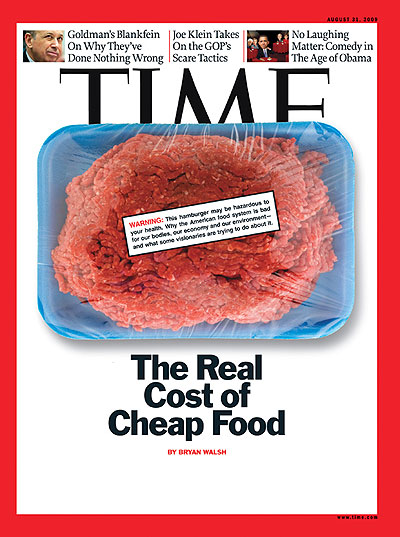
 TIME Magazine‘s current cover story wants you to know that our fossil-fueled, chemically intensive industrial food system is destined to fail. Granted, the second part of that sentence isn’t news to Grist readers. But the first part of that sentence is news. Personally, I wouldn’t have expected to read the following positively Philpottian (if not Pollan-esque) prose in a national newsweekly cover story:
With the exhaustion of the soil, the impact of global warming and the inevitably rising price of oil — which will affect everything from fertilizer to supermarket electricity bills — our industrial style of food production will end sooner or later. As the developing world grows richer, hundreds of millions of people will want to shift to the same calorie-heavy, protein-rich diet that has made Americans so unhealthy — demand for meat and poultry worldwide is set to rise 25% by 2015 — but the earth can no longer deliver. Unless Americans radically rethink the way they grow and consume food, they face a future of eroded farmland, hollowed-out countryside, scarier germs, higher health costs — and bland taste. Sustainable food has an élitist reputation, but each of us depends on the soil, animals and plants — and as every farmer knows, if you don’t take care of your land, it can’t take care of you.
TIME Magazine talking about exhausted soil? Whooda thunkit? The importance of Bryan Walsh’s piece, of course, isn’t in the particulars of its insights or its prescriptions. The importance (aside from its very existence as a cover story) is in its declarative nature. For openers, Walsh offers a whirlwind tour of industrial ag practices which covers swine tail docking, sub-therapeutic antibiotic use, manure lagoons, ag subsidies, nitrogen fertilizer run-off and the Gulf of Mexico deadzone — all in the first paragraph. And better yet, Walsh doesn’t fall back on that tired journalistic trope of the “third party fact.” “Experts” don’t “claim” nor do “critics” “observe” nor even does “Michael Pollan” “relate” this or that fact of industrial ag’s excesses: they are instead plainly stated as established, if awful, truth. How refreshing.
Indeed, in these two paragraphs Walsh brings into stark relief the very issues over which Big Ag willfully and relentlessly refuses to engage. One of the more surprising aspects of the article is a total lack of any boilerplate denials from Big Ag of all responsibility for the ills of industrial food that typically get some play whenever the topic of food production gets attention from the MSM. I don’t think it’s an oversight that we didn’t hear from the National Corn Growers Association or the American Farm Bureau or Monsanto or Smithfield or any other Big Ag mouthpiece in this article — it’s likely that nothing they said was worth repeating.
Honestly, the best you can expect to hear from them is some paean to American agricultural ingenuity and productivity such as in soy farmer and AFM official Blake Hurst’s Omnivore’s Delusion (though after you read it, be sure to rinse your brain with Tom Philpott’s able riposte). Hurst, as it happens, manages to ignore or elide just about every damaging issue regarding industrial agriculture that TIME Magazine has so pointedly raised. And it’s no coincidence — the fact is that Big Ag doesn’t have the answers to sustainability. What they do know about is succeeding in a status quo of abundant oil, chemicals and subsidies. Change the rules of the game — spiking fuel prices, fertilizer shortages, superweeds, superbugs, etc. — and they no longer know how to play.
If I have a regret about this piece, it’s in the conclusion. Walsh invokes the concepts of “conscious” eating on the one hand, versus “selective forgetting” of the consequences of our food choices on the other. Consumers must be open to change, he declares, if we’re to move toward a more sustainable system. This is no doubt true. But I would have liked a final invocation as well of industrial agriculture’s “ticking clock.” Right now, consumer choice is surely a crucial factor. But if, for example, worldwide demand for meat is in fact set to rise 25% by 2015, it seems to me that we’ll be having unpleasant “choices” thrust upon us much sooner than we may expect. And after 2015 things are only going to get worse (Peak Oil, anyone?) America’s Food Crisis and How to Fix It may have been one of the most thorough and alarmist articles on the industrial food system ever to appear in a major magazine. Sadly, it may not have been nearly alarmist enough.