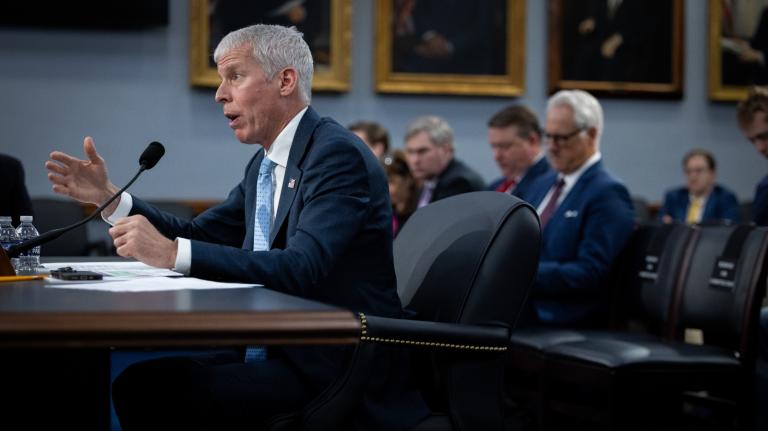
I just returned to Seattle from Netroots Nation, the yearly gathering of progressive bloggers, journalists, and activists. Last year, in Austin, the atmosphere was absolutely electric, with the election approaching and a clear sense of battle lines drawn, victory within reach. Also, lots of great parties.
This year, at least from my limited perspective, the atmosphere was more muted, the panels less exciting, and the parties both fewer and less fun. Some of this could just be me getting to be an old fart, but others I spoke to had similar experiences.
The tone of the conference was, in part, related to a general frustration among progressives.
I wouldn’t say the “netroots” (I hate that damn word) have turned on Obama, this sensationalistic HuffPo story notwithstanding. New pieces from Robert Kuttner and Jane Smiley represent a growing frustration with Obama’s pursuit of bipartisanship, but overall, Obama’s personal popularity is still plenty in evidence. The sense, rather, is that we are witnessing a tsunami of progressive enthusiasm, organizing, and, um, Hope crash on the shoals of the status quo … and the status quo isn’t budging. Bit by bit, the giddy high of those days following Obama’s election is dissipating. It’s dispiriting.
The dynamic is most obvious around health care, and in my panel Thursday morning, one of the things I discussed was what that battle portends for the battle over climate legislation when it resumes in the Senate this fall.
Depending on who you believe, heath care is going to come to a vote anywhere between the end of September and Thanksgiving. I’d say there’s around a 30-40% chance that enough conservative Democratic senators defect that the whole project crashes and burns in a cloture vote (60 votes are needed to overcome the threat of a Republican filibuster). There’s around a 60-70% chance that the Senate produces a watered-down, incrementalist bill that doesn’t come anywhere close to the fundamental changes needed in U.S. health care insurance and delivery. (It looks like the public option is the latest thing to be compromised away.) And there’s about a 1% chance of a genuinely good bill passing.
How did this craptastic state of affairs come to be? Without dragging this post out forever, here’s a short list:
- NO is easy. The Republican opposition does not have to do any education of its activist base. The grounds for opposing every Democratic initiative are the same: fear of creeping socialism, with an undercurrent of racial and revanchist sentiment. So there’s this large army of wingnuts that can be mobilized quickly and easily, on any issue that comes up. By contrast, explaining the public option, or co-ops, or cap-and-trade, or offsets requires a patient campaign. And even then, it’s hard to work up passion for that kind of technocratic detail. Long story short: on the ground, in terms of tangible grassroots activity — calls to congressional offices, presence at public town halls — the right is kicking the left’s ass.
- The filibuster. This “process issue” is difficult to make sexy, but it’s absolutely central to the difficulty in advancing the Dem agenda. It’s only in recent decades that 60 votes has become the default threshold in the Senate; it has fundamentally changed the political landscape. I asked Rep. Jay Inslee (D-Wash.) about it at NN, and his answer didn’t contain much cause for hope:
- Blue Dog Senate Dems are bad people. Partly thanks the new 60-vote requirement, “centrist” Democratic senators like Max Baucus (Mont.) and Ben Nelson (Neb.) have accrued enormous power. Their states went for McCain; they face no serious challenge (no election until 2012 for Nelson; 2014 for Baucus); they receive lavish support from special interests; and finally, importantly, they are not good people. It’s important to speak about this directly, without euphemism. They could decide to use their political power to insure better health care for millions of people or prevent catastrophe for low-lying developing countries. Instead they slow the process to a crawl with substanceless, affective appeals to “fiscal conservatism” for the “folks back home,” thin cover for acting on behalf of their corporate funders.
Two notable features of these lamentable facts.
First, they are structural. It’s really hard to see what Obama or progressives can do to change them except at the margins. Too frequently people talk as though Obama or House Energy and Commerce Committee Chair Henry Waxman (D-Calif.) just aren’t trying hard enough — the Green Lantern theory of domestic politics. They aren’t powerless, of course, and it would be nice if the progressive caucus learned to throw its weight around more. But the fact that the U.S. system of government is riddled with procedural chokepoints is not something one can will away. The filibuster could theoretically be fought, but we seem to be a long way from that being a live possibility. And finally, it’s hard to see what leverage Obama has over conservative Dem senators whose states didn’t vote for him.
Secondly, on virtually every score, climate change is worse off than health care. The right wing is just as motivated and organized on climate as they are on health, but the progressive coalition is fragmented. The policy options aren’t as well understood; there isn’t single rallying point equivalent to the public option. On climate/energy there are far more “centrists” in positions of power to appease in order to get to 60 votes. (And it’s important to understand that “centrist” is a situational description. When Dems are in power, it means “a little weaker than whatever the Dems come up with” — see: stimulus bill. When Republicans are in power, it means “a little closer to the Republicans than the other Dems” — see: Bush tax cuts.) There’s even less credible leverage over Dem senators; voting against Obama’s climate agenda will not threaten the reelection of a single Southern or Midwestern Dem.
I’m afraid this is a depressing post, but it’s just become clear that structural features of American politics make it so change averse that virtually no progressive electoral sweep is enough to do the job. And however difficult those features may be for health care, they’re worse for climate. At this point, chances seem to be split pretty evenly between total failure and the passage of an utterly defanged bill.
Or as Jon Stewart put it: “And now, cap-and-trade — naked, bruised, and humiliated — is off to the Senate to get skull-f*cked.”