Oh, Here It Is!

Four years after my pleading essay, climate art is hot 12

That pleading little essay I wrote in 2005? It was probably the last moment I could have written it. Clearly there were lots and lots of people already thinking the same way, because ever since it’s seemed to me as if deep and moving images and sounds and words have been flooding out into the world.
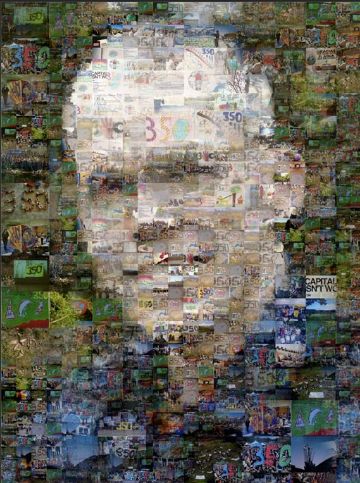
McKibben collageBill, built from Flickr pix.Kalman Gacs, 350.org/galleryThat torrent of art has been, often, deeply disturbing—it should be deeply disturbing, given what we’re doing to the earth. (And none of it has quite matched the performance work that nature itself is providing. Check out, for instance, James Balog’s time-lapse photography of glaciers crashing into the sea—if we could somehow crowd that thrashing sheet of ice into the Guggenheim for a week, people would truly get it.) But for me, it’s been more comforting than disturbing, because it means that the immune system of the planet is finally kicking in.

Artists, in a sense, are the antibodies of the cultural bloodstream. They sense trouble early, and rally to isolate and expose and defeat it, to bring to bear the human power for love and beauty and meaning against the worst results of carelessness and greed and stupidity. So when art both of great worth, and in great quantities, begins to cluster around an issue, it means that civilization has identified it finally as a threat. Artists and scientists perform this function most reliably; politicians are a lagging indicator.

But once a threat has been identified, the attack has to be at least a little organized. Which is why I’m so pleased that many artists are not just doing their own thing, but also increasingly figuring out how to come together to make the sum of their voices louder than the individual parts. Let me use the example that’s closest at hand: the 350.org campaign that I’ve been helping run this past year, the biggest global grassroots effort on climate change.

We’re working with ministers and mountain climbers and youth networks and even politicians. But with artists too. I’ve been shamelessly asking friends to shape their work to fit our message: that 350, as in parts per million CO2, is the most important number in the world, that beyond it the world simply doesn’t work in the ways it must for our civilization to survive. And people have responded in remarkable ways. You can see many of them on our website, from crafters to fine artists to someone who somehow managed to make a portrait of me from hundreds of Flickr photos of 350 demonstrations around the world. (I’ve always hated looking at pictures of myself, but that one I stared at for a long time, because it seemed to illustrate a principle that matters to me: we are who we are because of our connection to others.) 350.org is one of the first campaigns I know of with an official artist-in-residence, Kevin Buckland, who is coordinating as best he can many of these contributions. But mostly it’s like a potluck supper. Everyone is bringing what they do best.

We’ve asked writers if they would pen 350-word poems and essays, and many have responded. Here’s the great Chilean writer Ariel Dorfman, for instance.

Photographers are organizing around the world, not only to send us images, but also to document the thousands of actions that will be taking place on October 24 on our global day of action. (That day itself will be a carnival of performance art; I’ve just come from helping cobble together what we think will be the world’s largest underwater demonstration, in the Maldive Islands.) We’ll take the pictures they upload from around the planet and show them on a giant screen at the U.N. that day, and then deliver prints to every delegate and negotiator.

Amazing artists keep stepping up to fill needs we didn’t even know existed. John Quigley, for instance, who is the Rembrandt of what you might call aerial art—arranging human beings on the ground to make a point from above. Here’s a picture from Poznan in Poland, and from Bonn, Germany, and from Bali, Indonesia. (See more aerial art in our performance art slideshow.)

Musicians too. Some of them world-famous: Moby will apparently headline a concert/rally on the big day in Mexico City, and Groove Armada in the U.K.; Sigur Rós let us use a song of theirs on our most recent organizing video. Fred Small provided us a marching song that we put to great use when we helped shut down the Capitol Hill Power plant in Washington in March. Rev. Lennox Yearwood and the Hip Hop Caucus have been helping us plan events across the country that use a different beat than old-school environmentalists are used to. Today’s email brought not one but two cuts from one of my favorite pairs of singers, Michigan’s Seth Bernard and May Erlewine. I asked them—humbly but insistently—for a song; they went to work. That’s how it’s been with pretty much everyone. (Read more about climate-change tunes and North American bands going green.)
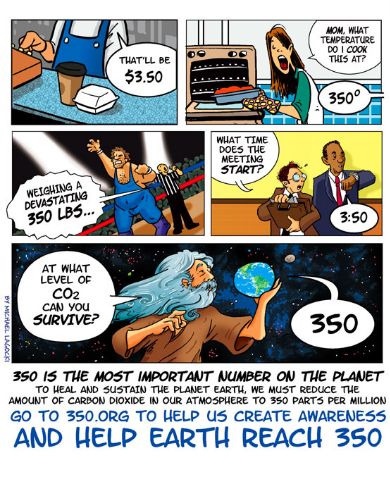
350 comic bookA graphic depiction of the task at hand.Michael Lagocki, 350.org/galleryThere’s no limit to the stuff we can use, from pros and from amateurs. Crafters have sent in endless great patterns; graffiti artists have started taking the number to the streets and building buzz; dancers have been creating dances of 350 steps and more; great video artists put together our first organizing video, which has now been seen all over the planet.

My point four years ago was that we needed art to help build a general consciousness about climate change, the greatest problem we’ve ever faced. That’s happened. Now we need to focus some of that beauty and witness and anger sharply enough to help spur deep and lasting change. It’s always hard for any of us who are writers and musicians and visual artists to subordinate our own personal vision even a little—that’s what makes us artists. But the pleasure of working together in common cause more than makes up for the imposition. Please join us!

Bill McKibben, a scholar-in-residence at Middlebury College, is the author of a dozen books, most recently The Bill McKibben Reader. He serves on Grist’s board of directors and is cofounder of 350.org.

Advertisement
Advertisement
  1. Erik Hoffner's avatar

    Erik Hoffner Posted 8:13 am
    06 Aug 2009

    Great roundup, Bill! Your review of Alexis Rockman's post-apocalyptic-climate paintings in 2006 in Orion magazine also comes to mind:http://www.orionmagazine.org/index.php/articles/article/165/And then there's http://greenmuseum.org - a super place to find inspiring art on all sorts of natural topics.(sorry the links don't work: the new grist.org does not work or load (including toolbars) properly on dialup still)
    - Erik, Orion Grassroots Network
  2. sustainablejohn's avatar

    sustainablejohn Posted 12:21 pm
    06 Aug 2009

    Although, we don't have the video posted online (the video doesn't do the live performance justice), we believe this may have been one of the first every comedies performed about environmental issues: Lean Mean and Greenhttp://www.chinasgreenbeat.com/blog/?p=32Here is some eco-rap in English and Chinese:http://www.chinasgreenbeat.com/blog/?p=43
  3. gullyfourmyle's avatar

    gullyfourmyle Posted 12:46 pm
    06 Aug 2009

    I've been an Eco Artist since January 1970. My avatar on this site is of a Question Mark butterfly. Swirling in the background that you can't see due to the avatar's small size is the chemical formula for Think.com's (a Chinese chemical company) pesticide. On the right side in the background is the elemental symbol for Humanity. Below the Question Mark is a line from Let It Be - 'There Will Be An Answer..."The Human elemental symbol has a number at the top right. That number is supposed to be 52. But if any of you have read The Hitchhiker's Guide to the Galaxy by the late Douglas Adams where the super computer is asked for the answer to the meaning of creation and everything in it, you know the number has to be 42. So I changed it to 42.I've been painting enviro art for years and never realized there was a market for it. Various experts told me I was wasting my time and to paint more conventional art if I wanted to make a living at it. They may be right. But on the other hand, no artist ever made a name for himself painting conventional art. Artists do have to be ahead of the curve and the be patient while everyone else catches up. Sometimes you die first.Another painting I did was of a Tortiseshell butterfly blowing its wings up on what looks like a piece of string. When you look closer, you can see drilled into the rockface behind, four sticks of dynamite. The butterfly is blowing its wings up on a dynamite fuse. We the audience are the miners waiting for it to finish and fly away before blowing the top off another mountain in West Virginia. The caption for that painting is from the Donovan song - First there is a mountain...Of course I did a "LET IT BE" butterfly as well. That was a Buckeye that was tattered and torn on a turbulent background.My next butterfly painting will be of a Tiger Swallowtail with Pickering Nuclear Plant in the background and the Nuclear hazard symbol on the chain link fence next to the butterfly.I'd load them on this site so you could see but I don't know how. Don't have a website yet either. Maybe the butterflies will help me pay for it at some point.The painting that started it all back in 1970 was originally titled "Pollution". The title was changed years later to The Reign of the Third Horseman when I realized that what I'd depicted is exactly what is going on right now. For example, one end of the painting (it was 8'-0" long by 4'-0" high) looked stunningly like one of the iconic photographs taken of the aftermath of 9/11 which in my mind is the watershed moment when the Third Horseman asserted itself.The Third Horseman is part of a series I did about the Appocalypse and the reign of each of the Horsemen. I'm not a religious person in the traditional sense but the symbolism in the Book of Revelations and recent human history is a "coincidence" that is too huge to overlook. What was even more amazing was that each of my paintings "predicted" 9/11 to the point I got the address right each time. The Reign of the Second Horseman was painted in the mid-seventies. The Reign of the First Horseman was painted in 1978 and the Third as I said in 1970. The fourth is in gestation.Developing the concept for an enviro painting - The Reign of the Fourth HorsemanMy take on our enduring global strife is that environmental issues are what is really at the root of all of the conflicts. As much as religion is a huge part of it, if each party had sufficient resources and something precious to lose, there would likely be no major conflicts. But since we have multiple races all claiming the exact same piece of real estate and resources, the conflict can't end until there is a massive event that reduces the numbers and the mind sets of the people trying to access the resources. That massive event has to involve most if not all of the world's populations since oil extraction and useage, one of the three critical resources (oil, land, water) is the cause of not only our climate difficulties but also CHEMICAL WINTER. Chemical Winter is causing the destruction of gentic integrity of higher life forms globally. Essentially, science is showing piece meal at the moment that the eco systems that support the existence of animate life forms (including us) more complex than single cells are begining to collapse.Therefore Chemical Winter is the subject of my next Apocalyptic painting and will be called the Reign of the Fourth Horseman - the Pale Horseman - "and with him came Hell". So far three of the Horseman are understood to be in "play" right now. People don't understand that the Fourth Horseman is the most fearsome and is only now beginning to flex his "muscles".I've delayed painting the Fourth Horseman because my science research has shown that what is coming is so horrific that I haven't been able to come to grips with the composition. It took me until two weeks ago to figure out how to depict genetic destruction in a symbolic way that viewers would understand as soon as they look at it.This concept of Apocalyptic strife has been the driving force behind my interest in the environment since that first painting done in my teacher's office in 1970. It has overshadowed every single day of my life since. I have spent a lot of time, money and effort trying to help people understand what is coming as I watched events unfold. Seeing this process evolve made me understand how the predictions in the Bible worked and how Nostradamus made his predictions. Once you are on a track and you can "see" the ramifications of current events, it is no big thing to "predict" or "see" the future. So far everything I've foretold as a result of studing the science, world and local events and understanding how they interact, has come true.There is only option that will take us off our path to destruction and that's to somehow stop extracting oil from the ground and using it. That or figure out how to completely neutralize the emissions. Not just from burning oil products, but how to stop products made from oil based products to stop off-gassing. We have to stop using oil based products as pesticides and herbicides. In short we can no longer afford to allow oil and its derivatives to enter the modern environment.Virtually every single landfill in the world is leaking oil and other chemicals into the planet's ground water. That's a lethal mixture that is anti-life. We're contaminating the lifeblood of the planet for all time for all future species. Anything that evolves after us will have to do so with the capacity to metabolize oil. That will make such species even more dependent on the planet. That means no interstellar travel for any earth species that might want to inhabit other planets. Most likely oil does not exist on other planets.  The same scenario will play out for nuclear energy and other forms of radioactive fuels whose half life we still don't understand how to neutralize.The bottom line is that our technolgical advances are bringing us quickly to an evolutionary dead end in every sense of the word.Our oil use is demanding that animate species find a way to metabolize oil and survive. So far there are very few living things on earth that can metabolize oil and thrive. What that tells you is that living species as we know them will have to give way to new life forms that can utilize oil without invoking cancer. But the irony is that as soon as our oil using cultures collapse, all of the oil in play will sink back into the earth. The survivors will then have to deal with cancer and other acquired genetic encumberances thanks to impaired genetic codes.Wildlife will quickly defeat cancer by killing off genetic anomalies. If any humans survive, we will perpetuate our genetic injuries by medical means and fatally weaken our species assuming there is any clean water left. As a species we all qualify for the final Darwin Awards for finally figuring out what is killing us and the planet and then not bothering to stop it. http://www.darwinawards.com/There you go - the inner workings of an artist's mind as he develops the concept for a cutting edge painting that most people would be too terrified to hang never mind own.You don't choose to paint enviro art. It crawls out of you and will not be stopped or denied. You don't paint such subjects because you want to make money. You paint them because you are driven.Being an artist living at the edge means you have to have the courage to live with thoughts and concepts most people would want to hide from or at least not acknowledge.The public for the most part does not want to know the details.Even the forward thinkers who populate this site demonstrate this. Where I've posted information about Chemical Winter on this site and others, it generally stops the thread; or subsequent posters ignore it like it wasn't there.Chemical Winter is the scariest thing on the planet today bar none and no one wants to face it or talk about it. That's how I know the Fourth Horseman will reign for a long time. Procrastination on this subject is going to really hurt.My job as an artist is to make you face the reality of CHEMICAL WINTER and deal with it. There is no choice.
  4. Bobbe Posted 2:29 pm
    06 Aug 2009

     While the work of Greenpeace is indeed worthy, and people making signs with their bodies to be photographed by airplanes about our carbon footprint and folks dressed up in polar bear costumes is too- this is not art - it is activism. Sometimes the line between art and activism is crossed. But not in the stuff you picked. The Yes Men. How could you overlook The Yes Men! That is art. Dominique Mazeaud's great cleansing of the Rio Grande, Erika Wanenmacher's veggie oil car, Helen Mayer Harrison and Newton Harrison's work in communities - for watersheds, Basia Irland, Rebecca Belmore, Lynne Hull, Mary Miss, all extraordinary artists, making art about climate change and the envirnoment - and this list is, indeed the tip of the melting iceberg. If you intend to cover art about climate change, why don't you contact writer/curator Lucy Lippard, who has letured extensively on the subject, globally. Your peice here is simply lazy, sloppy reporting.  
    1. greenergirl Posted 9:58 pm
      20 Aug 2009

      I think you're being a little tough on Bill.  Art and activism can go hand in hand.  What one person sees as art, another person may question the value of, or call something else.  Some people view useful items made from recycled materials as crafts, rather than art, but some of them are very beautiful,even if they are useful, and take some creativity and an artistic eye to design.  You maybe be a little more open-minded.  I can't speak to the issues of the other eco-artists or research, you might be right about that. 
  5. spiak Posted 4:42 pm
    11 Aug 2009

    Bill,  I thought this information regarding our upcoming season and focus on issues of sustainability might be of interest to you. Our Defining Sustainability fall season at the Arizona State University Art Museum is being picked up by national press.  This reporter at the Sundance Channel puts his finger on the possibilities of the season and the role that artists can play in the conversation and solutions.http://www.sundancechannel.com/sunfiltered/2009/07/asu-art-museum-sustainability-definitions-fall-exhibitions/ The official ASU press release that includes downloadable images of a few of the artists works can be found online at:http://asunews.asu.edu/20090624_definingsustainability As the exhibition begins to develop here at the Museum we will be photo documenting the process and updating our blog with images on regular bases. Wishing you all the very best, John SpiakCuratorArizona State University Art Museum    
  6. Eco-artist Posted 7:22 pm
    11 Aug 2009

    Eco-artists have been around for decades.  Just because climate change is this decade's 'enviro-crisis' (and sadly has become some kind of trend) there are just as grave issues that have always been tirelessly addressed by artists who just don't get the publicity unless the media catches wind of them (because it's suddenly a hot topic.)  It is debatable whether art can effect change (in all issues), but it is the hope of many of my peers that it can.   I'm afraid, though, the jump-on-the-band-wagon act is often too common in the cultural sector. Including curators who wish to raise the profile (and their careers) of the museum they work for.  How do we sift through the 'one-hit wonders' to get to the real artists who are there for the long run?  Because, frankly, taking care of the earth should not be a passing fancy.I have to agree with the above post by Bobbe...you need to dig the dirt a little deeper, Bill. 
  7. gullyfourmyle's avatar

    gullyfourmyle Posted 8:05 pm
    11 Aug 2009

    Art is art regardless of the reason it was produced. Greenpeace may go after sensationalism but that does not stop it being art. As mentioned there are lots of artists who have been out there for the long haul without a sniff of publicity. That wasn't why they did what they did. In my experience, as hot as this site makes eco art out to be, it ain't that hot yet. Most people still don't understand the issues including the scientists.The other problem is that explict eco art - the real thing - is not pretty - it's scary. The eco art that leaves the viewer to mindread what the artist meant is not eco art. If it were, anyone painting a mountain lion could be saying they hope people see the beauty in it and understand that nature is under threat and maybe we should do something about it. Like what exactly? Most people don't have a clue and paintings like that don't do much to help. I call them wallpaper. People have been painting nature for centuries without anyone cluing in to the fact that the artist really meant to convey a conservation message. So to suddenly be coming out with bilge like that yet still painting the same old humdrum bird on a branch and expecting us to get it is preposterous. But that is what most wildlife artists are doing today. How insincere can you get?For eco art to mean anything - to have punch, it needs to name the names, portray the offenders and make the consequences of failing to look after the environment graphic. That's what Greenpeace and too few others do. Don't knock Greenpeace or its methods until you've walked the talk yourself. They  have gotten results around the world and they've lost lives doing it. What they are doing is art in action. It takes every bit of creativity to come up with the campaigns and more than it takes to put on a feel good play or a pat on the back art exhibition.From a visual art point of view, everyone takes a back seat to Greenpeace. They lead the way. They walked the talk and made the graphic images long before it was popular. Long before some of you were alive.Eco-artist's comment about bandwagoneers is appropriate too but without those fairweather friends, we'd have a lot less publicity. So in retrospect it doesn't matter where the support comes from or why as long as it comes fast. Even the limp-wristed artists who can't bear to tell it like it is at least are talking about it even if they don't have the nerve to paint it.But before the visual arts there were the musicians. A significant portion of the music that started it all way back in the sixties is still timely today. Big Yellow Taxi, Where Have All The Flowers Gone, Shapes of Things to Come to name a few. The musicians were who really got the ball rolling so it was them who were really at the corona of the curve. The visual arts followed. It has to be that way because sound catches the attention, the visuals capture it.
  8. seawitch Posted 12:05 am
    15 Aug 2009

    I have to jump on the bandwagon with others here and point out that artists have been doing exemplary work in this area for decades. I have been one of these artists, and I have and still do write, lecture, develop and teach curriculum at university level on this very topic.Your comments are appreciated, and I have quoted you myself - however, this might be a good time for you to acquaint yourself with not only the recent surge in popularity of ecoart, or environmental art, or art and sustainability, but also with the rich history and body of works that span decades and countries.   
  9. seawitch Posted 12:12 am
    15 Aug 2009

    ps - for just a tiny sampling of examples, see the Ashden Directory, if you have a particular penchant for performance: http://www.ashdendirectory.org.uksee too the International Ecoart Network for visual, bioremedial and community engaged, social practices art: http://www.ecoartnetwork.orgsee the Harrison Studio (the Harrisons have been doing this work since the late 1960s): http://www.theharrisonstudio.netThere are ecoart centres from Canada to Britain, to Iran, to India, to israel and beyond...
  10. jopa Posted 11:45 am
    22 Aug 2009

     I don't see why there has to be a divide between art and activism, I think the point is that art is a form of activism.  Art is taking action to evoke emotion about something and disseminate a message through multiple mediums.  I think its great that climate art is taking off. Even the Climate conference in Geneva this month is going to have an artistic aspect http://bit.ly/IezjY it just shows how much the greater climate movement, and even the policymakers have open their arms to understanding the different concerns from different people, and understanding that the expression of these concerns has many different modes.
  11. gullyfourmyle's avatar

    gullyfourmyle Posted 7:11 am
    28 Aug 2009

    Don't tell me Greenpeace does not create art: http://www.flickr.com:80/photos/greenpeaceusa09/

Add a Comment

You are not logged in. Thus, you cannot post a comment. If you have an account, log in. If you don't have an account, well, by all means go make one! Meet you back here in five.

Hello, Visitor!    Why not register?

Series Intro
Four years after my pleading essay, climate art is hot 12
Portrait of an artist as a climate activist 1
Audio slideshow: Facing climate change -- and wildfire 1
Audio slideshow: Chris Jordan on America's coal consumption 0
Songs about climate change are not so hot 20
North American bands playing to greener tune 0
Slideshow: Climate activism as performance art 0
Slideshow: Preview the Royal Academy of Arts exhibit 'Earth: Art of a Changing World' 0
Slideshow: A tour of green-leaning museums 0
Resources and links for the art-hungry 0
Advertisement