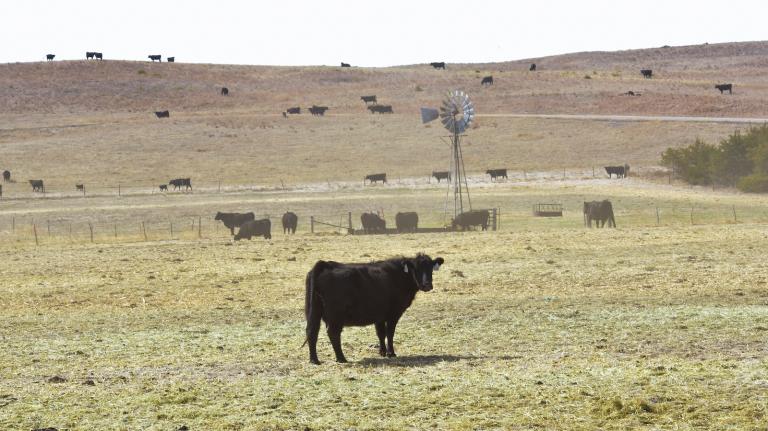
In a pair of articles in New Scientist, Debora MacKenzie links the swine flu virus now spreading across the globe to large-scale pork-raising operations in the United States.
In the first article, titled “Swine flu: the predictable pandemic?,” MacKenzie writes that the “virus has been a serious pandemic threat for years, New Scientist can reveal — but research into its potential has been neglected compared with other kinds of flu.” She writes that the strain now in the headlines has its origins in an earlier outbreak in the United States a decade ago:
This type of virus emerged in the U.S. in 1998 and has since become endemic on hog farms across North America. Equipped with a suite of pig, bird and human genes, it was also evolving rapidly.
Before ’98, MacKenzie claims, a genetically stable swine flu, in the H1N1 family, regularly visited hog farms, not causing much trouble. It was a relatively benign mutation of the strain that caused the great 1918 pandemic. But in 1998, something changed. Citing the work of Richard Webby of St. Jude’s Children’s Research Hospital in Memphis, MacKenzie writes:
[S]wine H1N1 hybridised with human and bird viruses, resulting in “triple reassortants” that surfaced in Minnesota, Iowa and Texas. The viruses initially had human surface proteins and swine internal proteins, with the exception of three genes that make RNA polymerase, the crucial enzyme the virus uses to replicate in its host. Two were from bird flu and one from human flu. Researchers believe that the bird polymerase allows the virus to replicate faster than those with the human or swine versions, making it more virulent.
 New ScientistWithin a year, the triple-reassortant types became the dominant flu bugs seen on U.S. hog farms. Importantly, “unlike the swine virus they replaced,” the new ones “were actively evolving.” Today, she writes, “There are many versions with different pig or human surface proteins, including one, like the Mexican flu spreading now, with H1 and N1 from the original swine virus.”
Since the mutation that occurred in or before 1998, evidently, the risk of a swine flu pandemic has grown dramatically. At this point, MacKenzie refers to a 2008 paper co-written by USDA livestock specialist Amy Vincent. “The first 80 years of Swine Influenza [i.e., since 1918] remained relatively static, whereas the last decade has become dynamic with the establishment of many emerging subtypes. With the increasing number of novel subtypes and genetic variants, the control of SI has become increasingly difficult and innovative strategies to combat this economically important zoonotic disease are critical,” the authors write in the abstract. They continue:
It is expected that the dynamic evolutionary changes of SIVs [swine influenza viruses] in North American pigs will continue, making currently available prophylactic approaches of limited use to control the spread and economic losses associated with this important swine pathogen. [Emphasis mine]
According to MacKenzie, Vincent said last year that the rapid evolution of these post-1998 strains has created “potential for pandemic influenza emergence in North America.” MacKenzie also points to a CDC memo from last year warning that swine H1N1 would “represent a pandemic threat” if it started circulating in humans. MacKenzie continues:
Webby [of St. Jude’s Research Hospital], too, warned in 2004 that pigs in the U.S. are “an increasingly important reservoir of viruses with human pandemic potential.” One in five U.S. pig workers has been found to have antibodies to swine flu, showing they have been infected, but most people have no immunity to these viruses.
The presence of avian genes in the strain are what make it so alarming, MacKenzie writes, “as similar genes are what make H5N1 bird flu lethal in mammals and what made the 1918 human pandemic virus so lethal in people. Despite ample knowledge of the threat among livestock-oriented scientists, there’s been shockingly little work among human influenza specialists to prepare for the post-1998 H1N1 strains, MacKenzie claims.
The New Scientist characterization of the current flu crisis is at odds with the position of the U.S. hog industry — at least superficially. I interviewed David Warner, director of communications at the National Pork Producers Council. He told me that “this particular flu is not in the U.S. swine herd.” He repeatedly added that “it’s not swine flu,” since it’s a mixture of avian, human, and swine varieties.
That particular verbal subtlety seems meaningless — even if President Obama has picked it up. New Scientist and the NPPC agree that the current flu mixes avian, human, and swine strains. The claim that “this particular flu is not in the U.S. swine herd” is actually not inconsistent with the NS analysis, however. If the post-’98 strains have been evolving rapidly and manifesting as different mutations on different sites, then it’s perfectly plausible that a strain that grew out of the U.S. post-1998 H1NI family could have mutated in Mexican CAFOs into the one now grabbing headlines. There has been cross-border trade in hogs between the United States and Mexico since the inception of NAFTA in 1994; and, of course, U.S.-based Smithfield’s Granjas Carroll subsidiary has been operating down there since 1994. It wouldn’t exactly match strains in the U.S. herd, because of mutations, so the industry could still deny its presence.
I asked Warner to comment on the link made by New Scientist between the strain now causing global panic and the ones that have been evolving for years on U.S. hog farms. He insisted that the current flu “isn’t a swine flu, it’s a human flu,” adding that the World Health Organization and the U.S. Dept. of Agriculture are carefully avoiding calling it swine flu. He then reiterated that “no pig in the U.S. herd has that strain.” When I pressed him on the genetic similarity, he said, “look, all flu strains are ‘similar,’ so what does that tell us?” And he pointed to the Mexican government’s claim that a person must have brought the infection to Mexico from Asia.
So what does all of this teach us about the origins of the current outbreak? I inspired a storm of criticism (see reader comments here and here, and journalist Merritt Clifton’s critique here) when I pointed out that the first known case of the current swine flu pandemic occurred amid a highly unusual outbreak of contagious respiratory ailments near a large factory hog farm in Mexico; and the public-health community had been warning for years that hog farms posed just such a threat. New Scientist, for its part, is taking the possible connection quite seriously. Pointing out that U.S. pork behemoth Smithfield Foods runs the Mexican operation in question, MacKenzie writes:
Smithfield Foods, in a statement, insists there are “no clinical signs or symptoms” of swine flu in its pigs or workers in Mexico. That is unsurprising, as the company says it “routinely administers influenza virus vaccination to swine herds and conducts monthly tests for the presence of swine influenza.” The company would not tell New Scientist any more about recent tests. USDA researchers say that while vaccination keeps pigs from getting sick, it does not block infection or shedding of the virus. [Emphasis mine.]
In her accompanying piece, titled “Pork industry is blurring the science of swine flu,” MacKenzie claims that global and U.S. health officials are “battling to keep this [the outbreak] from harming the pork industry”:
The pork industry? People are dead and more will die. But let’s not harm pork belly prices on the Chicago futures exchange.
I try not to get angry, but on Wednesday no less a global authority than the U.N. Food and Agriculture Organisation said it was “mobilising a team of experts to assist government efforts to protect the pig sector from the novel H1N1 virus by confirming there is no direct link to pigs.” [Emphasis MacKenzie’s.]
She then returns to her central point:
But let us be clear: the genetic sequences, which admirably are all being posted publicly, overwhelmingly confirm that the virus from Mexico is one of a type that has been circulating aggressively in North American pigs since 1998.
How to explain statements like the recent one from USDA chief Tom Vilsack that “There is no evidence or reports that U.S. swine have been infected with this virus”? MacKenzie says these officials are splitting hairs over small differences.
The virus from Mexico contains that same internal cassette [as the U.S. version], although it has made one small change. The M genetic segment in the classic cassette came from pig viruses. The Mexican virus has swapped it for another M, also from pig viruses — the sequence looks like M genes from pigs in Europe and Asia. Interestingly, M is also the “internal” gene that is not entirely internal: its protein protrudes, and may be why this virus spreads so much better in people than its predecessors.
But the published sequences show that the other five of the six genes of the cassette are exactly the same as those in the pig flu that has spread across the U.S. and Canada since 1998. And a tribe of viruses that took over pig farms across the U.S. and Canada within a year seems awfully unlikely not to have spread to similar farms in Mexico.
She adds:
[T]he people making these statements know perfectly well that the Mexican flu virus is the very recent descendant of one of the triple reassortants that have been circulating in the U.S. for a decade. It has changed its coat — but all these viruses do that regularly. It has swapped one of its six internal genetic segments, originally from pigs, for a slightly different pig segment. But the rest of the internal genes, including the all-important human-avian polymerase, are exactly the same.
A message from
Your support keeps our climate news free.
Grist is the only award-winning newsroom focused on exploring equitable solutions to climate change. It’s vital reporting made entirely possible by loyal readers like you.
At Grist, we don’t believe in paywalls. Instead, we rely on our readers to pitch in what they can so that we can continue bringing you our solution-based climate news. Donate today to keep our site free.