Jenny Price is a nature writer, but unlike most of the species, she insists on writing about nature as it actually exists in our lives. If that means writing about plastic pink flamingos and concrete-bound rivers, well, that's the nature we see in the 21st century.
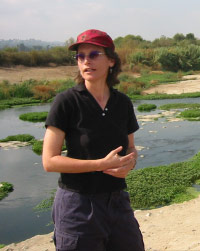 Jenny Price is a nature writer, but unlike most of the species, she insists on writing about nature as it actually exists in our lives. If that means writing about plastic pink flamingos and concrete-bound rivers, well, that’s the nature we see in the 21st century.
Her recently published dissertation from Yale is the remarkably light and witty Flight Maps. On the site L.A. Observed, she has a popular guide to half-secret access routes to the beaches of Malibu. For The Believer, she recently wrote a spectacular essay on the Los Angeles River, and last month published a tribute to the late, great plastic flamingo for The New York Times ($) that concluded: “Rest in peace, my pink plastic friend. It was fun while it lasted.”
She is a Guggenheim fellow whose writing takes chances, and can open minds. For Grist, she graciously consented to an interview via email, which went back and forth for nearly two weeks. Take a look:
Kit Stolz: Last month the Union Products factory that has been making the plastic pink flamingo for nearly fifty years shut down, and the inventor Don Featherstone said he thought his creation would soon become extinct. Can we use that word for something that was never alive in the first place?
Jenny Price: Well, I think it’s more accurate to say it’s stopped reproducing.
The greatest thing about the pink flamingo, I think, is that it’s made of nature. Literally. The plastics and pink dyes are petroleum-based, and the metal legs are made from iron and other ores. The ultimate symbol of anti-nature? It’s nature incarnate. And to me, that’s the object’s ultimate meaning: we have to see the nature in it — and in all the stuff of modern life — because the important, vital question is not whether a plastic bird is nature or not but how, exactly, we use nature to make it. Should we be making plastics that won’t break down — or go extinct — for hundreds of years or more? How can we use nature better — more sustainably, more equitably — to make plastics that are themselves better for human health and ecological systems?
KS: The plastic pink flamingo became famous thanks in large part to interest in Florida, and a desire to decorate lawns. Do you think the new style of development, which often has little or no room for lawns, could be driving the pink plastic flamingo to extinction? Is it a habitat issue? Or a matter of changing tastes?
JP: Why, why, why? Flamingo-lovers certainly have been wringing their hands these past months (I myself am more of a flamingologist, you know, a scholar).
Well, like all objects, the flamingo is a product of a particular time and place. In the 1950s, it arises to meet the desires of new working-class American suburban homeowners — and quickly gets slammed as the epitome of kitsch and bad taste. But the pivotal moment in its history proves to be the late ’60s and ’70s, when the rebel middle-class baby boomers adopt the bird to torment their parents. I mean, in John Waters’s film Pink Flamingos, the heroine has sex with her son, who himself gets it on with a dead chicken, and she eats dog feces and urinates on suburban lawns: Waters’s parents still refuse to see it.
My generation of boomers uses the bird to mark the transgression of every social moré and cultural standard. Gay men adopt it as a mascot, and by the 1980s, the adult boomers are strapping it to backpacks and kayaks, and traveling with it to Europe, and plopping it on birthday and wedding cakes. In other words, after the bird becomes the ultimate marker for transgressing boundaries, the boomers use it just to cross boundaries of every kind — art, taste, nature, sexuality, space, time.
But in the new century, we live in a much more boundary-muddled world. How can this bird be an effective marker, when so many people no longer believe in the boundaries of art and nature that the bird itself is supposed to transgress?
The one boundary that my generation never seriously challenged was the boundary between a pure nature and a corrupted human artifice, but that is finally starting to erode now too. And that’s not a bad thing, since if these kids are going to save the world from our environmental (and other) messes, they’re going to need a more flexible understanding of what nature is.
Of course, if you ask the manufacturer Union Products, they’ll attribute the extinction to the rising cost of plastic resins and electricity. But that’s so short and simple.
KS: Can you detect differences between the attitudes of Boomers, Gen-Xers, and college students today?
JP: I do think the idea of nature as wilderness is still strong, but that the boomers’ children are instinctively more ironic, and — as others such as William Cronon, Michael Pollan, and Richard White have pointed out — irony has been sorely missing from the standard paeans to nature as wild and pure.
KS: Earlier you mentioned “the idea of nature as pure and unchanging.” But aren’t these two separate concepts? After all, nearly all naturalists believe in evolution, which is the embodiment of change.
JP: Ah, but that’s in the longue durée; that’s in geological time. I think the tendency has been to define nature as the antidote to everything that disturbs us about modern life — as pure, quiet, slow, stable, unsullied, unchanging …
KS: I agree with you that the American concept of nature as something pure and apart from our lives is a 19th-century construct overdue for change, but at the same time I know there is still such a thing as wilderness. I talked about this a little with the late David Brower, and he felt that environmentalists and park managers were making a huge mistake in giving up on the transformative power of wilderness. Can environmentalists afford to forget about that?
JP: I am a huge fan of wilderness areas. They are important spiritually. They are unbelievably important ecologically. But when you say that wilderness is where nature mostly is, then you obscure your hugely abundant connections in modern life to the nature you use, the nature you inhabit. And how can you think about how to use nature more sustainably when you don’t see it in the first place?
In fact, the dire necessity for wilderness is one of the most important reasons to see nature as much more — since whether we can preserve wild areas depends absolutely on how sustainably (and equitably) we use nature in the cities and towns that most people inhabit.
KS: In your essay for The Believer, “Thirteen Ways of Seeing Nature in L.A.,” you write that because Angelenos were not able to see the seasonal-but-big L.A. River as a natural feature of the land, they allowed the U.S. Army Corps of Engineers to spend 25 years and 3.5 million barrels of concrete putting it in a concrete straightjacket. Why couldn’t they see it?
JP: Well, at the time Angelenos did see the river, and they begged the Corps to control the river’s floods — though turning the river into a 51-mile storm drain was hardly the only available option. After that, the most common question about L.A.’s major river became: “What’s the L.A. River?”
However — and this is a big however — there are now enormous projects afoot not just to revitalize the river, which is the major artery of the major watershed, but to implement large-scale watershed management throughout this huge urban area. Among the great many American cities to revitalize their rivers, L.A. faces the greatest challenge. Still, the great advantage of having such huge environmental problems is that it forces you to come up with dramatic and often cutting-edge solutions. Which is one reason I love L.A. I mean, it’s easy being an environmentalist in Boulder.
KS: In your essay, you write that “L.A. has long been decried as the Anti-Nature: it’s the American megalopolis with brown air, fouled beaches, pavement to the horizon, and a concrete river. It’s sort of the Death Star to American nature lovers.” But you like to take people out into Los Angeles and show them the nature that is actually there. What do you show them?
JP: You know a great place to think about nature in L.A.? The port — which is the busiest port in the U.S. and fifth in the world. You can watch the indigenous cranes load and unload oil from Alaska, coal from the Rockies, tropical woods from southeast Asia. And it’s on Terminal Island, a 5000-acre manmade landmass where you can also visit two power plants, active oil derricks, and the city’s second largest wastewater reclamation facility. It’s the largest source of air pollution in the U.S. city with the worst air. Terminal Island is an amazing place to ponder energy production, waste management, and the worldwide consumption of natural resources — and the consequences.
I love Zuma Creek, too, which winds up a stunning canyon in the Santa Monica Mountains in Malibu, and I love the tidepools on Broad Beach (also in Malibu). But as a writer, I’ve become more interested in looking at the nature we tend not to see — in our houses, cars, factories, restaurants. I mean, Zuma Creek’s a great wild place to escape from the city. But how do I inhabit nature, too, for better and worse? — and we can never escape from that.
KS: I understand you’ve decided to take on David Geffen and the other folks trying to control the Malibu beach. How is that going?
JP: I write about public beach access in Malibu, since I’m really interested in how equitably — not just sustainably — we inhabit nature in L.A. And access to parks and green space is a huge justice issue here.
Twenty out of 27 miles of the gorgeous Malibu coastline — a quarter of LA County’s beaches! — are gated off by private development. In California, the beach is public to the high tide line, and state law mandates maximum public access. But the folks in Malibu have long treated, signed, and even guarded these beaches as private.
The good news is that the state Coastal Commission and the nonprofit Access For All are now pushing to open these beaches up, and with surprising success.
I’m writing a guide to these beaches — a kind of owner’s manual for public owners — at the online journal L.A. Observed. And for an arts show a few years ago, my friend David Kipen and I constructed “28 Private Property Signs for a Public Beach,” which offered the homeowners suggestions to make their illegal “private beach” signs more accurate or at least more creative — from “our tax shelters at work” to “if you donate millions to good causes in L.A., you deserve to have a beach” to “if we’d let anybody walk here, it’d be you” to “endangered fatcat habitat.”
KS: You talk about how ecologists, policy wonks, landscape architects, urban planners, and countless others have been paying attention to urban nature in L.A. as they work to restore the L.A. River … but not nature writers. Why not?
JP: For all the talk of green cities and sustainability — such a red-hot topic now — I think most people, even the environmentally minded, don’t really truly actually think of cities as places of nature. Nine times out of 10, when I tell friends, family, and people at parties that I write about nature in L.A., the question I get is, “Is there nature in L.A.?” — and people are only being half-facetious. American nature writing, I think, has generally strongly encouraged this way of thinking — it’s been allergic to cities. You know how many nature writers there are among the 10 million people in L.A.? Four, I think.
As a consequence, the ecologists and planners and policy wonks I know here often don’t or actively won’t read it. And that disturbs me, because the vital groundbreaking environmental work that goes on here is mostly bereft of a poetry, an aesthetics, an imaginative literature that can show us how we live in nature, and that can nurture a sense of attachment and a spirit of place.
KS: It’s absolutely true that we’re seeing change and restoration in Southern California, in the L.A. River restoration, in the Owens Valley River restoration, in the return of the gnatcatcher (once feared extinct) to the Palos Verdes coast, and the dismantling of Matilija Dam. Have we become so habituated to stories of natural destruction and devastation that we are unable to recognize good news when we see it?
JP: Well, I think we do see the good news — but at the same time, we’re blinded a bit by the idea that we’ve destroyed nature. We haven’t destroyed nature in L.A., we’ve just treated it exceptionally badly.
Of course, the first step to grappling with how to live in nature better is to see that you haven’t destroyed it — and the L.A. River is a perfect example of that. It’s a river, it’s always been a river, however degraded — and its revitalization now promises great things for this city — but one of the greatest struggles in building public support is to convince people that the river still exists — that it has been degraded, but not destroyed.
KS: In your essay, you take a shot at Bill McKibben for his book The End of Nature, saying this idea “makes as much sense as declaring an end to rocks or air or water …” But although literally you’re correct, in his 1989 book, McKibben argues that nature as an idea apart from us is now much less important than it was in the 19th century, and may actually be extinct. The central example he cites is global warming. He’s talking about how humanity now dominates wild nature; you’re talking about how nature persists in our lives, even when it’s not the wild nature of the 19th century. Aren’t you really looking at two sides of the same coin?
JP: Well, let’s say we’re concerned about many of the same problems. I admire McKibben deeply; he’s been such an amazing advocate. But in End of Nature, he mourns for the idea of nature as a separate realm, and that’s exactly the idea I’ve been arguing should go extinct! I’d like to see us define nature not as something people destroy, but as something we inhabit poorly or well.
So “what is nature?” and “where is nature?” and “is there any nature left?” just aren’t the right questions. The truly useful questions are “what nature is it, exactly?” And how do we use nature? How do we change nature? How does nature react? How do we react back? How do we imagine nature? Who uses and changes and imagines nature? And most important: how sustainably, how fairly, and how well?
KS: And finally … how important is nature writing? Is it possible that photographers (such as Ansel Adams and Edward Weston) tell nature stories more effectively than writers? (I ask because John Muir himself, although usually considered a great nature writer, actually preferred photographs to writing when it came to exposing people to nature.) And I wonder if nature writers — with exceptions, such as yourself, and Edward Abbey — are actually trailing after photographers, trying to duplicate their power, instead of forging out on their own.
JP: No, no, not possible! Well, maybe I have to say that, since I rely on the written word to pay my rent, but I believe passionately in the power of literature to help us see and imagine the world around us. Michael Pollan, Robert Sullivan, Rebecca Solnit, Charles Siebert: I couldn’t ask for more powerful writers to show us the nature of things. As for photographers, to me the most powerful ones right now are the many whose pictures ask us to question the boundary between the natural and human worlds.