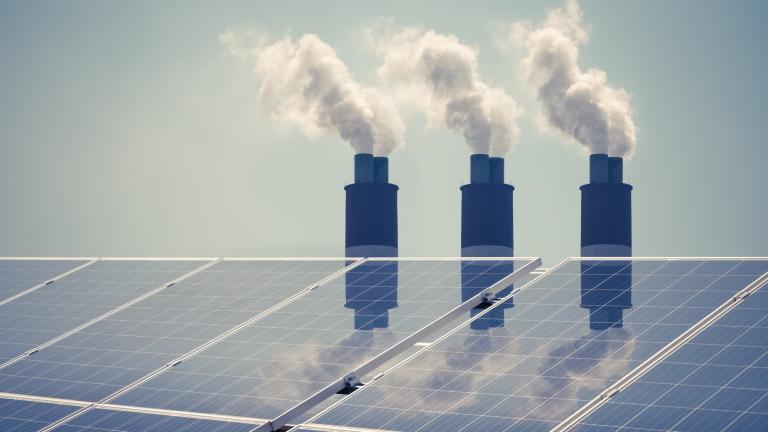
Comparisons of electricity generation costs from various sources are a ubiquitous feature of energy discussions. Virtually everyone accepts as fact that coal is the cheapest source of electricity, that natural gas is the next cheapest, that solar PV is the most expensive, that wind is competitive in some states and not others, etc. Sometimes the specific numbers that support these comparisons are contested; cents-per-kilowatt-hour are adjusted up or down by a few cents here and there. What is rarely if ever questioned is the underlying assumption that objective cost comparisons are possible when it comes to varieties of electricity generation.
These comparisons have always rubbed me the wrong way. Intuitively, their purported objectivity has always struck me as a veneer covering dozens of contestable and sometimes arbitrary assumptions. Worse, they’re often used as rhetorical bludgeons to shut down discussion, substituting economics for what are essentially political, even moral, decisions.
However, I’m not smart enough, and don’t know the electrical industry well enough, to mount a decent argument to that effect. Imagine my delight, then, when I stumbled across someone who is smart enough, and who knows the industry like the back of his hand, making the case for me. He is energy guru Walt Patterson, and the argument is made in his latest book Keeping the Lights On: Towards Sustainable Electricity. (It’s fairly dry, and some parts make by brain hurt, but it will change the way you think about electricity in particular and energy in general.)
In a nutshell, his argument is this: "As far as comparative costs are concerned, the choice of generation is political, not economic." He supports that thesis with the following points:
- The cost of a given generator’s electricity depends on the entire electricity system — other generators, the grid, and loads. Under such conditions of "continually shifting non-linearity," the unit-cost of electricity from the generator is constantly shifting. Further, it shifts in different ways and at different speeds and scales for different types of generators. This makes comparison across generation types "egregiously tendentious."
- Traditional electricity cost estimates are based on "engineering economics rather than financial economics" — that is to say, they take no account of risk over the life of the generator, including shifting fuel prices and fuel taxes (and, I would add, regulations). Different generators have different risk profiles that can dramatically affect costs over time.
- The costs of so-called "externalities" — social and environmental costs not borne by generators themselves — are to a large degree arbitrary and unquantifiable. Decisions on how to account for externalities are driven by politics, not science.
Under the fold is a longish passage wherein Patterson makes the case in more detail. It’s from Chapter Six: "Generating Change" (a working version of the chapter is available as a PDF; I’ve added some links and emphases). I hope everyone will read it.
—–
In an interconnected electricity system, not only the revenues but also the costs of a particular generator depend to a significant extent on the rest of the system and how it operates. To give but one obvious example: if the system load and other generation make a given steam-cycle unit operate at below maximum capacity — as is often the case — the unit’s fuel-efficiency falls, and its output therefore costs more per unit. Against this background of continually shifting non-linearity, the common practice of stating the ‘cost’ of a unit of electricity as ‘2.7 cents per kWh’ or some similar figure is frankly indefensible. It becomes yet more so when such numbers, stated even to three significant figures, are used to advocate or justify choosing to invest in a particular generator technology or design as against others claimed to produce ‘more expensive’ electricity. The practice was disreputable even when the choice lay between otherwise similar technologies, as for example between types of coal-fired or nuclear generation. When the choice is between technologies so fundamentally different, say, as gas-fired combined cycles and photovoltaics, the use of such purported cost comparisons becomes egregiously tendentious.
In any case, moreover, recent studies suggest that traditional techniques of estimating the anticipated cost of electricity from a proposed generator may be inherently and seriously flawed. In 2002 Shimon Awerbuch, at the time a senior advisor in the Renewable Energy Unit of the International Energy Agency, produced a draft report called Estimating Electricity Costs and Prices: The Effects of Market Risk and Taxes. The report demonstrated just how untrustworthy such estimates can be. The thesis was straightforward, if complex to demonstrate. It declared that the traditional approach to estimating the cost of electricity from a particular generator is based on engineering economics rather than financial economics. Engineering economics fails to apply a premium to account for the risk that over the life of the generator fuel prices and fuel taxes may vary from those used to estimate the cost of electricity. So long as alternative generating options have broadly similar risks, and those risks move in the same direction with contingencies, the effect on choice of generating technology may be modest to trivial. However, between technologies with dramatically different risk profiles, failure to account for risk may drastically skew the comparison of costs.
Consider, for instance, comparing fuel-based generation with non-biomass renewable generation — say, a gas-fired combined cycle station with a wind farm. An investor trying to choose between putting money into one or the other will be aware that the price of natural gas may rise unpredictably during the operating life of the combined-cycle station. The investor will therefore require a higher return, to compensate for the risk that the station output may not be as profitable as anticipated. That in turn will increase the cost of generating a unit of electricity. For the wind farm, however, no such fuel-price risk arises. Apart from small and predictable running costs for maintenance, the entire cost of the wind farm is the initial capital investment, known at the outset and unvarying over the operating life of the wind farm. Using well-established techniques of financial analysis demonstrates that adding renewable generation free of fuel-price risk to a generating portfolio otherwise based on fossil fuels reduces the risk for an equivalent return, or alternatively increases the return for the same risk.
Again, an increase in fossil fuel prices appears to be strongly correlated with a downturn in overall economic activity, reducing demand for electricity and aggravating the problem of higher electricity cost. Renewables, however, whose costs are mainly servicing capital charges, may actually benefit from the economic downturn, if interest rates fall. Adding renewables thus diversifies the portfolio and reinforces its robustness against unwelcome surprises. The prevailing assumption is that official support for renewables, especially in Europe, is making electricity more expensive. The financial reality, however, may well be that adding renewables free of fuel-price risk should reduce the overall investment cost of generation on systems. Developing and extending this ground-breaking comparative analysis of generating options, refining and sharpening estimates of comparative cost in this way could have striking consequences for the technology choices that drive the evolution of electricity systems.
Other aspects of comparative generating cost are likewise controversial. For instance, environmental impacts associated with different forms of generation have been called ‘externalities’ because their putative costs are borne not by the generator but by the environment within which it operates — the air, the land, the water, and by extension the other people who use the same environment. The decision as to whether and how to account for such externalities has a dramatic effect on the cost, operability and profitability of individual generating plant. Over the years analysts, planners, legislators and regulators have tried to quantify these externalities, and incorporate some suitable numerical and financial measure into the costs attributed to generators. The judgements are necessarily arbitrary; some consider them invidious. Comparative quantification, perhaps in cents or pence per unit, of the different environmental impacts of, say, coal-fired, nuclear or wind-powered generation is ultimately political, not scientific. …
All in all, what with assorted, perverse and often enormous subsidies to fossil fuels and nuclear power, and more modest but more visible subsidies for renewables; with inadequate accounting for risks; and with arbitrary and distorted provisions for externalities, only one conclusion can be drawn. As far as comparative costs are concerned, the choice of generation is political, not economic. Electricity costs stated as so many cents or pence per kilowatt-hour are just window-dressing after the fact, an artefact of prior decisions otherwise concealed. The same applies to the other original nineteenth-century criteria for choice of generation. Size and location are profoundly affected by politics, especially planning constraints on siting and operation. So is connection to networks … Once we acknowledge that the choice of generating technology, including its type, size, location and network connection, is fundamentally political, electricity policy takes on a significantly different flavour.