Support Grist
Support nonprofit, independent environmental journalism.
Donate to Grist.
Muckraker

Even Stevens?

With new energy-focused bills, Stevens delights enviros and Obama disappoints

By Amanda Griscom Little
12 Jan 2007
Tools: print | email | discuss | write to the editor | subscribe | RSS
Among the barrage of energy-related bills already unleashed by the 110th Congress, one of the most progressive comes not from the newly empowered Democrats, but from Republican Sen. Ted Stevens of Alaska, a zealous proponent of drilling in the Arctic National Wildlife Refuge. Just as peculiar, one of the bills that most rankles environmentalists comes from Democratic golden boy Barack Obama, the junior senator from Illinois.

Stevens flabbergasted many on Capitol Hill last week when he introduced legislation that would require passenger cars sold in the U.S. to get an average of 40 miles per gallon within a decade -- a 12.5 mpg increase from today's standards.

Enviros could quibble with the particulars -- the bill ignores SUVs and other light trucks, doesn't move as quickly as many would like, and includes a caveat that would let automakers off the hook if the costs of fuel-economy upgrades were determined to outweigh the benefits -- but actually they're just happy that a prominent Republican is joining the battle to raise Corporate Average Fuel Economy standards.

The importance of the Stevens bill "isn't in the details," says the Sierra Club's Dan Becker. "The importance is that an extremely conservative Republican and longtime opponent of CAFE has come out with a fairly decent and very interesting fuel-economy bill. His turnaround on this issue is a profound signal of change -- on par with Nixon going to China." Becker says he heard from Capitol Hill staffers that Stevens introduced the bill because he's worried that his home state is melting.

"By increasing fuel efficiency, we will reduce greenhouse gases," Stevens said in introducing his bill -- not a radical statement by most standards, but a startling one coming from a senator who, as recently as last year, was considered one of the most influential and dogged climate-change skeptics in Congress. "Sen. Stevens is for energy independence and he's for reducing [greenhouse-gas] emissions," said his spokesperson Joe Brenckle. "He sees this as part of a holistic vision that will serve both goals."

Barack in a Hard Place


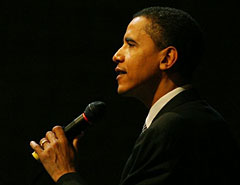
Barack Obama.
Barack Obama.
Photo: David Katz
On Jan. 4, the same day Stevens introduced his fuel-economy bill, Obama joined with Kentucky Republican Jim Bunning to introduce the "Coal-to-Liquid Fuel Promotion Act of 2007." Coal-to-liquid (CTL) technology uses a highly energy-intensive process to convert coal into diesel fuel for cars or jet fuel for airplanes -- an appealing prospect to the coal industry in Obama's home state of Illinois, but not to enviros and others concerned about global warming. Obama, who got a 100 percent approval rating from the League of Conservation Voters for his environmental voting record in the Senate last year, is now getting grumbles from greens and thumpings from the press for backing the dirtiest of all fossil fuels.

The Bunning-Obama bill, which would expand tax incentives for CTL and help jumpstart the industry with public-private partnerships, was first introduced by the senators in spring of last year. Back then, it didn't get traction in either the Senate or the media, but now that Obama is publicly toying with the idea of a presidential campaign, the proposal is getting real attention -- much of it unwanted.

"[The CTL bill] raises the strong possibility of increasing global-warming pollution," says Frank O'Donnell, executive director of Clean Air Watch, a D.C.-based watchdog group. "Obama may be a climate crusader, but in this case he's marching in the wrong direction."

Obama's office seems taken aback by the criticism from the enviro community. They're responding by stressing the national-security advantages of using homegrown coal to power the nation's transportation sector, and talking hopefully about the possibility of making CTL greener. Says Obama spokesperson Tommy Vietor, "Sen. Obama believes investing in coal technologies is an important part of weaning the United States off foreign oil. He also believes that through investment and innovation, we can make these technologies cleaner." Vietor pointed to ongoing research into sequestering the carbon released by coal gasification and suggested that similar strides could be made with the coal-liquefaction process.

Environmental advocates aren't so optimistic. David Doniger, policy director of the Natural Resources Defense Council's Climate Center, has supported coal gasification as a viable alternative to coal-burning power plants, but explains that CTL is not as promising an alternative to conventional gasoline or biofuels. "Coal-to-liquid is, in the best-case scenario, no worse for the climate than oil-derived gasoline -- and no better," he says. The best-case scenario assumes that CTL producers find a way to capture their carbon emissions. Problem is, none of the current CTL projects actually involve carbon capture. Without that step, the climate impacts of CTL fuel are far worse than those of gasoline. According to an NRDC analysis, a 35-mpg car powered by the CTL fuel that's currently available would generate as much carbon dioxide pollution as a far less efficient 19-mpg car that runs on conventional gasoline.

Enviros have been nudging Obama in recent months to retract his support for CTL technology, to no avail.

Vietor told Muckraker that Obama "is very concerned about the role carbon emissions play in global climate change, which is why he has been such a strong supporter of increasing the use of biofuels like ethanol and raising fuel-economy standards that would eventually save us 4.3 million barrels of oil a day and reduce global-warming pollution by 760 million metric tons of greenhouse gases." Vietor added that Obama supports a cap-and-trade program for greenhouse-gas emissions as part of a federal strategy to fight climate change, and that the CTL industry would have to operate within that framework.

Green reactions to Stevens' and Obama's bills reveal a tension between energy security and environmental protection that's likely to escalate in coming months and years. As NRDC's Doniger says, "There are solutions to global warming that are also solutions to energy security, but there are solutions to energy security that go backwards environmentally, that make global warming worse."

Environmentalists want energy legislation that attacks both of these big problems, rather than one at the expense of the other. As strange as it seems -- and it seems deeply, deeply strange -- Ted Stevens has got a better start on this in the new congressional session than many of his Democratic counterparts.
Tools: print | email | discuss | write to the editor | subscribe | RSS

Muck it up: We welcome rumors, whistleblowing, classified documents, or other useful tips on environmental policies, Beltway shenanigans, and the people behind them. Please send 'em to muckraker@grist.org.
Amanda Griscom Little writes Grist's Muckraker column on environmental politics and policy and interviews green luminaries for the magazine. Her articles on energy and the environment have also appeared in publications ranging from Rolling Stone to The New York Times Magazine.
< Previous | Next >
Comments: (14 comments)

You are not logged in. Thus, you cannot post a comment. If you have a Gristmill account, log in below. If you don't have a Gristmill account, well, by all means go make one! Meet you back here in five.

Username: Password:

Forgot your password? Enter your username and click:

Push back!

Where's Moveon getting a zillion people to tell Obama that this is a dumb idea?  Or our friends in the big green organizations?  This is an important time to make sure that Obama's walk is as good as his talk.  Everybody likes him, but if we want to keep liking him when he's running for president, then we'd better make sure that he doesn't think our votes are automatic.

In other words, I think that putting the pressure on right now is at least as important as it is later as the spotlight on him gets even brighter.  It gives him (A) and idea that "dirty hippies" don't automatically think he's god (even if most things he says do make us swoon) and (B) it does this while he still has the chance to change his position without be a flip-flopper.

Don't wait until this idea gets a lot of airtime to point out that it's a problem.  Let's nip it in the bud.

Stevens and Obama

Senator Stevens makes some sense but then makes a major error.  I agree with him that drilling in ANWAR makes sense if we can do it with minimum damage to the environment.  I take issue with his plan to increase millage efficiency standars for "passenger cars" while ignoring SUVs, minivans, and light trucks.  The latter is where most gasoline is used.  New CAFE standards must be enacted for ALL light vehicles.

Senator Obama's support for coal liquefaction is legitimate as long as the tedhniques used sequester the CO2 emmisions and do not use large quantities of petroleum in the process.  And this is doable.  The latest methods being considered today do take these things into consideration.  And coal is the U.S. main energy resource we have.  We should utilize it as much as we can.

Begging the question, Paul

And coal is the U.S. main energy resource we have.  We should utilize it as much as we can.

The unstated premise behind this conclusion is that because it's abundant, it will be cheap. But if it turns out that liquefaction coupled with sequestration gives you fuel that's much more expensive that equivalent amounts of renewable power, well, we shouldn't utilize it, should we? We should get the best bang for our buck.

That's what liquefaction and gasification supporters don't seem willing to own up to: if those processes are made environmentally benign, they will thereby be made incredibly expensive. So why bother? Why not use the time and money where they can produce more effect?

grist.org

Coal gasification (IGCC) is no panacea

There is nothing clean about coal.  Coal gasification has been around and has left its legacy - google "coal gasification" and "water contamination" and look at all the hazardous waste sites in Iowa, look at the record of the Beulah Synfuels plant in North Dakota.

I represent landowners next to the proposed site for Excelsior's Mesaba Project.  Just google Excelsior and coal gasification.  This 600MW plant will cost at least $2,155,680,783, or $3,593/kW, and that does NOT include capture and sequestration.  Capture and sequestration ISN'T being done generally other than in testing, and isn't required for Mesaba -- it's not commercial ready.  Capture alone will cost at least 25% in efficiency (600MW plant is instantly 450MW), plus capital costs for retrofit, hundreds of millions.  The first 30% of capture is easy with IGCC, but to get upto 90%, it's very pricy.  And that's just to the plant gate.  Then add $60k/in/mi for pipeline (600 miles to potential site from Taconite, MN), pressurization stations because it's over 2,000 psi, and then costs of sequestration, IF you can find a site, at $3-10/ton (Mesaba is 616/hr, or 5.4 million tons annually).  Mesaba's emissions profile is very close to SCPC.  Water use is 6,500 gpm, and the Wabash River plant on which it is based "routinely" violated the water permit for cyanide, arsenic, and selenium.  Oh, great...

Don't be suprised that Obama supports it though, because the Joyce Foundation HQ is there, and it's funding a surprising cadre of organizations to PROMOTE coal gasification, like the Clean Air Task Force ($787k) and the mentioned National Resources Defense Council ($400k+), Clean Wisconsin ($750k), Great Plains Institute ($437k), and othesr.  They're spending millions.  But these organizations are operating with information that is way off, and need to do some investigation before they ruin their good names on this boondoggle.  As does Obama.  Support of coal gasification is a political quagmire, as our Gov. Pawlenty is finding out.

Up to date information on IGCC & coal gasification can be found at mncoalgasplant.com and the Citizens Against the Mesaba Project at www.camp-site.info.  

Short version: It's twice the price of other generation before you even start capture, much less sequestration.  Sequestration is not happening.  Water use is high, and system must be zero liquid discharge.  Coal price is fluctuating (tripled in price December 2005, has gone down some) and transportation is iffy.  

Bottom line: DOn't get diverted -- keep doing the hard work of piecing together renewables, conservation and efficiency.  IGCC is no panacea.

Carol Overland
Attorney for mncoalgasplant.com
legalectric.org

Carol,

thanks very much for stopping by. It reinforces all my impressions and puts some numbers on them. Well done.

grist.org
Huh?

I am SO disappointed in Obama. I was really hoping that he was going to be different. That he would stand up to the special interests and not get into bed with them. I guess I hoped for too much. Maybe I should just accept that politicians are politicians and they're all the same. *sigh*

Coal is not the largest energy source.

Solar is our largest energy source, then wind.  Coal is a distant third in size and we do not have a climate for burning coal.


What would happen if...

tomorrow, we suddenly had unlimited solar power, (enough to supply even Las Vegas...LOL)? What would be the short term and longterm environmental and economic impacts of unleashing nearly "free power" to the world? (This is of course assuming that the world powers would make the technology available to all countries not on the UN's sh*t list.)

Scenic pics at http://Lhfotoware.blogspot.com
Why a carbon tax is a good thing

This juxtaposition of reports that Ted Stevens is doing (some of) the right things and that Barack Obama is doing (some of) the wrong things does a lot to show why a carbon tax is the way to all of the (actually positive) goals their bills are meant to accomplish: Energy independence; cleaner air; fewer emissions of greenhouse pollutants; greater use of renewables; etc.  The tax need not be so large at the outset, so long as it's recognized that the tax itself (per tonne of carbon emitted as opposed to captured) must grow, and probably exponentially, in order to produce these results.  At its inception, though, the proceeds must be devoted to research on improving the technology.  Without this devotion, it will be insufficient to the task.

Flattening of Appalachia

Global warming and climate change aside, promoting the use of coal will have other particularly devasating implications...namely an encouragement of a coal extraction process that goes by the name of mountaintop removal.  This increasingly used method has resulted in the destruction of over a million acres of land in Appalachia (W.V. and K.Y. particularly) and wrought havoc on the livelihoods and culture of the people there.   Bringing the war from the Middle East to exclusively our country is not the answer.  Stopping our wars altogether and embracing non-extractive industries are.

See www.ohvec.org or http://www.ilovemountains.org/ for more information.

even stevens

Why are we spending all this effort on developing new fuels for 200+ year old technology? The internal combustion engine is a relic. If anything, we should be processing waste materials, like restaurant fats, chickens parts, etc. into "crude" until we come up with energy sources that are sustainable and non-polluting. Taking one fossil fuel and turning it into another form doesn't reduce it's terrible impact on the planet.

Obama has bad energy advisors

He has also jumped on the ethanol bandwagon, which will go nowhere.

Given that energy will be an important topic in 2008, his Republican and Democratic challengers will be able to tear him apart on this issue.  Get a clue, guy!

The safe strategy would be:

  1. Encourage PHEVs
  2. Encourage more Renewable Energy (RE) deployment (solar, wind)
  3. Encourage PHEV grid connect to offset transient energy loads by RE.


Build plugin hybrids that run on renewable methane. That's all that's needed.
Cars, SUVs, light trucks

  Oh PLEEZE........why are there separate catagories for the vehicles ????? Whatever "THE REASON" it cannot be good enough.
   We are Americans........We are smart .......We are inventive..........Lets demand that these problems be solved........for all these vehicles, utilities etc. Go solar. Go wind. Whatever it takes.
  Call for all large industries, corporations,etc to take heed and make them pay with their profits if they do not comply with what has to be done. Don' let them simply pass the cost on to the consumer. It is oh so much fun and so easy to sit on your laurels and collect profits beyond belief and "fiddle while Rome burns".
  Well, we ALL live here. Call them to responsibility.

Even Stevens???

I am very surprised that Dan Becker of the Sierra Club would make the suggestion that the DETAILS of the Stevens bill are not important.  I would very much beg to differ with him.  I have a funny feeling that the bill is a gesture with more bogus intentions behind it than my brain could want to imagine.  One would be that Uncle Teddy might think that sponsoring such a soft and cuddly bill will help his Oil Barron buds in the long run.  Staving off any REAL legislation that would actually have some teeth to it.  Please don't be gullible Mr. Becker.  This is another bait and switch tactic of the current administration, of which Ted Stevens is a hard-core, card-carrying member!

true blue bean

You are not logged in. Thus, you cannot post a comment. If you have a Gristmill account, log in below. If you don't have a Gristmill account, well, by all means go make one! Meet you back here in five.

Username: Password:

Forgot your password? Enter your username and click:

The comments of Grist users reflect the opinions of those individuals only, and do not necessarily reflect the viewpoints of Grist, its staff, its board members, their psychotherapists, or their aestheticians. Got it?


Also in Grist

The Week's Most Popular


From the Archives
A Little of This, a Little of That, by Amanda Griscom Little. Congress gives parting nod to offshore drillers, but also to renewable-energy industries.
Dingell All the Way, by Amanda Griscom Little. Dingell and other Democrats plan oversight hearings on environmental issues.
A Capitol Idea, by Amanda Griscom Little. How green will the 110th Congress be?

ADVERTISING POLICY


About Grist | Support Grist | Jobs Board | Archives | Grist by Email | RSS | Podcasts
Gristmill Blog | In the News | Ask Umbra | Muckraker | Victual Reality | 'Tis the Season | The Grist List | The Bottom Line


Grist: Environmental News and Commentary
a beacon in the smog (tm) ©2007. Grist Magazine, Inc. All rights reserved. Gloom and doom with a sense of humor®.
Webmaster | Privacy Policy | Terms of Service | Trademarks