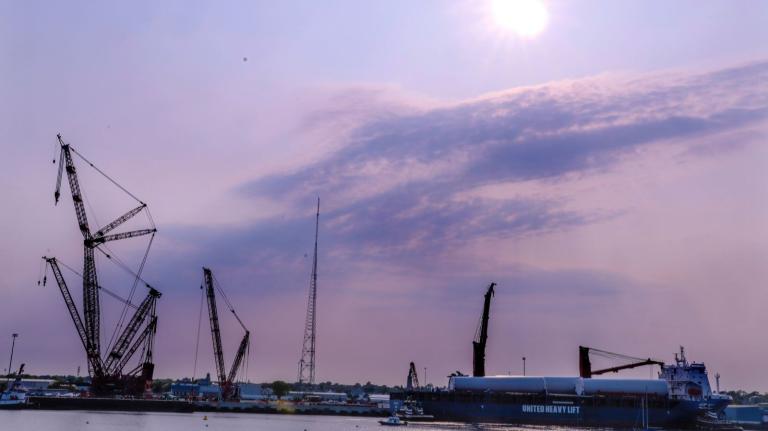
What are the enviro impacts of a construction project on the U.S.-Mexico border?
Photo: U.S. Army Corps of Engineers.
The Bush administration has proposed yet another list of environmental sacrifices that it believes America should make for the War on Terror.
Last year, President Bush pushed through legislation that exempts military training bases from cornerstone environmental protections mandated by the Endangered Species Act and Marine Mammal Protection Act, in the name of “military readiness.” Despite howls of protest from the environmental community and government officials alike — the unprecedented, sweeping wartime request was unaccompanied by any evidence that America’s military strength is at odds with environmental protection — the Department of Defense insisted on the rollbacks and got much of what it asked for.
Now the Bush administration may be weeks from implementing more environmental exemptions for the sake of “national security,” which critics find equally preposterous. The Department of Homeland Security has proposed a directive [PDF] that would enable a raft of agencies under its domain — including the Federal Emergency Management Agency, Coast Guard, Border Patrol, and more than a dozen others — to eschew environmental reviews and assessments of their operations, as required by the National Environmental Policy Act, if agency officials feel such reviews are impinging on their efficacy. The directive, which does not require congressional approval, would also allow the agencies to conceal information they consider sensitive from a national-security standpoint.
Enviros are aghast, of course. A whole conflux of groups — including Defenders of Wildlife, Natural Resources Defense Council, Audubon Society, and Ocean Conservancy — have submitted exhaustive comments criticizing the proposal for its potential impact on the environment and public health. Members of the public can also submit comments on the draft directive through Aug. 16. (Fax to 202.772.9749.)
“What they’ve proposed is outrageous,” said Sharon Buccino, a senior attorney at NRDC, “not just from the point of view of exploiting the issue of national security to bend the [environmental] rules, but because it inhibits Americans’ democratic right to the freedom of information — in this case, information that the American public could use to protect itself from potentially considerable health risks.”
NEPA requires federal agencies to evaluate and disclose the possible environmental and public-health impacts of their operations, and to give the public an opportunity to weigh in. While there is not one standard formula for implementing NEPA — each federal agency develops environmental review processes tailored to its own activities, exempting certain provisions when appropriate — critics say that the DHS has done such a radical tailoring job that it has effectively ripped the requirements to shreds.
“The environmental community isn’t opposed to agencies developing their own NEPA procedures that include certain exemptions,” said Buccino. “The problem here is that it’s being abused to include wide-ranging activities that can significantly harm the environment and public health.”
DHS argues that the proposed exemptions will have no significant environmental impact, and are necessary to save time and paperwork and improve the efficiency of an agency that has more important things to worry about.
“Why should we keep having to prepare environmental assessments for operations that clearly have no adverse environmental impacts?” a top DHS official told Muckraker on condition of anonymity. “Our agencies have done these reviews over and over again, only to arrive at the same conclusion — that the environmental impacts of these activities are insignificant. Why create the needless paperwork? It wastes time and resources.” Streamlining this process improves the efficacy of the DHS, said the official, “because we don’t have to be expending those resources … and can put them toward the goal of national security.”
Lest the DHS be seen as crying “excessive paperwork” as a way to shirk federal environmental law, spokesperson Valerie Smith was quick to assure Muckraker that the agency “is serious about environmental stewardship,” adding this proviso: “We need to strike a balance with the agility required for our homeland-security mission and the genuine responsibility to take environmental impact into consideration.”
But take a look at the sorts of activities the DHS considers worthy of exclusion from NEPA and you’ll find they have as little to do with national security as Iraq had to do with 9/11.
Will logging stop the terrorists?
Photo: BLM.
For instance, the directive would permit logging of live trees on up to 70 acres and salvage logging projects on up to 250 acres on DHS-controlled lands without so much as a page of environmental review. Similarly, the Border Patrol would be allowed to build roads through national forests with zero public input if DHS decides the projects must be classified for national-security reasons.
The directive would grant a categorical exclusion from NEPA reviews for the use of pesticides on all “buildings, roads, airfields, grounds, equipment, and other facilities” under DHS jurisdiction. And Homeland Security agencies across the board would be exempted from environmental reviews for dredging and repair activity within waterways and wetlands under their control.
There’s also a proposed exemption for DHS agencies from NEPA reviews of their hazardous and non-hazardous waste disposal. While Homeland Security officials insist that their agencies would still have to qualify for permits at designated landfills or disposal facilities, enviros say that the permitting process is hardly environmentally rigorous, and does not necessarily take into account the impact on surrounding communities or allow those communities to have a say about whether the waste should be dumped in their backyards.
Will concealing pipeline info make us safer?
Photo: U.S. Army Corps of Engineers.
The directive would also allow the DHS to work with the Department of Energy on plans to build new natural-gas pipelines in the U.S. and keep those projects classified if they deem it necessary for the sake of national security. Communities located near proposed pipelines might have no knowledge of the disproportionate security risk they face, nor any opportunity to give feedback. (In a separate but similar rollback last week, the Nuclear Regulatory Commission announced that the nation’s 103 nuclear power plants will no longer be required to reveal security snafus discovered on their premises, lest terrorists get ahold of the information.)
“The DHS directive raises major questions about the fine line between protecting national security and jeopardizing public and environmental safety,” said Brian Segee, associate counsel for Defenders of Wildlife, adding that the Bush administration is using fear tactics to roll back protections purely for the sake of cutting corners. “We’re all for expediency and keeping secrets when it’s necessary, but if our government refuses to tell us that there is hazardous waste in our backyard, or that environmental damage is occurring on our public lands, are we truly safer as a nation?”
Is FEMA really hampered by having to properly dispose of its trash? Does the Border Patrol really need to be able to secretly blaze roads through national forests for the sake of our security? Will we be safer if the feds log more trees or spray more pesticides? Is any of this really going to prevent terrorist attacks on America?
Not likely, enviros say.