Support Grist
Support nonprofit, independent environmental journalism.
Donate to Grist.
Fill 'er Up: A Grist special series on biofuels
Main Dish

Miles to Go

An interview with Missouri farmer and ethanol co-op member Brian Miles

By Yolanda Crous
13 Dec 2006
Tools: print | email | discuss | write to the editor | subscribe | RSS
Cultivating change?
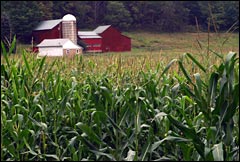
Photo: iStockphoto
Like his father, grandfather, and great-grandfather before him, Brian Miles spends his days working the family farm. Unlike his forebears, however, he also sits on the board of Mid-Missouri Energy, a farmer-owned ethanol cooperative in Malta Bend, Mo. Grist talked to Miles about the present ethanol boom, the potential for an ethanol bust, and the many splendors of fresh corn on the cob.


question How did you get involved in the ethanol biz?

answer Our state corn growers association had a meeting a few years ago, because they had isolated this area as a good spot for an ethanol plant. The economics were a little different back then than they are now. It wasn't as tried and true. There were probably 250 people that showed up. Anybody that was interested in helping to get the thing going and put in a time commitment could sign a sheet. We were crazy enough to volunteer.

question Why was starting an ethanol cooperative important to you?

answer There are a lot of articles that say, oh, ethanol will never work; it will never be the solution. Well, they're right. It's never going to be 100 percent of the solution. But it's certainly a piece of the puzzle. And if we get enough of those kinds of pieces, then maybe we won't have as many people blowing us up. [Laughs.]

The core reason most of us volunteered to do it is to help the price of corn locally and internationally. And the second reason is that our community of 13,000 has probably been around 13,000 for the past 30 to 40 years. We knew that we needed economic development. We're just far enough away from Kansas City, and St. Louis, and even Columbia that it's tough to commute. We knew this would provide at least 34 jobs early on -- and really good paying jobs, with good insurance and good benefits for families.

question It seems like everyone is jumping on the ethanol bandwagon right now. I know other companies have approached Mid-Missouri about buying you out. What do you think is the future of Mid-Missouri?

answer [The head of Mid-Missouri's board] jokes that sometimes it's harder to manage prosperity than the other way around. It's been a great run. Now that things have started, we're a little concerned that the industry could be overbuilt. But there's also a possibility that demand can keep up with supply. I guess $3 [per gallon] fuel taught us one thing, myself included: we're probably not going to slow down our lifestyle by that much, at least at that price.

question What has the ethanol plant meant for the average farmer or investor?

answer It's really been nice. We really don't hear any negative comments. The return on investment has been a huge bonus. That's been a really nice surprise, how high it's been. But it's been a great market. No matter what people say, we have a lot of corn out here in the country and we've needed a place to turn it into something good.

question There have been some studies that ethanol takes more energy to produce than it supplies. What's your take? What do you use to power your plant?

Fill er Up
An introduction to Grist's special series on biofuels.
Can My Car Do That? Find out which cars can run on ethanol and biodiesel.
The Big Three. The numbers behind ethanol, cellulosic ethanol, and biodiesel in the U.S.
What About the Land? A look at the impacts of biofuels production, in the U.S. and the world.
Give Green, Go Yellow. How cash and corporate pressure pushed ethanol to the fore.
More articles on biofuels.
answer What we use to power our plant is electricity and natural gas. As far as the net energy gain, the reason they love that, is that it's good press. There's a 30 to 40 percent gain there, and it's continuing to get better at a steady rate.

question Are you taking any measures to make your plant more efficient? Any new technology?

answer A lot of plant managers talk to other plant managers. It's not a them-versus-us scenario. A lot of these technologies are really new, and a lot of them I can't even discuss because there's a confidentiality clause.

question So what kind of car do you drive?

answer We have a pickup that's E85 [compatible]. My wife drives -- if you can believe it -- a foreign vehicle. We burn the 10 percent in there. [Editor's note: See "Can My Car Do That?"]

question All right, I've got to ask: What's your favorite corn dish?

answer This will be a strange answer, but my honest-to-gosh favorite is corn on the cob -- but that's only at certain times of the year. Beyond that, one way that I really do like corn is in chicken pot pies. My wife and my sister make it. We like to really lay on the sweet corn in there. And that's probably my favorite.


Tools: print | email | discuss | write to the editor | subscribe | RSS
Yolanda Crous is a Grist contributing writer based in Santa Barbara, Calif.
< Previous | Next >
Comments: (3 comments)

You are not logged in. Thus, you cannot post a comment. If you have a Gristmill account, log in below. If you don't have a Gristmill account, well, by all means go make one! Meet you back here in five.

Username: Password:

Forgot your password? Enter your username and click:

Bright spots?

One very tiny bright spot that could come from the ravenous demand for corn might be a lessening of pressure on Mexico and other corn-growing countries.  As documented numerous times (by Michael Pollan here), Mexican farmers are being devastated by cheap U.S. corn imports.  

Another potential bright spot might be a reduction in consumption of HFCS sweetened soft drinks, and thus reduction in the health effects of overconsumption.  I haven't seen any data on the demand elasticity for chicken vs. cola, but would bet that Americans would sooner give up cola than chicken.    


Meander

Mexican farmers may indeed get some relief from higher corn prices. Looks like weaning the soft-frink industry off of HFCS is going to be tough, though. This this post from last week.
And just to two things up, looks like the HFCS industry has succeeded in bullying Mexico into accepting  US-made HFCS.

Victual Reality
The answer

We could be growing corn in rotation with soybeans organically for the same yield at less of a cost with less environmental damages.
Sustainable AG is the Only Long Term Solution

As far chicken vs cola it takes alot of corn to make  one chicken remember that bird in a box eats for two years or so to grow to full size.  The energy footprint of  an American meat eater to vegetarian to an is  high, something like ten to one.

Also consider that meat production industry releases more C02  than the transportation industry. It isn't a carbon tax on meat yet, but it wouldn't be a bad idea.  I'll take a smaller hormone and steroid added CO2 producing meat industry any way i can.

As far as the economical challenged population starving to death. We have to remember it isn't that some evil corporations intended on messing up the planet. The problem is that there are too many people and not enough space. It may be best interest in the human species to allow evaluation to take its course.

The comments of Grist users reflect the opinions of those individuals only, and do not necessarily reflect the viewpoints of Grist, its staff, its board members, their psychotherapists, or their aestheticians. Got it?


Also in Grist

The Week's Most Popular


From the Archives
Professor Cellulose, by Jennifer Weeks. Biofuel pioneer Lee Lynd points the way toward a "carbohydrate economy".
It's Happening in Ottawa, by Sharon Boddy. Grains become fuel at the world's first cellulosic ethanol demo plant.
Are We There Yet?, by Jennifer Weeks. Not quite, but cellulosic ethanol may be coming sooner than you think.

ADVERTISING POLICY


About Grist | Support Grist | Job Board | Archives | Grist by Email | RSS | Podcast
Gristmill Blog | In the News | Ask Umbra | Muckraker | Victual Reality | Weekly Recipes | The Grist List | The Bottom Line


Grist: Environmental News and Commentary
a beacon in the smog (tm) ©2008. Grist Magazine, Inc. All rights reserved. Gloom and doom with a sense of humor®.
Webmaster | Sitemap | Privacy Policy | Terms of Service | Trademarks