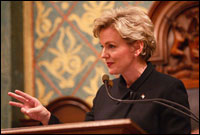
Jennifer Granholm.
If John Kerry becomes president, he’ll owe an awful lot to Jennifer M. Granholm, Michigan’s environmentally minded first-term Democratic governor. For all but a few shaky days in early September when some polls indicated that Michigan may have been leaning President Bush’s way, the state and its 17 critical electoral votes have stayed all year as alpine blue as a northern Lake Michigan bay. Granholm has actively accompanied the senator on swings through Michigan, and her husband, Daniel Mulhern, is co-chair of the Kerry-Edwards state campaign.
Apart from the war and terrorism, the issues motivating voters in the nation’s eighth most populous state are a logical mix of economic and environmental concerns — 300,000 jobs lost in Michigan under Bush, the effect of raising the Corporate Average Fuel Economy (CAFE) standards on the auto industry, and who will stand in the way when thirsty states and nations come after the Great Lakes, the world’s largest supply of surface freshwater.
The 45-year-old Granholm, who was born in Vancouver, British Columbia, raised in California, and educated at Berkeley and Harvard Law School, settled in Detroit in the late 1980s with her husband, also a Harvard-educated lawyer and a Michigan native son. She’s devoted her career to public service as a federal judicial clerk, assistant U.S. attorney in charge of environmental enforcement, and head of the state’s largest county legal office. In 1998, Granholm was elected Michigan’s attorney general, and in 2002 handily beat her Republican gubernatorial opponent by articulating a novel economic-development strategy. It centered on conserving natural resources, rebuilding cities to attract young minds, and unleashing state government’s power to foster industrial and manufacturing innovation, especially in encouraging the auto industry to design and build more energy-efficient vehicles.
Granholm’s success in putting her ideas into motion in the face of immense state budget deficits — in some instances with the actual assistance of a Republican-led legislature — has made her the most popular governor since moderate Republican William G. Milliken in the 1970s. Her favorable ratings consistently top 60 percent, and are even higher in Michigan’s rural and conservative “Up North” region around Traverse City. National Democratic leaders have taken note and she’s been actively courted by Kerry. He invited Granholm to deliver a prime-time speech on the economy at the party’s national convention in July, and to join the Kerry team that negotiated the rules of engagement for the three presidential debates.
We caught up with the governor in her office in Lansing, the state capital.
Where are you on the debate about increasing the CAFE standard? Is it true that Kerry asked you about his proposed 36-mile-per-gallon standard and you said don’t go there?
A number of us had conversations with the Kerry campaign about what he was going to say about CAFE. What he told us was that he did not want to sacrifice jobs and that he wanted to work with the auto industry to achieve that goal. He said it wasn’t a hard and fast rule. He obviously wanted to achieve greater fuel efficiency in vehicles, and that we needed to do that if we were to wean ourselves from dependency on foreign oil. So we definitely had conversations with him to try to feel out what he was going to say. The whole purpose was to say that it doesn’t have to be a zero sum. It’s not the environment or jobs. You can have both. You can help the auto industry achieve that if you have investment in plants.
He came out, and I don’t want to say it’s the result of our conversation, but he did come out with an investment plan to help us get the cars of the future, the fuel-efficient vehicles of the future.
Is it your belief that cleaner, more fuel-efficient cars will help the auto industry and Michigan?
Absolutely. It’s going to put us at the forefront. That’s one of the most exciting things about Michigan’s future. We need to, we must capitalize on our alternative-energy vehicles that we can produce right here. There is going to be great demand. We have gasoline at $2 a gallon. If that doesn’t drive demand, I don’t know what will. We just acquired our hybrid fleet [new Ford Escapes] here in state government. I will have a hybrid vehicle and hopefully it can be a model for others contemplating driving fuel-efficient vehicles.
Is this related to climate change in any way? Are you making suggestions to the Kerry campaign about climate change?
I have not made any suggestions about climate change. This is more about blending or shifting the conversation about the environment versus the economy. It’s just such an old, outdated conversation.
If Kerry is elected, what should he focus on in the environmental policy arena? Have you talked about that with him?
You know, he’s been very responsive to us. When we’ve asked him what is his position with respect to water, he’s responded. What is his position with respect to water diversions, and quantity and quality? He’s made unequivocal statements about not allowing diversions from the Great Lakes, which is great.
With respect to the environment in our state and our state’s future — in addition to water which is very important here — I think it is crucial for him to make a sincere commitment to energy efficiency, fuel efficiency, by helping us to produce those cars of the future. That would be a tremendous step for Michigan and for the United States as a whole.
There is no reason why, with the huge potential for market out there in the world for fuel-efficient vehicles, we can’t be the cutting edge for change. So when it comes to the environment, his pursuit of fuel-efficient vehicles and cleaner energy all around, that’s all right for us in Michigan.
We’ve got this great possibility for wind energy here, too. We’ve got the kinds of energy sources that are renewable. Those are all things that we can be working on, industries that we can capitalize on. As a state we are so uniquely positioned in so many ways. Our geography, our placement in the country, and our history positions us to be the state that propels energy efficiency as an industry.
For you, the environment is really a way to focus on jobs. Jobs are the issue?
Obviously we want to keep the jobs we’ve got. It’s difficult in a global economy for a state that has relied so heavily on manufacturing, the repetitive-motion kinds of jobs. Many of them, not all of them, but many of them are likely to go to countries that pay $1.57 an hour.
One of the things that Kerry needs to do right off the bat is take a look at our trade agreements to make sure we are leveraging the great strength of our economy to negotiate trade agreements with countries that are abiding by our environmental standards, by our child labor laws. Our basic labor standards. We aren’t doing that. We aren’t leveraging this great economic engine, the strongest economy in the world. And yet we have this totally weak response. We import $500 billion a year more in products than we export. What is wrong?
The Clinton administration brought 65 cases from 1995 to 2000 before the World Trade Organization. The Bush administration has brought twelve. Twelve cases. They haven’t even been able to stand up for our jobs.
Where did your concerns about environmental issues come from?
I don’t know of a single place, but it is related to the time I spent Up North. It’s transformative. There is a gentleness in Michigan that you just can’t replicate. California has a beautiful coastline. It can be a rough coastline. The waves are huge. The rocks are steep. Same thing in Vancouver. It has a beautiful coastline. It’s dramatic. Michigan’s topography, its beauty, to me it’s accessible. It’s breathtaking. It’s gentle. You can climb the dunes. You can run down the dunes. You can feel it and touch it. California is beautiful to look at, but you can’t be a part of it like you can in Michigan.
This summer I took the girls [two teenage daughters] on a fishing trip. Whenever we went Up North in the summer when they were little they were never into fishing. So I said we’re going to go and have a girls’ weekend and you’re going to love to fish. You’re going to love to fish. We went to a small lake, Bass Lake. It was beautiful. It was perfectly still when we got there in the morning. The fog was lifting off the water. It was just magical. And we did catch some fish, 13 fish.
Were you surprised when President Bush said that he wanted to eliminate water diversions from the Great Lakes?
Was I surprised? No. I think he did that because he knows what a hot issue it is and he had made some ambiguous statements previous to that. He needed to correct them. He had made some remarks to [former Canadian Prime Minister] Jean Chretien that led people to believe that he was open to the diversion of Great Lakes waters.
The Democrats in the House on the state level made such a big deal about this, as had we, that I think at both the state and the federal level this issue has been elevated to such a position that Bush had to say something, particularly when he was in northern Michigan. He was in Traverse City.
The irony from my perspective is that he’s in Traverse City and he talks about no diversions. We’ve got this proposal which has been languishing in the legislature, the Water Legacy Act, which is derived from a Republican task force on protecting the Great Lakes. Yet nothing has been done on it. I used it as an opportunity to say that even Bush is saying that we should be making sure we protect our Great Lakes.
Have you provided some guidance to the Kerry campaign on Great Lakes water diversion? He had a little muddle too.
Oh, believe me, he heard about it quickly. Within 24 hours, he made his position extremely clear that he was not going in any way to allow diversions of Great Lakes water.
Did he hear from you about it?
Oh yeah, he heard from me about it.
Who’s going to win the election?
John Kerry is going to win Michigan. And if the election was held today he would be president. We still have a week to go.
If Kerry wins, are you going to be his attorney general?
No.
Are you sure?
Yes.
A message from
Your support keeps our climate news free.
Grist is the only award-winning newsroom focused on exploring equitable solutions to climate change. It’s vital reporting made entirely possible by loyal readers like you.
At Grist, we don’t believe in paywalls. Instead, we rely on our readers to pitch in what they can so that we can continue bringing you our solution-based climate news. Donate today to keep our site free.