A while ago I wrote about Jonathan Foley, an environmental scientist at the University of Wisconsin, who is so appalled at the lack of government action on global warming that he has taken matters into his own hands. Through energy efficiency and solar energy, he and his family have greatly reduced their use of gas, oil, or coal (whose burning produces the greenhouse gas carbon dioxide). When they do burn fossil fuel, they see that a tree is planted or a patch of prairie restored to take the carbon dioxide they’ve generated back out of the atmosphere.
Jon Foley has been corresponding with his brother David, who designs “green” buildings in Maine, about whether David can rack up carbon-absorbing credit for his organic garden. When David and his wife Judy started gardening about 10 years ago, their soil tested just 1 percent organic matter. Now it tests 7.7 percent (an astonishingly high number, about twice as high as most farm soils). That difference is made up of carbon taken by plants out of the atmosphere — a reverse greenhouse effect.
Sequestering carbon, one squash at a time.
Jon, the numbers guy, has gone to work estimating David and Judy’s carbon credits. Here, for you gardeners who want to quantify your own contribution to the climate — and for policymakers who’d like to reward farmers for climate-stabilizing behavior — is how he went about it. The quotes are from Jon’s emails to David. I’ve translated units from his proper scientific metrics back to the crazy American system we all understand.
“The biggest uncertainty relates to how deep the organic matter is going into the soil. I assume that the change in soil organic matter is confined to the top 8 inches. I suspect that you’re actually leaching humus into deeper soil, which would affect the result a lot. So this is a conservative estimate.”
A silt-loam soil, Jonathan says, weighs roughly 85 pounds per cubic foot. Eight inches of it weighs 56 pounds per square foot.
Organic matter is about 58 percent carbon. So soil with 1 percent organic matter contains (hmmm, 1 percent of 58 percent of 56 pounds) 0.3 pounds of carbon per square foot. Soil with 7.7 percent organic matter contains 2.5 pounds of carbon per square foot. David and Judy have increased the amount of carbon in every square foot of their garden by 2.2 pounds.
It’s a big garden, 0.4 acres. (Actually it’s a communal garden, which David and Judy share with their neighbors.) That’s 17,424 square feet. Multiply by 2.2 pounds of carbon per square foot — let’s see here — that makes over 38,000 pounds of carbon removed from the atmosphere — 19 tons!
Jon writes to David: “You have sequestered 19 tons of carbon into your garden over the last 10 years. If you think that the soil test is representative of a deeper soil profile (let’s say 16 inches instead of 8), then scale that number up. This is impressive! The average American releases 6 to 6.5 tons of carbon into the atmosphere each year. So you have offset about three years of an average American’s emissions.”
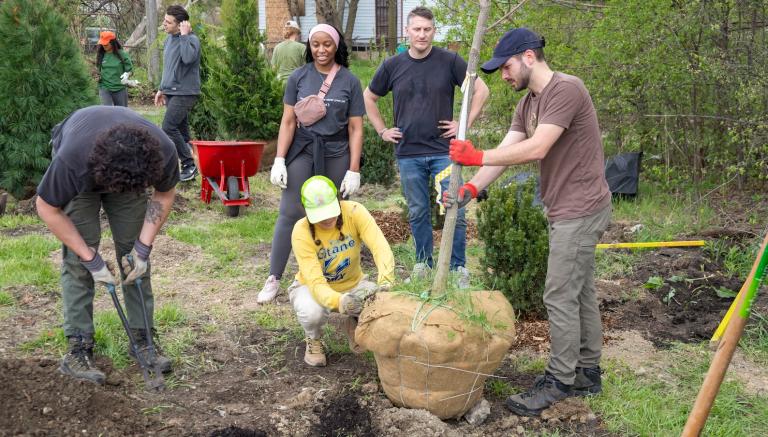
David Foley is no average American, given his energy-efficient house and frugal consumption habits. He and Judy have also planted more than a thousand trees and shrubs. I’m willing to give them credit for offsetting their last 10 years of carbon emissions. But, I pointed out to David, he’s not likely to get that soil any richer in humus. What’s he going to do to offset the next 10 years?
He replied, “It’s true that we’ve ‘shot our wad.’ You can never earn more than a one-time credit for tree-planting or building soil organic matter. But if everyone would do that, it would give us a great breathing space to make the transition to sustainable energy sources. And, of course, the organic matter we’ve built up helps the garden grow wonderfully and holds onto water to help us get through droughts.”
This little calculation could go beyond gardening. This month, the world’s nations will reconvene in a climate bargaining session, where a central issue will be how to account for carbon sequestration. If, say, Costa Rica will be charged for the gasoline burned by its growing car fleet, shouldn’t it get credit for the fact that it is restoring its forests? If the U.S. helps Guatemala plant trees, couldn’t we count that against our own rising carbon emissions?
U.S. negotiators will be pushing hard for the idea of paying cash for carbon sequestration. (The Clinton administration would rather pay someone else to plant forests than question our gas-guzzling SUV habit.) If “carbon trading” flies, it seems fair to reward every kind of carbon-fixing, including building soil humus. Farmers who increase the humus content of their soil should be able to charge us all for slowing the crazing of the climate.
By the same token, anyone who levels a forest or runs down soil carbon should have to pay. That’s fair. Climate change puts real and huge costs onto everyone.
Carbon sequestration can only be a temporary strategy toward stabilizing the climate. Jon Foley estimates that if we grew back every forest and restored the humus in all the agricultural land in the world, we would only offset 25 to 30 years of our economy’s present carbon emissions. Still, a turn in that direction could help the climate a bit and farmers a lot.
Says David, “Imagine farmers being able to supplement their incomes by farming the way they should. Imagine a transfer of income from CO2-emitting corporations back to farmers. Wow!”