|
|
||
Friday, 02 Dec 2005
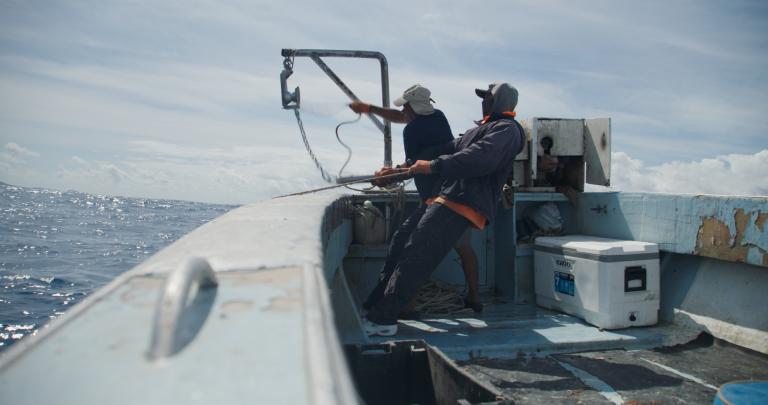
Free Your Mind and the Tax Deduction Will FollowGive to Grist, annihilate your angstFeeling burdened by your eco-sins? Did you nudge up the heat instead of donning a cardigan? Let the tap run while brushing your teeth? Drive all over town hunting for bargains on Black Friday? Don't sweat it. Just buy a Grist Indulgence and wipe that slate clean. That's right: make a tax-deductible donation to your favorite source of environmental news, get a chance to win cool prizes, and clear your conscience, all with a few clicks of the mouse. What are you waiting for?Bye CatchOver a fifth of all fish caught are killed and discarded, study findsThe first comprehensive study of "bycatch" -- unwanted fish caught and discarded by commercial fishing operations -- has confirmed the worst fears of conservationists: Over a fifth of all fish caught by U.S. commercial fishers, around 1.1 million tons, are tossed out every year. Commissioned by marine eco-group Oceana, the study analyzed federal data between 1991 and 2002 to find the most and least efficient fisheries. Topping the study's list of bad actors are shrimp operations in the Gulf of Mexico, whose huge trawling nets were responsible for about half of the nation's bycatch in 2002. By contrast, Alaska fisheries have made notable progress in reducing waste. Needless to say, catching and scrapping millions of tons of fish hampers efforts to restore ailing fish stocks. "The scale of the problem here is enormous," says one of the study's authors.That's Soil, FolksOfficials understating health risks in New Orleans, say eco-groupsLouisiana state and federal regulators are not doing enough to warn the public about the health risks in New Orleans, say public-health advocates and enviros. According to the Natural Resources Defense Council and state eco-groups, soil in many parts of the city is contaminated -- sometimes heavily -- with a wealth of toxins, including carcinogens. After conducting independent tests and reviewing government data, NRDC says it found substances like arsenic, lead, banned pesticides, and mercury wherever the city was flooded -- with some of the most contaminated sites in the Lower Ninth Ward, just reopened to residents yesterday. Louisiana environmental officials and the U.S. EPA deny the allegations, saying that while NRDC's data more or less matches up with state and federal testing, the group has interpreted the findings all wrong. And really, what New Orleans resident wouldn't trust the state and federal government?
NEW IN GRIST
Today's society nudges us toward isolation -- think self-serve gas, U-Scan groceries, and Netflix -- but there was a time when people met in sewing circles and loyal orders and actually, you know, talked to each other. Marshall Ganz, a civil-rights activist turned Harvard sociologist, says the dwindling of local community organizations and chapters is undermining citizens' political power -- and on the left far more than on the right. Ganz recently completed a two-year study for the Sierra Club on reinvigorating environmentalism, and he shares his prognosis with Gregory Dicum.A Second GanzEnviros need to get social, says activist-turned-sociologist Marshall Ganz
The Chemical DruthersNew Jersey becomes first state to require stronger chemical securityNew Jersey has become the first state in the nation to require security assessments for chemical plants -- assessments blocked at the federal level by industry and Republican lawmakers. The new rules call for the state's 140-odd chemical plants to evaluate potential security risks and report plans for addressing them. Forty-three facilities using especially dangerous chemicals will also have to investigate reducing or ending their reliance on such materials. Despite post-9/11 awareness that the densely populated state's chemical facilities are prime terrorist targets -- one stretch of facilities near Newark has been termed the most vulnerable two miles in the country by federal authorities -- New Jersey's $27 billion chemical industry has fiercely resisted state-mandated security measures. It's squawking about the new regulations, even while some activists say the rules are largely based on industry recommendations and too weak to be meaningful anyway.
NEW IN GRIST
A company committing to donate 1 percent of sales to environmental causes (whether said company turns a profit or not) is no small matter, says Terry Kellogg, head of 1% for the Planet. Kellogg, this week's InterActivist, is looking forward to a time when there's no excuse for a company not to make such a pledge via his nonprofit because so many others are doing the same. In answering reader questions, Kellogg chats about setting the bar high, urging new companies to join, and understanding the agenda behind Wal-Mart's green campaign.All for One and One for AllTerry Kellogg, director of 1% for the Planet, answers readers' questions
Small WonderSales of some big SUVs drop by halfIt's an early Christmahanukwanzakah present for the planet, and a chunk of coal in the stocking of Detroit's Big Three automakers: The American love affair with huge SUVs seems finally to be on the wane. Really this time! Sales of once-hot vehicles like the Ford Explorer and Chevrolet Suburban are about half what they were a year ago. Auto-industry watchers blame plummeting SUV demand for much of Detroit's financial woes, saying consumers have woken up to the volatility of fuel costs. Auto execs, on the other hand, blame ... anyone but themselves, really. They claim high labor costs and rigid union rules are doing them in, not gas prices. Mmmkay. Still, GM and Ford both announced yesterday that they'd cut back SUV and truck production in favor of passenger cars, whose overall sales have picked up. Nothing like a touch of financial peril to focus the mind. |
Also in Grist
The Week's Most Popular
From the Archives
A Current Despair, 01 Dec 2005
Leggo My Negotiation, 30 Nov 2005
See the Forest for the Fees, 29 Nov 2005
|
|