Support Grist
Support nonprofit, independent environmental journalism.
Donate to Grist.
Election 08

Paul on the Issues

A look at Ron Paul's environmental platform and record


16 Oct 2007
Tools: print | email | discuss | write to the editor | subscribe | RSS
Update: Ron Paul dropped out of the presidential race on June 12, 2008.

Ron Paul
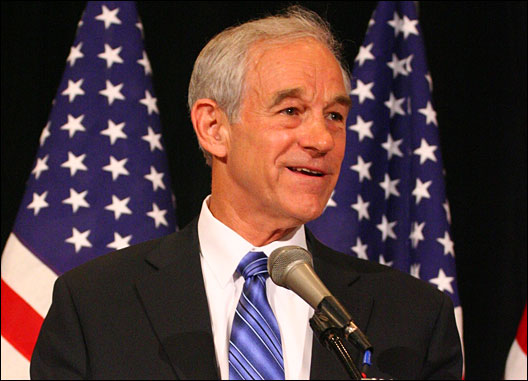
Ron Paul.
Republican presidential candidate Ron Paul doesn't spend much time talking about the environment; when he does address the issue, it's usually to say that our land, air, and water would be in better shape if the government butted out and let the free-market, private-property system run its course. Paul has represented Texas's 14th district in the U.S. House of Representatives for the past decade, and he represented the 22nd district for about seven years in the '70s and '80s. In 1988, he ran for president as the Libertarian Party candidate. Paul's lifetime voting score from the League of Conservation Voters is 29 percent.

Read an interview with Ron Paul by Grist and Outside.

Key Points


  • Does not consider climate change a major issue and is not convinced that it is largely caused by human activity.

  • Says he would end all subsidies and special benefits to energy companies.

  • Has voted in favor of offshore drilling and drilling in the Arctic National Wildlife Refuge.

  • Has consistently opposed farm subsidies.

Video & Audio


Watch Ron Paul answer a question about climate change at the Iowa Straw Poll on Aug. 11, 2007:


Watch a YouTube interview with Ron Paul; he addresses a question about the environment at 1:44:


Listen to a clip of Paul's interview with Grist and Outside:


Quotable Quotes


  • "The freer the market is and the more respect you have for private property, the better the environment is protected."
    -- July 13, 2007, in a YouTube interview


  • "Fear is constantly generated by politicians to rally the support of the people. Environmentalists go back and forth, from warning about a coming ice age to arguing the grave dangers of global warming."
    -- June 29, 2006, in a speech before the U.S. House of Representatives.


Platform & Record In-Depth


  • Sponsor of the Affordable Gas Price Act, which would allow offshore drilling in U.S. waters, allow oil and gas drilling in the Arctic National Wildlife Refuge, exempt environmental impact statements conducted under the National Environmental Policy Act from judicial review, give more tax incentives for investing in oil refineries, and suspend the federal gasoline tax when retail gasoline prices hit $3 a gallon.

  • Cosponsor of legislation that would streamline the federal approval process for oil refinery construction or expansion.

  • Lead sponsor of the Industrial Hemp Farming Act of 2007, which would exclude industrial hemp from the definition of marijuana under the Controlled Substances Act.

  • Cosponsor of legislation to make bicycle commuters eligible for the transportation fringe-benefit tax credit.

  • Cosponsor of legislation that would provide a tax deduction for the costs of using public transit.

  • Cosponsor of the Buildings for the 21st Century Act, which would increase the allowable tax deduction for energy-efficient commercial building costs and extend the deduction through 2013.

  • Cosponsor of numerous bills giving or extending tax credits to various forms of renewable energy (in the 110th Congress, HR 197, HR 550, HR 1772, and HR 3107).

  • Voted against the final version of the 2005 Energy Policy Act, a sweeping, oil-friendly energy bill opposed by enviros. The act passed and Bush signed it into law in August 2005.

  • In 2002, voted against storing nuclear waste at the Yucca Mountain repository now being built in southern Nevada.

  • In 2001, voted against raising fuel-economy standards for cars and light trucks to a combined average of 27.5 mpg for model years 2005 and 2006.

Still Haven't Gotten Enough?


What did we miss? Tell us below in comments. We'll update this page as the presidential campaign continues.


Todd Hymas Samkara contributed to this fact sheet.
Tools: print | email | discuss | write to the editor | subscribe | RSS
< Previous | Next >
Comments: (6 comments)

You are not logged in. Thus, you cannot post a comment. If you have a Gristmill account, log in below. If you don't have a Gristmill account, well, by all means go make one! Meet you back here in five.

Username: Password:

Forgot your password? Enter your username and click:

Environmental detectives

The death of an environmental industry in its infancy often goes un-noted. Environmental detectives were just starting to gain steam early on in the industrial revolution. These detectives would find the sources of pollution on other people's property and sue for compensation. These detectives made money from polluters answering only to those who were being affected by it.

Then along comes the EPA and the government charges polluters "fines" for pollution in a broad brush stroke, killing the environmental detective industry.

So basically, the government makes money from polluters under the guise of caring for the environment. Incentive is no longer to stop polluting for fear of losing money...incentive becomes investment into the right candidate in power that will go easy on them.

And those affected by pollution no longer get compensation.

This is akin to having an agency that fines people for killing people...you're limited to killing 5 people a year and if you go over that limit you have to pay a fine to the Person Protection Agency (PPA). Then serial murderers start voting for and lobbying candidates that will raise the kill limit and reduce the fines.

--
Also, the fact is also ignored that the federal government is the country's largest polluter. Of course, they are immune to the EPA.

The whole story

Here is a very good interview of Ron Paul concerning the environment.  And it's from Grist.

http://www.grist.org/feature/2007/10/16/paul/

point

I think that the point Mr. Paul is trying to get across is that when the Government gets involved, regardless of their intentions, they most often fail.  They end up being pressured by interest groups because politicians are not experts and they must rely on others to tell them what is right; they listen to those with the deepest pockets...industry.  If we allow the market to capture the full and complete costs of damages both to person and property, it becomes too expensive for firms to pollute as usual and they will therefore find a way to curb emmissions as is demanded by the people.  Growth in government is not the answer b/c elected officials by their nature are not able to look at things long-term, beyond their immediate and most vocal constituents, or with in-depth knowledge that professionals are.

Marriage/Family/Abortion/Homosexuality

In your overview of Ron Paul, I believe you did not mention several topics that are of great importance to many Americans. I have listed them in the subject line. With regard to abortion, Paul is "unshakably pro-life." With regard to marriage, the family and homosexuality, Paul is conservative, but not completely so. I would like to see him more conservative on those things, as I feel that so long as this country maintains strong morals and strong families, it can withstand anything, even a nuclear bomb being detonated in one of our cities, should the sleep-walking left allow it to come to that.

harming your neighbors

Though I consider myself a bleeding heart liberal, I have to applaud Ron Paul for being the first Libertarian to bring up the following plank in the Libertarian Party platform...

No one should be permitted to release harmful pollutants that travel beyond THEIR property. It is essentially trespassing and violation of one's neighbors property rights. Clean air and water entering "your" space, should leave free of harmful chemicals. Industry would be forced to internalize all costs.

This is why Ron Paul believes, I think, strengthening personal property rights would protect the environment. It is a two-way street... protect industry's rights AND individual rights. This was brought up very briefly during an On Point interview of Ron Paul, but the host of the program failed to pursue this line of discussion. It is very disappointing that this plank of the Libertarian Part platform is not discussed more.

The same strategy could be used for protecting endangered species, since harming animals that travel independent of human boundaries or destroying ecosystems that provide important "services" deprives your neighbor of the pleasure of enjoying a healthy environment.

If Ron Paul truly wishes to apply the principle of not permitting activities the deprive your neighbors of their own right to clean air and water. AND if Ron Paul is truly committed to putting an end to military adventures, bringing all of our troops home, cutting military spending, and examining the ultimate causes of hostility in the world, I'm going to cast a vote for him in the primary and, perhaps, in the November election. I think the result would be a huge net gain for our nation, the environment, and the rest of the planet. A Democratic Congress should be able to prevent Ron Paul from inflicting any harm. Remember, legislation emerges from the House. Ron Paul would not be able to dismantle agencies like the EPA without Congressional support. Only the President can bring all of our troops home and dramatically cut military spending. Imagine the peace dividend available for building a sustainable green economy.

The Constitution is Green

The Greens and Constitutionalists should join the Libertarians, in extending an open invitation for Ron Paul to be their candidate for US President in the event that, heaven forbid, Ron Paul loses the Republican nomination. In the process, a new and powerful third triparty could be created. Enough of these watermelons (green on the outside, red on the inside) running the show. The Constitution is Green.

You are not logged in. Thus, you cannot post a comment. If you have a Gristmill account, log in below. If you don't have a Gristmill account, well, by all means go make one! Meet you back here in five.

Username: Password:

Forgot your password? Enter your username and click:

The comments of Grist users reflect the opinions of those individuals only, and do not necessarily reflect the viewpoints of Grist, its staff, its board members, their psychotherapists, or their aestheticians. Got it?


Also in Grist

The Week's Most Popular
From the Archives
Paul on the Record, by Amanda Griscom Little. An interview with Ron Paul about his presidential platform on energy and the environment.
From Bad to Thirst, by Elizabeth Royte. How the nation's breadbasket is poisoning its own water supply.
Snack and Diane, by Katharine Wroth. An interview with sustainable-food advocate Diane Hatz.

ADVERTISING POLICY


About Grist | Support Grist | Jobs Board | Archives | Grist by Email | RSS | Podcasts
Gristmill Blog | In the News | Ask Umbra® | Muckraker | Victual Reality | 'Tis the Season | The Grist List | The Bottom Line


Grist: Environmental News and Commentary
a beacon in the smog (tm) ©2007. Grist Magazine, Inc. All rights reserved. Gloom and doom with a sense of humor®.
Webmaster | Privacy Policy | Terms of Service | Trademarks