
Ever dreamed of eating your way across the country? This summer, Diane Hatz did just that on the Eat Well Guided Tour of America. Convinced there was more to the sustainable-food movement than met the eye (i.e., it ain’t just happening on the coasts), Hatz and her colleagues from Sustainable Table partnered with several other organizations to organize a 25-city tour that stretched from West Hollywood, Calif., to New York’s Hudson Valley. Hopping aboard a biofueled bus, the group set out to discover the true tastes of American eaters.

Diane Hatz.
Ambitious, yes, but that’s hardly a surprise. This is the same group behind both the popular Meatrix series and the Eat Well Guide, a national online directory of farms and restaurants providing fresh, local food. They know from big.
Now that she’s back at her desk in the Big Apple, we checked in with Hatz, a former music industry exec, to find out how she made the switch to food, what advice she has for getting through the grocery store, and what other projects she’s got up her sleeve. Send her a question of your own by midnight PDT on Tuesday — she’ll answer the best burning queries later this week.
Tell us a little about yourself — your background, how you came to Sustainable Table, what excites you about these issues.
I’m originally from the suburbs in northern Delaware, where I grew up always having a garden in the back yard and fruit trees around the house, and my parents would buy half a cow from the local butcher and freeze the cuts. My family would also go down to the Delaware beach every weekend in the summer, where we’d catch our own fish, crabs, and clams. When I was young, I never thought about where my food came from because even though I didn’t grow up on a farm, a lot of the food I ate was grown or caught by someone in the family. I remember even going down to the local park to pick berries.
Second Helpings
I actually came to the sustainable food movement by accident. I had worked for about 10 years in the music industry, much of it in a corporate music company, and in my early 30s I knew I had to get out. I’d lost my passion for music, mainly because of how corporate the business was and how little passion and actual creativity I saw in it. I brushed up my resume and sent it out to a little blind ad in The New York Times … my first resume went to GRACE [now the parent organization of Sustainable Table], and when I was offered the job, I thought working in a nonprofit might be interesting. Around that time, I’d also discovered an organic mango, which tasted so unbelievably good that I started becoming interested in organic food.
One day in about 2001, I got an email from a consumer asking me about genetic engineering. I searched around other sites to try to find the answer, and I realized that every website assumed the visitor already knew what genetic engineering was, and it really frustrated me. I figured if I was frustrated, there were probably a lot of consumers out there equally as frustrated because they weren’t able to get information about how their food was being produced and where it came from. So, I had the privilege of founding Sustainable Table.
You asked what excites me about these issues — I was so excited and pleased [on the Eat Well tour] to see that there’s more going on than even I realized! We all know that wonderful things are being done on the West Coast and in the Northeast, but do you know what’s happening in Wyoming? Montana? Missouri? Everywhere we went, we found people excited, passionate, and enthusiastic about local, sustainable food, and it has reenergized me and given me so much hope for us and our food system … I’d challenge everyone reading this to look around in their area. I’d be surprised if you couldn’t find an organic, sustainable, or biodynamic farm, restaurant, or store near you. They’re popping up everywhere.
From your perspective, what’s the one thing people should be aware of when they shop for food?
The main thing I think people should be aware of is how the food was raised or grown. Find out if added hormones or constant daily doses of antibiotics were used. Ask about what animals were fed. Find out if chemical fertilizers or pesticides were used. Sustainable Table has a series of handouts called Questions to Ask — you can print these out or download them onto your iPod or PDA.
Find out where the food comes from — and if you want something you don’t see, ask for it! Consumers need to understand that we have all the power. We’re the ones who are going to change the food system, but we need to speak up.
When it comes to agribiz, are there big companies that are trying to improve their practices? Are there others you’d recommend avoiding?
I’ve read that all the big companies know that consumers want more local, sustainable food, and they are reacting to the demand. Most of the smaller health-food-type companies have already been bought out by large conglomerations, and these large companies are sitting in their boardrooms trying to figure out how they can continue to make huge profits while becoming more “green” (which is not necessarily sustainable).
It’s not really for me to pick out any particular companies to avoid, but one thing I would suggest is that people try to buy food as unprocessed as possible. The more processed a food, the less nutrients it’s going to have. If you really want to avoid something, try staying away from high-fructose corn syrup or some derivative of corn syrup. (If you want to learn about the problems with corn, check out the movie King Corn.)
Consumers should look for whole foods like fruits, vegetables, and meat, and relearn the joy of cooking. You’re going to get more nutrients that way, and you’re going to get a better product. And once you start looking for unprocessed foods, go a step further and look for local, sustainable unprocessed foods — it really will taste better!
What about restaurants — any chains you’d hold up as role models?
With regard to restaurants to hold up as a model, I don’t know of any national chains, but while we were on the tour, we stopped in at Grilla Bites in Northern California. It’s a franchise operation that’s looking to go national — they source local, organic, sustainable food. Not only did they have an organic salad bar, they had sandwiches like a local bison burger and even products like local wine. Even though this is a fast-food-type restaurant, where you order at the counter and get your food quickly, it was the best fast food I’ve ever had! I also like that it’s a franchise so owners can actually own their business. I haven’t been to Vermont’s Farmer’s Diner yet, but they source as locally as possible, and I know they’re also looking to go national, so they’re another restaurant to look out for.
What can consumers do to support small farms more actively? And what resources do you recommend if the Eat Well Guide doesn’t turn up much in an area?
The best way to support a small farm actively is to join a community-supported agriculture program. With CSA, you purchase a share of a farmer’s crop at the beginning of the growing season. This gives them the resources to purchase seed and equipment. Each CSA member gets a share of the harvest, which is either picked up at the farm or dropped off at particular points, like a local church or community centers. CSAs have become extremely popular, and some now offer meat, fish, dairy products, and even flowers.
Another way to support small farms is to join a local sustainable agriculture or food group — if you go into the advance search feature on the Eat Well Guide, you can find local organizations to join. Two excellent programs are Slow Food and Food Routes’ Buy Fresh Buy Local campaign … And if none of that helps, I’d suggest looking in your phone book for a health-food store and giving them a call to see if they know of any CSA programs or farmers’ markets in the area. Local stores tend to be a wealth of information on sustainable food.
Do you see regional patterns in the sustainable-food movement? In this series, we looked at a county in Iowa that’s gone whole hog, so to speak, on the buy-local movement. Anomaly, or indication of a growing trend?
The buy local, sustainable movement is growing exponentially all across the country! I believe this is no longer a movement, trend, or fad. Sustainable food is here, and here to stay. The local aspect of sustainable food might be a little newer, but everywhere we went, in every part of the country, people were talking about how to source more local sustainable food and were asking the same questions: What do I do in the winter? How do I define local? What exactly is sustainable? What can I do to be more a part of this? I’ve only been off tour for just over a month, so I’m still trying to digest and pull together all the information we learned, and, hopefully, we can help answer some of these questions based on our experiences on the road.
Another pattern we saw … is that it’s not an “us and them” mentality. Organic food suffered (and to some degree still suffers) from an elitist image, but local, sustainable food is different. We went to PEAS Farm in Missoula, Mont., where they have a CSA program, but they also provide food to the local food bank … City Farm in Chicago employs residents in a low-income area and provides them a living wage — among the food they grow are heirloom tomatoes, which are sold to high-end restaurants around the city. The rest are given to food banks and food kitchens. City Slicker Farms in Oakland, Calif., is an urban farm where residents can buy the produce raised on a sliding scale — if you have no money, you don’t have to pay anything, no questions asked.
After seeing this across the country, I realized that my definition of sustainability, which includes building and maintaining community, also includes helping to provide food access for all. Sustainable food is not about just giving back to the planet but about giving to each other as well … And what I find so heartening is that not only are groups working together, but consumers are working with and supporting farms, restaurants, and farmers’ markets. There’s this sense of community that’s reinvigorating areas all over the country.
Our readers love to debate the merits of vegetarianism — do you or Sustainable Table have a stance on that?
Sustainable Table does not have a stance on vegetarianism. We’re specifically trying to reach consumers who eat meat, to educate them on problems with our food supply and offer them healthier options so they can choose what’s best for them. Personally, I’ve been a vegetarian for almost 20 years, but I promote local, sustainable meat for a living, and I don’t see any contradictions in that.
Sustainable Table was created to offer people information and choices, and to leave the decisions up to each individual. People are at different levels: some might be comfortable with being vegan, while others might eat meat every day, three times a day. We can only do what we can do, and I don’t believe we have the right to tell anyone what to do — we can only provide information and perhaps encourage them to eat/live healthier (and if they’re going to eat meat, to try to eat sustainable, pasture-raised meat), but it’s really up to each one of us. Obviously, having said that, I absolutely do not agree with our industrial food system so I do have some limits!
You guys created The Meatrix — were you surprised at its success? Any plans for more fun along those lines?
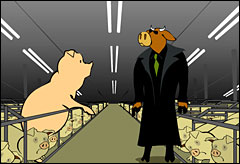
Moopheus exposes the Meatrix.
Image: themeatrix.com
Sustainable Table created The Meatrix with Free Range Studios. For anyone who might not have heard of The Meatrix, they’re online flash animations that educate consumers about factory farming and our food supply. We used humor and entertainment to teach people about serious food issues. And, yes, we were pleasantly shocked by the movie’s success!
When the first one came out, we were told that if 10,000 people watched the film over three months, it would be considered a success. We had 10,000 people in the first few hours! And as the days went by, we went into the millions — our server crashed twice from all the traffic. We can’t count the amount of people who’ve seen the movie anymore, but we know it’s way over 20 million. We’ve translated it into 30 languages and have sent out thousands of DVDs to students and teachers all around the world (we still get dozens of requests each week for the film). And we’ve received thousands of emails since the launch of the original Meatrix in November 2003, and we’re always excited when we get an email that says the person or family has changed their eating habits because of the film.
With regard to a Meatrix III … we don’t have anything scheduled yet. I’m not ruling it out, but if we do create something, it won’t be an online viral film — it will be more of an interactive web experience. What exactly that will be, I’m not sure yet — we’re so busy right now with the other Meatrix films and the success of Sustainable Table and the Eat Well Guide that it might be a little while before anything happens. But we’ll definitely let you know if it does!

Let them eat pie.
Photos: iStockphoto
What’s your favorite meal?
Wow — that’s actually impossible to answer because I like so many different types of food. So I can’t say that I have a favorite meal, but I can say that food made from local, sustainable farms has a taste that industrial food doesn’t. Local, sustainable food even tastes better than industrial organic food shipped thousands of miles.
On our cross-country tour, we were hosted by groups in various cities who often put on events for us — our theme for the tour was “Pie Across America,” so most of our events revolved around pies (sweet, savory, and even pizza). I figure I sampled well over 200 pies on the tour … I’ve never eaten so well in my life, and I still love pie. So, if I had to answer you, right now I would say pie in any form from local, sustainable ingredients is my favorite meal, whether for breakfast, lunch, or dinner!