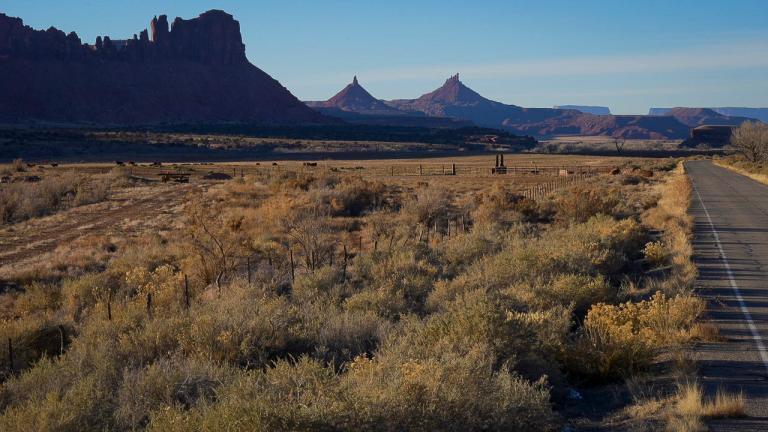
We are destroying our country — I mean our country itself, our land. This is a terrible thing to know, but it is not a reason for despair unless we decide to continue the destruction. If we decide to continue the destruction, that will not be because we have no other choice. This destruction is not necessary. It is not inevitable, except that by our submissiveness we make it so.
We Americans are not usually thought to be a submissive people, but of course we are. Why else would we allow our country to be destroyed? Why else would we be rewarding its destroyers? Why else would we all — by proxies we have given to greedy corporations and corrupt politicians — be participating in its destruction? Most of us are still too sane to piss in our own cistern, but we allow others to do so and we reward them for it. We reward them so well, in fact, that those who piss in our cistern are wealthier than the rest of us.
How do we submit? By not being radical enough. Or by not being thorough enough, which is the same thing.
Protection to the People
Since the beginning of the conservation effort in our country, conservationists have too often believed that we could protect the land without protecting the people. This has begun to change, but for a while yet we will have to reckon with the old assumption that we can preserve the natural world by protecting wilderness areas while we neglect or destroy the economic landscapes — the farms and ranches and working forests — and the people who use them. That assumption is understandable in view of the worsening threats to wilderness areas, but it is wrong. If conservationists hope to save even the wild lands and wild creatures, they are going to have to address issues of economy, which is to say issues of the health of the landscapes and the towns and cities where we do our work, and the quality of that work, and the well-being of the people who do the work.
Governments seem to be making the opposite error, believing that the people can be adequately protected without protecting the land. And here I am not talking about parties or party doctrines, but about the dominant political assumption. Sooner or later, governments will have to recognize that if the land does not prosper, nothing else can prosper for very long. We can have no industry or trade or wealth or security if we don’t uphold the health of the land and the people and the people’s work.
It is merely a fact that the land, here and everywhere, is suffering. We have the “dead zone” in the Gulf of Mexico and undrinkable water to attest to the toxicity of our agriculture. We know that we are carelessly and wastefully logging our forests. We know that soil erosion, air and water pollution, urban sprawl, the proliferation of highways and garbage are making our lives always less pleasant, less healthful, less sustainable, and our dwelling places more ugly.
Nearly 40 years ago, my state of Kentucky, like other coal-producing states, began an effort to regulate strip mining. While that effort has continued, and has imposed certain requirements of “reclamation,” strip mining has become steadily more destructive of the land and the land’s future. We are now permitting the destruction of entire mountains and entire watersheds. No war, so far, has done such extensive or such permanent damage. If we know that coal is an exhaustible resource, whereas the forests over it are with proper use inexhaustible, and that strip mining destroys the forest virtually forever, how can we permit this destruction? If we honor at all that fragile creature the topsoil, so long in the making, so miraculously made, so indispensable to all life, how can we destroy it? If we believe, as so many of us profess to do, that the earth is God’s property and is full of His glory, how can we do harm to any part of it?
In Kentucky, as in other unfortunate states, and again at great public cost, we have allowed — in fact we have officially encouraged — the establishment of the confined animal-feeding industry, which exploits and abuses everything involved: the land, the people, the animals, and the consumers. If we love our country, as so many of us profess to do, how can we so desecrate it?
But the economic damage is not confined just to our farms and forests. For the sake of “job creation,” in Kentucky, and in other backward states, we have lavished public money on corporations that come in and stay only so long as they can exploit people here more cheaply than elsewhere. The general purpose of the present economy is to exploit, not to foster or conserve.
Look carefully, if you doubt me, at the centers of the larger towns in virtually every part of our country. You will find that they are economically dead or dying. Good buildings that used to house needful, useful, locally owned small businesses of all kinds are now empty or have evolved into junk stores or antique shops. But look at the houses, the churches, the commercial buildings, the courthouse, and you will see that more often than not they are comely and well made. And then go look at the corporate outskirts: the chain stores, the fast-food joints, the food-and-fuel stores that no longer can be called service stations, the motels. Try to find something comely or well made there.
What is the difference? The difference is that the old town centers were built by people who were proud of their place and who realized a particular value in living there. The old buildings look good because they were built by people who respected themselves and wanted the respect of their neighbors. The corporate outskirts, on the contrary, were built by people who manifestly take no pride in the place, see no value in lives lived there, and recognize no neighbors. The only value they see in the place is the money that can be siphoned out of it to more fortunate places — that is, to the wealthier suburbs of the larger cities.
Can we actually suppose that we are wasting, polluting, and making ugly this beautiful land for the sake of patriotism and the love of God? Perhaps some of us would like to think so, but in fact this destruction is taking place because we have allowed ourselves to believe, and to live, a mated pair of economic lies: that nothing has a value that is not assigned to it by the market; and that the economic life of our communities can safely be handed over to the great corporations.
We citizens have a large responsibility for our delusion and our destructiveness, and I don’t want to minimize that. But I don’t want to minimize, either, the large responsibility that is borne by government.
The Dissent of the Governed
It is commonly understood that governments are instituted to provide certain protections that citizens individually cannot provide for themselves. But governments have tended to assume that this responsibility can be fulfilled mainly by the police and the military. They have used their regulatory powers reluctantly and often poorly. Our governments have only occasionally recognized the need of land and people to be protected against economic violence. It is true that economic violence is not always as swift, and is rarely as bloody, as the violence of war, but it can be devastating nonetheless. Acts of economic aggression can destroy a landscape or a community or the center of a town or city, and they routinely do so.
Such damage is justified by its corporate perpetrators and their political abettors in the name of the “free market” and “free enterprise,” but this is a freedom that makes greed the dominant economic virtue, and it destroys the freedom of other people along with their communities and livelihoods. There are such things as economic weapons of massive destruction. We have allowed them to be used against us, not just by public submission and regulatory malfeasance, but also by public subsidies, incentives, and sufferances impossible to justify.
We have failed to acknowledge this threat and to act in our own defense. As a result, our once-beautiful and bountiful countryside has long been a colony of the coal, timber, and agribusiness corporations, yielding an immense wealth of energy and raw materials at an immense cost to our land and our land’s people. Because of that failure also, our towns and cities have been gutted by the likes of Wal-Mart, which have had the permitted luxury of destroying locally owned small businesses by means of volume discounts.
Because as individuals or even as communities we cannot protect ourselves against these aggressions, we need our state and national governments to protect us. As the poor deserve as much justice from our courts as the rich, so the small farmer and the small merchant deserve the same economic justice, the same freedom in the market, as big farmers and chain stores. They should not suffer ruin merely because their rich competitors can afford (for a while) to undersell them.
Furthermore, to permit the smaller enterprises always to be ruined by false advantages, either at home or in the global economy, is ultimately to destroy local, regional, and even national capabilities of producing vital supplies such as food and textiles. It is impossible to understand, let alone justify, a government’s willingness to allow the human sources of necessary goods to be destroyed by the “freedom” of this corporate anarchy. It is equally impossible to understand how a government can permit, and even subsidize, the destruction of the land and the land’s productivity. Somehow we have lost or discarded any controlling sense of the interdependence of the earth and the human capacity to use it well. The governmental obligation to protect these economic resources, inseparably human and natural, is the same as the obligation to protect us from hunger or from foreign invaders. In result, there is no difference between a domestic threat to the sources of our life and a foreign one.
It appears that we have fallen into the habit of compromising on issues that should not, and in fact cannot, be compromised. I have an idea that a large number of us, including even a large number of politicians, believe that it is wrong to destroy the earth. But we have powerful political opponents who insist that an earth-destroying economy is justified by freedom and profit. And so we compromise by agreeing to permit the destruction only of parts of the earth, or to permit the earth to be destroyed a little at a time — like the famous three-legged pig that was too well-loved to be slaughtered all at once.
The logic of this sort of compromising is clear, and it is clearly fatal. If we continue to be economically dependent on destroying parts of the earth, then eventually we will destroy it all.
Hope Notes
So long a complaint accumulates a debt to hope, and I would like to end with hope. To do so I need only repeat something I said at the beginning: Our destructiveness has not been, and it is not, inevitable. People who use that excuse are morally incompetent, they are cowardly, and they are lazy. Humans don’t have to live by destroying the sources of their life. People can change; they can learn to do better. All of us, regardless of party, can be moved by love of our land to rise above the greed and contempt of our land’s exploiters. This of course leads to practical problems, and I will offer a short list of practical suggestions.
We have got to learn better to respect ourselves and our dwelling places. We need to quit thinking of rural America as a colony. Too much of the economic history of our land has been that of the export of fuel, food, and raw materials that have been destructively and too cheaply produced. We must reaffirm the economic value of good stewardship and good work. For that we will need better accounting than we have had so far.
We need to reconsider the idea of solving our economic problems by “bringing in industry.” Every state government appears to be scheming to lure in a large corporation from somewhere else by “tax incentives” and other squanderings of the people’s money. We ought to suspend that practice until we are sure that in every state we have made the most and the best of what is already there. We need to build the local economies of our communities and regions by adding value to local products and marketing them locally before we seek markets elsewhere.
We need to confront honestly the issue of scale. Bigness has a charm and a drama that are seductive, especially to politicians and financiers; but bigness promotes greed, indifference, and damage, and often bigness is not necessary. You may need a large corporation to run an airline or to manufacture cars, but you don’t need a large corporation to raise a chicken or a hog. You don’t need a large corporation to process local food or local timber and market it locally.
And, finally, we need to give an absolute priority to caring well for our land — for every bit of it. There should be no compromise with the destruction of the land or of anything else that we cannot replace. We have been too tolerant of politicians who, entrusted with our country’s defense, become the agents of our country’s destroyers, compromising on its ruin.
And so I will end this by quoting my fellow Kentuckian, a great patriot and an indomitable foe of strip-mining, Joe Begley of Blackey: “Compromise, hell!”
This article originally appeared in Orion, 187 Main St., Great Barrington, MA 01230, 888.909.6568 ($35/year for six issues). Printed with permission of Shoemaker & Hoard, Publishers.