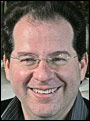
Gerald Prolman.
What work do you do?
I’m CEO of Organic Bouquet.
How does it relate to the environment?
Organic Bouquet is the world’s first online organic florist. All the flowers we sell are grown in a manner that is gentle on the earth and safe for the farmworkers, wildlife, and the environment.
Non-organic flowers are grown with a variety of fertilizers, insecticides, fungicides, nematocides, and plant-growth regulators. Nearly 70 percent of all flowers sold in the U.S. are imported, and the federal government requires that flowers arrive at our borders pest-free. Trade laws thus encourage the use of strong chemicals that can negatively affect the environment.
What long and winding road led you to your current position?
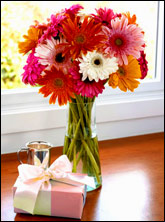
Photo: Organic Bouquet.
I have been working in the natural-products business for the past 27 years.
I was a chef-in-training at a very young age and took an interest in where the ingredients came from, how they were grown, and what nutritional value they offered. This led me to start a business supplying top restaurants and hotels with natural gourmet ingredients.
The next business venture was to market organic produce. I met several organic growers and was highly impressed with the organic method and was personally moved by their commitment to grow crops in a responsible manner, and they needed help in marketing. The name of that company was Made in Nature and was the first to successfully introduce a line of organic produce under a brand to mass-market retailers. In 1994, I sold Made in Nature to Dole. Once Dole embraced the organic concept, most other major agribusinesses started some level of organic production.
Five years ago, I started a quest to find or develop sources for organically grown flowers. It is the goal of Organic Bouquet to lead the floral trade to a day when all flowers grown and sold are produced in a socially responsible and sustainable manner. I’m proud to say that Veriflora, the organic certification standard Organic Bouquet initiated, is now in the process of becoming a national standard for the fresh-cut flower trade.
Where were you born? Where do you live now?
Born in Boston. Now live in Marin County, Calif. (San Francisco Bay Area).
What’s been the best moment in your professional life to date?
Organic Bouquet was named “official florist” for the United Nations World Environment Day, a historic event that took place in San Francisco in June.
What environmental offense has infuriated you the most?
It infuriates me to know that the harsh chemicals used in floriculture pose a threat to people, the environment, and wildlife, but are not outlawed. There are viable alternatives, and the industry needs to take a stand for responsible choices.
Who is your environmental hero?
I have several: Katherine DiMatteo, Julia Butterfly Hill, Wangari Maathai, Vandana Shiva, Heather Mills McCartney, John Jeavons.
What is your environmental nightmare?
That it’s too late. That the damage being done to our planet is out of control and change is too slow to reverse the accelerating downward trend.
What’s your environmental vice?
I still drive a car that requires gasoline, but I am planning to change as soon as possible.
What are you reading these days?
College applications with my son.
What’s your favorite meal?
Veggie pad thai. Oatmeal for breakfast. Real French-made croissants, warm just out of the oven with organic strawberry jam.
Which stereotype about environmentalists most fits you?
I am always pointing out various environmental and social-justice issues, though it’s not always “appropriate” light subject matter in social settings.
If you could institute by fiat one environmental reform, what would it be?
Make it law that only socially responsible and sustainably grown products can be sold in retail markets under appropriate certifications. If it were mandatory, you can bet that the industry would figure how to be green faster than you can blink.
Who were your favorite musical artists when you were 18?
Electric Light Orchestra, 10CC, Queen, Beatles, David Bowie, Bob Marley, Stevie Wonder, Simon and Garfunkel, Meatloaf.
Favorite musical artists today?
Raquel Bitton (my wife!), Leonard Cohen, Roy Orbison, Paul McCartney, Edwin Hawkins, and so many more.
What are you happy about right now?
I am happy to see my children growing to be responsible, compassionate, and giving people who are bound for great adventures.
I am also very happy to see that after five years of development, Organic Bouquet is now gaining traction at a fast clip. We are making an impact on a global scale, and that is quite satisfying.
If you could have every InterActivist reader do one thing, what would it be?
Advise your retailer in writing (via an in-store suggestion box and/or a letter to corporate management) that you want them to assure that all the flowers they carry are sustainably grown on farms that also maintain socially responsible practices.