Photo courtesy of, ah, Bitchcakes via Flickr
Alec Baldwin weighs in, but which is better, coal or nuclear?
The official response to that question by most environmental organizations is to say “neither.”
Neither? Are they are privy to a secret consensus finding of multiple, detailed, peer-reviewed, scientific studies which have demonstrated that when all negative and positive aspects of both methods of generating power are assessed they prove to be equally environmentally destructive in the aggregate?
Of course not. I’m being facetious. “Neither” isn’t an answer; it’s a dodge.
I also want to suggest at the start that this is mostly a thought exercise, not something to get bent out of shape over. I have little confidence that our political system (a reflection of we the people of the United States) has whatever it takes to reduce GHG emissions to the levels needed in the time frame allocated. We should already be converting coal power plants over to natural gas as an interim step to replace them entirely with carbon neutral sources. We are more than likely fooling ourselves.
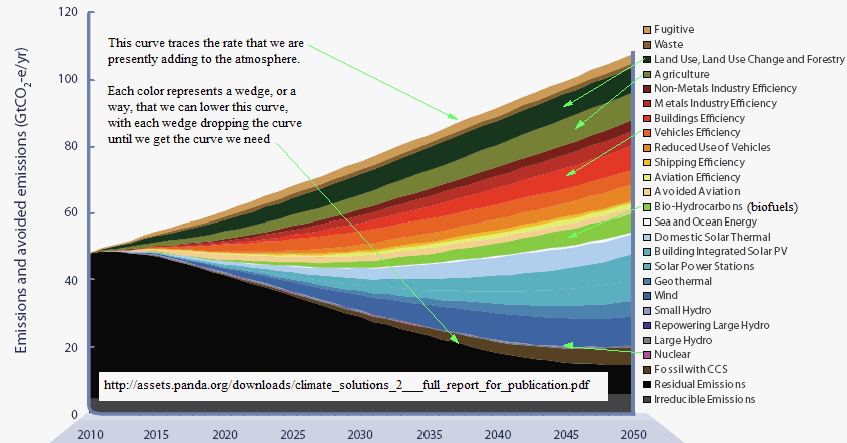
Take all the time you need to understand the following colorful chart (click here to see all of it):
It’s from a study commissioned by the Word Wildlife Fund. The researchers were asked to see if we could reduce our GHG emissions to the necessary levels in the allocated time frame without increasing use of nuclear power. Note that they did not get rid of nuclear power.
They managed to pull it off but just barely. They admitted that one of the solutions–pumping billions of tons of CO2 captured from burned fossil fuels underground–may not work. Giant bubbles of odorless, colorless, CO2 finding their way back to the surface to suffocate whole cities in the night would not be a good thing.
Their conclusion? We can do this if the entire world hits the ground running in the next four years and maximizes industrial output to create low carbon energy sources (sound of crickets chirping…).
Use your imagination to expand that thin purple band that represents nuclear power to make it as wide as the widest band shown. At the same time, decrease the width of all of the other bands by about four percent. What you will have is a scenario that is hardly impacted at all by greatly increasing nuclear power. My conclusion? We are “probably” hosed regardless.
Staring at that graph you should also be impressed, or maybe stunned, by how much has to be accomplished in such a short time.
Another problem with this analysis is that they also assume that the intermittent and highly diffused nature of wind and solar can be compensated for with more technology called a smart super-grid, which is at this time, an untested hypothesis.
I am fairly confident that to make renewables our main source of energy, we will still need some other power sources to help it (called baseline, provided today by coal and nuclear) as well as some power plants that can rapidly increase output when needed (called peaking power plants and today they are usually natural gas fired). I’ll explain why later.
I am not about to argue that we should generate all of our power with conventional nuclear. I’m saying it would be much wiser to accept some additional conventional nuclear in the mix as needed to help bring more renewables on line (help defeat the real enemy–coal) while increasing R&D funding for designs that can reduce the impacts of existing problems, like limits on uranium fuel supply, waste, and safety. Instead of lumping nuclear with coal to make it look bad, we should be more realistic and honest by lumping it with zero carbon sources like wind and solar.
Nuclear power plants today are used for baseline power. However, some designs, like the Canadian CANDU reactors are capable of being used for peak power–more on this later.
Time frames and climate change aside, humanity needs to move away from fossil fuels because the supplies will all eventually peak and decline, making them more expensive and disruptive to economies long before they run out entirely. We heat our structures and fuel transport mostly with natural gas and oil. We are counting on electricity to take over most of those duties as well.
Without environmental groups there would be far fewer environmental safeguards, including nuclear ones. Environmentalism is a good thing but we don’t always get it right. Growing plants to fuel our cars sure sounded like a great idea five years ago until we realized it was increasing the price of grains, helping to push the number of chronically malnourished to over a billion souls for the first time in all of human history. Not to mention researchers have proven what common sense would suggest, that to grow more plants you have to clear ecosystem carbon sinks, making crop-based biofuels gallon for gallon as bad or worse than fossil fuels although for slightly different reasons.
Some major (and a lot of minor) environmentalists are beginning to question the party line that nuclear is the devil incarnate. Understand, to belong to any given group you must, by definition, adhere to that group’s belief system. It is not a matter of cowardice, its a simple matter of self-preservation and the classic group think dynamic called peer pressure. We know a lot more now than we did thirty years ago and many of the legitimate arguments used against nuclear in the past have lost some of their punch.
That freedom from the peer pressure may explain why a number of highly visible but independent environmental types (typically not immersed inside or strongly affiliated with–and therefore constrained by–a group) have begun publicly suggesting that nuclear power isn’t such a bad thing after all: George Monbiot, Steward Brand, James Lovelock, and Steve Kirsch, to name a few off the top of my head.
Maybe we should stop with the knee-jerk hysterics every time nuclear power enters the discussion. It hurts our image. It reinforces the stereotype held by many that environmentalists are irrational, uncompromising, innumerates (the same stereotype often used to describe conservatives). That stance is starting to drive a wedge between other environmentalists who have less incentive to carry the anti-nuke banner. Yes, sometimes things we have clung to as absolute truths turn out to be bullshit. Happens all the time now that we have the internet.
On the other hand, there are also some independent (not beholden to a particular group) intellectual giants who still think nuclear power is the devil incarnate, which finally brings us to actor and 30-Rock (one of the best sitcoms ever produced IMHO) star Alec Baldwin.
The Huffington Post, one of the best on-line publications in existence, is no different from any other on-line publication in that (not being constrained by th
e physical size of a piece of paper) it will print pretty much anything any celebrity figure or any other prominent figure for that matter, wants to write. That’s life in America. Articles are filtered less by quality of content than by who wrote them, regardless of qualifications or content. This tends to be true for books as well because profitability is directly proportional to celebrity status, regardless of what is in the book.
I am not going to parse the article here other than to say it’s your classic anti-nuclear diatribe, including the standard conflation of nuclear power with nuclear weapons. In his next article he will:
” …comment on last Saturday’s broadcast of Weekend Edition on NPR and how Scott Simon appallingly allowed Stewart Brand to burble on and on with his outrageous pablum about “the new safe and clean nuclear power.”
Here is an NPR interview with Alec on a different subject, which I suspect will go down in history.
From an environmental perspective it’s not even close, especially in light of climate change. There’s no contest. Nuclear power beats coal running away. Some of the old-guard environmentalists have gotten busy cobbling together new arguments against nuclear based on its economics in an attempt to bolster the flagging three-decade-old talking points.
The overarching fatal flaw in the argument that nuclear isn’t cost competitive is that wind and solar are also not cost competitive. In both cases fossil fuels win the economic argument while losing the environmental one. As an aside, this explains in a nutshell the importance of getting a price on carbon.
The goal with renewable energy is to get the costs down in the future with mass production. However, a standardized and mass-produced design would also bring the cost of nuclear down as well, making the economic argument against nuclear as ephemeral as the one against renewables.
Also making the rounds is an answer to the question of “which is worse” that might be better defined as “a refusal to engage in debate disguised as an answer.” It goes something like this:
“It’s a false dichotomy that lends legitimacy to a false scenario in which we as a region, country, or world are forced to chose coal or nukes and have no access to developing other energy sources. It is a worst-case, stuck-in-the-corner, fake match-up.”
The coal vs. nuclear comparison is no more of a false dichotomy than coal vs. renewables. You can just as easily say that the match-up between coal and renewables is fake. It’s an untested hypothesis that we can build a national super-grid capable of sending power from wherever the wind is blowing or the sun is shining to the far corners of the country without help from a 100% reliable form of (carbon free) backup power. In addition to the unknown technical feasibility, the cost of that super-grid is an unknown.
We know nuclear works. Nuclear would be a powerful ally of renewables in the battle against big coal. Nuclear could provide the stability needed by a national renewable smart energy grid. The power plants could be modular standardized designs to reduce cost and have less power output than the average plants of today, and strategically placed in areas of the mostly renewable grid to maintain stability.
Nuclear energy is not by any means a worst case scenario. It is a proven, safe, reliable way to generate energy. Sometimes you just have to use some common sense. Twenty percent of our power is coming from profitably run, safe, nuclear power plants that are just sitting there humming along 24 hours a day seven days a week. Japan, Germany, and Finland get almost a third of their power from them, Sweden and Switzerland almost half, and France gets about 75 percent.
All of the high-level waste that America’s nuclear plants have generated since they started operating is just sitting in their parking lots waiting for our inept politicians to make a decision. There are several technically feasible options for dealing with that waste and quite obviously there is not that much of it or it could not all still be stored on site after decades of operation.
The main reason we don’t have more nuclear power plants is because one-of-a-kind custom-designed reactors are no longer cost competitive with coal or natural gas, but as pointed out earlier, neither are renewables and unless you have a full array of photovoltaic and hot water panels installed on your roof providing you with all the electricity, hot water, and heat that you need (you have not put your money where your mouth is) your defense is already in trouble.
If nuclear power were cheaper than coal there would be no coal plants. You might not be able to say the same about renewables (regardless of cost) because nobody knows if a super grid could really give us the reliable supply needed.
The environmental camp splits into two main groups when it comes to solar. The distributed energy camp who think we should stick all of our solar panels on rooftops, and the concentrated solar power crowd who think we need large centralized power plants where the sun shines and a large sophisticated new grid to get it where it needs to go.
One of the warmest and fuzziest ideas found in some environmental camps is that we could finally stick it to the man by doing away with centralized power plants. I may be a big solar enthusiast but I’m also a realist.
Solar will be a mix of distributed and centralized, depending on which works best in a given locale. Solar panels on rooftops will be constrained by several factors. Seventy percent of our housing is built and most of it can’t generate much solar because it was never designed with proper sloping, shadow-free roofs. But the biggest impediment to solar on rooftops will come from consumers who, given the choice, would rather have their power come from three wires than have to be responsible for the capital costs and maintenance of a power plant on their roof, especially when they need a new roof. The analogy would be a choice between a municipal sewer system or your own septic system, or possibly a choice between drilling and maintaining your own well and a municipal water supply.
Get up from your computer and go stare at your water heater for a minute. On average they sell for about $300 retail. They will never get much cheaper than that. Hot water heaters have reached their cost minimum. Now visualize a solar hot water system. Imagine the expense and complexity with its collectors, pumps, tanks, heat exchanger, and temperature switches. That system will always cost far more than a simple water heater (in part because it includes two water heater tanks) even after mass production has brought the cost of solar to its minimum. Given the choice, most people will opt for a simple electric water heater knowing full well that in the long run they may pay more in energy costs.
The arguments against nuclear
I knew this article was going to get too long. The nuclear issue is just too complex to put in a nutshell.
Let me start with some clarifications that might cut some strawman counter-arguments off at the knees. Until very recently I have agreed that there was no need to build more nuclear. We have gotten by for the last several decades without building more by using fossil fuels.
In hindsight you have to admit that coal has done tremendous damage in the form of lung disease, mercury poisoning, mine accidents, water pollution, acidified lakes, climate change, destroyed mountain top ecosystems and buried mountain valley ecosystems and on and on it goes. There is an endless stream of train cars loaded with coa
l arriving at these power plants with other train cars hauling off the burned waste products. Hauling this coal is the biggest profit maker for railroad companies.
Nuclear was held at bay primarily by its cost restraints and there would not have been many more new plants built protests or no protests. Many projects were canceled after construction started thanks to the combination of cost overruns and really stupid energy demand predictions. As I said earlier, if nuclear were cheaper than coal, there would be no coal, protests or no protests.
I repeat, I am not arguing that we should generate all of our power with conventional nuclear. I’m saying it would be much wiser to accept some additional conventional nuclear in the mix as needed to help bring more renewables on line (help defeat the real enemy–coal) while increasing R&D funding for designs that can reduce the impacts of existing problems, like limits on uranium fuel supply, waste, safety, and proliferation.
I suspect that America has already lost the ability to design and build its own affordable nuclear power plants. If we want more of them, we will probably have to buy tried and true designs as well as expertise from others. Lots of engineering firms here would love to be given tax dollars to learn how to build custom designs again for a government with a bottomless ability to borrow money, but that is guaranteed to drive costs into the stratosphere. We always have to guard against pork politics spoiling it for everyone.
Waste
As mentioned earlier, the high-level waste generated by our nuclear power plants since the day they started operating is just sitting there in their own parking lots waiting for our government to make decisions–proof positive that they don’t generate large amounts of waste (and that our government is largely incompetent). By law, nuclear power plants have to pay the government a set amount per unit of power generated to fund a permanent waste storage solution. Our government is then supposed to use that money to find that solution. Yucca Mountain ate a pile of that money before being shit-canned. I rest my case. The waste issue is largely political, not so much a technical.
And if this waste is reprocessed and mixed with a special molten glass (vitrified) as is done in most other countries, the volume shrinks by roughly an order of magnitude. All of the high level waste generated to provide a typical European with all of her electricity for her entire life could be held in the palm of her hand–make that both hands for an American.
Puget Sound, the Gulf of Mexico dead zone, along with various and sundry rivers, lakes, and aquifers all over this country have been compromised by pollution from agriculture, landfills, industry, and sewage. Our landfills are chock-full of deadly toxins like PCBs and heavy metals that are separated from ground water by a thin layer of clay and a plastic liner. Nuclear waste is put into high-strength metal containers and will one day be sequestered thousands of feet underground far away from aquifers and fault lines in bone-dry caverns and salt mines that have been geologically stable for millions of years.
The guy who suggested shooting waste into space should be made into a saint. We would call him the “Saint of a total lack of any semblance of common sense.”
Note that anti-nuclear proponents will invariably talk about waste produced by nuclear weapons manufacturing and the abysmal government track record for dealing with it in the same article they discuss nuclear power. Although the two have little in common, this is done to shine a bad light on nuclear power by association–the same tactic is at play when associating nuclear power with coal.
Most nuclear fuel today actually comes form dismantled nuclear weapons. This is a case of turning swords to ploughshares writ large.
A concerted effort is being made to design some kind of long-lived warning sign to be used at nuclear waste sites to warn future generations that something bad is buried about half-a-mile below their feet.
It has been suggested that hundreds or thousands of years from now, our ancestors are either going to be so technologically advanced that they will be humored by our concerns or they will be hunter-gatherers unable to tunnel thousands of feet down to satisfy their curiosity even though we have pinpointed for them exactly where to dig (more potential candidates for that sainthood). And if I’m wrong and somebody digs that far down in the middle of nowhere to see what is going on, they won’t be doing it again. That’s one hole that will be back-filled in a hurry.
Proliferation
One idea to prevent people from creating weapons grade nuclear material from their nuclear fuel processing is to have all that done by existing nuclear powers. Iran exposed the idea’s weakness by declining the offer. Clearly they want to make a nuclear bomb.
Building a nuclear weapon takes tremendous resources and advanced technology. A rag-tag gang of fundamentalist religionist freaks may be stupid enough to use a nuclear weapon but they are not smart enough to build a nuclear weapon. That takes the resources of a national economy.
Our dearth of new nuclear power plants has had no impact on North Korea or Iran. Solutions to the problem of nuclear proliferation, whatever they are, have little if anything to do with the number of nuclear power plants in America.
Uranium supply
It will one day peak and decline like fossil fuels. The timing of this eventuality would depend on how many nuclear power plants there are.
Another popular argument used against nuclear is to point out that we would have to build about a bazillion of them a day for the next hundred years to meet all of our energy needs.
But that is not what I’m suggesting. I’m suggesting we use them judiciously as needed to shore up a renewable grid.
In addition, there is truly a reasonable chance that nuclear technologies presently in development will neutralize the uranium supply issue by using other sources, including our own stored waste.
I am aware of the weakness of the “use existing technology as a bridge to future technology” argument. If that technology never arrives you are stuck with what you got. But that does not mean we should not use nuclear to promote the success of renewables. If improved nuclear technology that minimizes existing problems never comes to fruition, at least we will have bought time and produced power that was carbon free all that time.
Cost
I’m going to ask you to use your imagination again. Pretend you are in orbit looking down at the US of A with a special camera that only sees electricity. Through the lightning flashes you see spread out across the country a complex web with glowing blobs that represent power plants.
That is our power grid. It acts like a single circuit board. Some components in a complex circuit board are more expensive than others. A high voltage diode may cost more than a cheap resistor but if you want that circuit board to work more efficiently, you may have to include a few of the more expensive parts to make the overall circuit board less expensive than a design using cheaper parts but requiring a lot more of them.
Nuclear power plants should not be viewed by themselves. They should be viewed as parts in a circuit board that make it more efficient and therefore less expensive overall.
I’ve talked a lot about cost already but I’ll add some thoughts here. I live in Seattle so the Washington Public Power Supply System (WPPSS) debacle hit close to home. This analysis looks at why the cost of building a nuclear power plant went ballistic.
As I’ve pointed out before, renewables are also not cost competitive but the hope is that they will be someday. The Canadian designed CANDU reactor is an example of how you can lower costs by tweaking designs. And we all know that standardization and mass production, coupled with learning curves can have dramatic impacts on costs.
I saw the power of learning curves first hand as lead engineer on the Boeing 777 wing in-spar shear structure (that’s a mouthful). One of my duties was to develop a standard procedure to make three dimensional Boolean solid models of these incredibly complex machined parts such that numerically controlled machines could be used to cut them out of blocks of metal.
It took a week to model the first part. By the end of the program it took three hours by simply climbing up a learning curve.
Giant custom designed from scratch nuclear reactors here in America are not cost effective. We may never build another one but that does not mean we won’t be able to build standardized modular designs that are not too expensive.
You can document what you paid or were paid but you cannot predict very far into the future what something will cost. Cost is whatever you ended up paying and that is all anything is worth. Cost is a moving target.
Chernobyl in perspective and in hindsight
The closest you will get to the truth can be found in a book called Wormwood Forest by Mary Mycio.
Did you know that the Chernobyl nuclear power plant continued to operate for 14 years after the accident?
A lot of the anti-nuclear fervor seen today stems from the Chernobyl disaster. Shortly after the incident sensationalist photos of deformed children began to circulate (that turned out to have nothing to do with Chernobyl). We were expecting to see mutants emerge from the woods and an epidemic of cancers.
Over 43 thousand people were killed …in auto accidents in the United States last year. Less than 60 people have died as a result of the Chernobyl disaster, including nine people from thyroid cancer who were children at the time and in the path of the fallout.
Roughly 4,000 cases of thyroid cancer (which has a cure rate of about 97%) have been detected and treated in people who were children at the time of the disaster.
Studies have not detected higher rates of cancers or birth defects in the population of people who were hired to clean up the radiation.
The “dead zone” has become rich with wildlife including many rare species that have either returned on their own or have been reintroduced: Lynx, Wild Boar, Wolf, Eurasian Brown Bear, European Bison, Przewalski’s horse and Eagle Owl.
It turns out that high levels of radiation are far less detrimental to wildlife than high levels of human beings.
(This post originally appeared at Biodiversivist.)