Support Grist
Support nonprofit, independent environmental journalism.
Donate to Grist.
Victual Reality

The Eat-Local Backlash

If buying locally isn't the answer, then what is?

By Tom Philpott
16 Aug 2007
Tools: print | email | discuss | write to the editor | subscribe | RSS
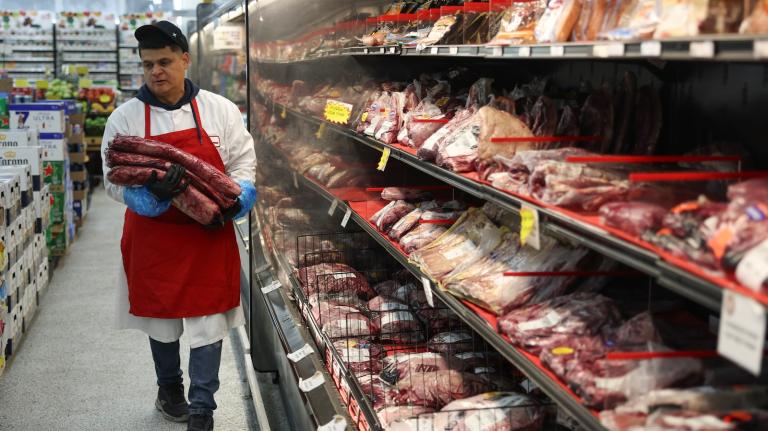
One of your typical long-haulers.
Is long-distance better than local?

Attention farmers' market shoppers: Put that heirloom tomato down and rush to the nearest supermarket.

By seeking local food, you're wantonly spewing carbon into the atmosphere.

That's the message of a budding backlash against the eat-local movement. The Economist fired a shotgun-style opening salvo last December, peppering what it called the "ethical foods movement" with a broad-spectrum critique.

Among the claims: organic agriculture consumes more energy than conventional, and food bought from nearby sources often creates more greenhouse-gas emissions than food hauled in from long distances. (Here was my response to that influential piece).

More recently, in a New York Times op-ed piece, the historian James E. McWilliams sought to debunk the idea that choosing locally produced food automatically decreases one's carbon footprint. He warns that efforts to reduce "food-miles" -- the distance between farm and plate -- might actually support higher carbon emissions at the source. And in Britain, a debate over whether to withdraw organic certification from African imports based on their transportation impact has spurred coverage of the issue as well.

In a sense, these high-profile rebukes are good news: they herald the arrival of the sustainable-food movement as a pop-culture phenomenon. Just as you're not really famous until you've been rumored to be gay or on drugs, a movement hasn't come into its own until it's drawn a formidable entourage of detractors.

A decade ago, few would have thought to analyze the efforts of eat-local zealots. But now, farmers' markets are booming, celebrity chefs are proudly decorating their menus with the names of nearby farms, and a steady stream of best-sellers is urging us to "come home to eat" (to paraphrase the title of Gary Paul Nabhan's popular 2001 book).

That surge has earned attention both positive and negative, and landed local-food advocates in a valuable position. By sniffing out easy sloganeering, a movement's critics can help it hone and deepen its analysis -- and reach the next level of acceptance.

Farm-to-Plate Tectonics


So how to respond to these critiques?

First of all, it's important to understand the context in which they come. The sustainable-food movement's achievements have thus far been largely cultural. In other words, despite all the attention from celebrity chefs, best-selling authors, and, ahem, environmental webzine columnists, the vast bulk of food consumed in this country still travels gargantuan distances, consumes unspeakable amounts of fossil fuel in its production and distribution, and leans heavily on poisons and water-polluting artificial fertilizers.

Way back in 1969, the U.S. Department of Defense performed what remains the only comprehensive nationwide study of the average distance food travels from farm to plate. The study's estimate, 1,200 miles, probably falls well short of the current mark.

Why? Because food imports are rising at a stunning pace. According to the USDA, the dollar value of U.S. food imports doubled [Excel] between 1999 and 2006. Over the same period, exports rose nearly as fast.

In short, while we "locavores" strive to minimize food-miles, and critics chide us for the effort, food continues to zip across the U.S. borders, gushing in from, and flowing out to, points all across the globe.

And while the sustainable-food movement's power may be causing vapors within the pages of the Economist and the New York Times op-ed page, Wall Street hasn't gotten the memo. In the stock exchanges, shares in agribiz powerhouses Monsanto, Archer Daniels Midland, John Deere, Smithfield, and Tyson are all trading at or near all-time highs. That means that the "smart money" isn't quite as impressed by the rise of buy-local campaigns as commentators on either side of the food-miles debate are. For unsentimental investors, the profit prospects for industrialized agriculture, geared for long-haul distribution, are rosier than ever.

Miles to Go


So food-miles are likely adding up at an accelerating rate, and may well continue to do so. Is that so bad? Not in the eyes of some. McWilliams makes the case that we should forget food-miles and focus instead on lifecycle analysis -- accounting for not just distribution, but also for energy burned in growing food.

This eminently reasonable insight leads him to a startling claim: that locally grown food under certain conditions burns more energy, and leads to higher greenhouse-gas emissions, than food produced thousands of miles away. Echoing The Economist, McWilliams trots out a recent study claiming to show that green-minded U.K. consumers should spurn locally grown lamb in favor of lamb grown in distant New Zealand.

Why? Because according to the study, "lamb raised on New Zealand's clover-choked pastures and shipped 11,000 miles by boat to Britain produced 1,520 pounds of carbon dioxide emissions per ton, while British lamb produced 6,280 pounds of carbon dioxide per ton, in part because poorer British pastures force farmers to use feed."

To McWilliams, the message is clear: U.K. residents should buy more New Zealand lamb, and reject local product. But over on Ethicurean, Small-Mart Revolution author Michael Shuman raises a key point about the study: it compares conventionally grown, feed-reliant U.K. lamb with lamb raised in New Zealand, where all lamb is grown on pasture.

But pasture-based organic U.K. lamb exists and is available. Wouldn't buying that be the greener option for U.K. consumers? The study doesn't comment on this option -- perhaps because, as Shuman points out, its authors are funded by New Zealand agribusiness interests that rely on export markets.

Act Locally, Think Regionally


What often arises in the food-miles debate, I think, is a false dichotomy: local vs. long distance. But the most attractive model might be a regional one. McWilliams touches on it, albeit vaguely, with a mention of a "hub-and-spoke system of food production and distribution." Crucially, he clings to the notion that Western consumers can continue to commandeer the globe's bounty perpetually, season be damned.

"Consumers living in developed nations will, for better or worse, always demand choices beyond what the season has to offer," he declares confidently, even though such choices have existed all of, say, 40 years.

At any rate, what could such a robust regional system look like?

Take North Carolina, where I live and help run a farm. The state stretches nearly 400 miles east to west, encompassing relatively cool Appalachian highlands and blistering-hot eastern lowlands. Orthodox "locavores" in either region commit themselves to various year-round privations: many vegetables wilt (or require heavy irrigation) in the eastern summers, and can't survive cold highland winters. But I like any idea that pushes local-food advocates beyond arbitrary constructions such as "100-mile" diets.

Currently, most supermarkets across the state tap into global production networks that rely on long-haul travel. But ideally, North Carolinians could eat regionally year-round if we organized to leverage these regional differences. What if the west provided the bulk of the state's food production in the summer months, and the east did so in the cold months?

To do so with any reasonable amount of environmental responsibility, we'd have to reject the temptation to transport food up and down the mountains in diesel-guzzling, highway-hogging 18-wheelers. Rather, as Rich Pirog of Iowa State University's Leopold Center for Sustainable Agriculture recently told me, "If we want regional food systems to be energy-efficient, we have to reinvest in rail infrastructure."

Pirog, who probably counts as the nation's most rigorous analyst of food-miles, told me that as recently as 1980, trains accounted for fully half of food transport in the United States. By 1997, following a period of low petroleum prices and steady decay of rail systems, just 13 percent of food traveled on trains. Trucks hauled the other 87 percent.

Thus rebuilding regional food networks -- presumably what McWilliams means by "strengthen[ing] comparative geographical advantages" -- requires something that critics of the eat-local movement rarely advocate: reinvestment in food-production and distribution infrastructure designed for something beyond maximizing agribusiness profit.

Such a regional conception requires not a rejection of the eat-local ethic, but rather a broadening of it.

Contra industrial-agriculture dogma -- implicitly echoed by McWilliams and other eat-local critics -- we'd still have to relearn the skill of thriving within the physical limits of relatively nearby landscapes. And we'd still have to think seriously about hard questions posed by Wendell Berry: "What will nature permit me to do here without damage to herself or to me? What will nature help me to do here?"

Tools: print | email | discuss | write to the editor | subscribe | RSS

Got a question about where your last supper came from?

Grist contributing writer Tom Philpott farms and cooks at Maverick Farms, a sustainable-agriculture nonprofit and small farm in the Blue Ridge Mountains of North Carolina.
< Previous | Next >
Comments: (28 comments)

You are not logged in. Thus, you cannot post a comment. If you have a Gristmill account, log in below. If you don't have a Gristmill account, well, by all means go make one! Meet you back here in five.

Username: Password:

Forgot your password? Enter your username and click:

Eat locally nonetheless

Mega-industrial food must be getting worried; they are already starting to push their flacks to work up dopey arguments against the logic of eating real food.
     "Carbon footprint" is too-too trendy a concept, and too vague a one as well.  The computational energy needed to figure out its putative values is more than I have on my desktop.
      So ignore those arguments, and just use the better ones for eating from local food sources:  the food is fresher, usually more varied, often grown with less reliance on petro-chemical agriproducts, usually brought to market without extraneous cosmetic enhancements (waxes, polishes, blushers and so on)--and it is more likely to be actual food, not "food products."  Locally grown food is often of better quality, and buying it often makes you face and talk to the people who grew it or raised it.  Knowing people--actual people--who put food in your belly has a certain satisfaction that never seems to occur when shopping in the supermarket.  

It really depends.

Growing grain in the prairie states would have less environmental impact than growing it in the southwestern deserts.

One thing about eating locally is people need to change their diets. Americans are used to getting food year round, in season or not. This would have to change to actually lower the impact that you make on the plent. Instead of worrying about an arbitrary distance of 100 miles, think about the consequences of your actions and the foods you buy. Instead of planning out your meals for the next week before you go shopping, purchase the food and plan from it. Just saying to buy food from 100 mile radius doesn't work. My milk comes from a dairy about 200 miles away. I also live in the California desert so the organic dairy to the north has less impact than a dairy locally. My buffalo meat however comes from a local farmer as do most of my in season fruits and vegetables. If you do have to purchase foods from a long distance (flour, rice and other grains for instance), purchase in bulk to reduce the impact.

One needs to be socially conscious of their decisions.

Food transportation

Food miles are rapidly becoming more complicated concept than a straight "as the crow flies" distance from the farm to your plate. While food in the conventional system often comes from further distances, the Economist article points out that the trucks are often packed efficiently ... more efficiently at least than a small pickup bringing 400 pounds of produce to a farmer's market. I have been undertaking a small study in my region and the preliminary data shows that the carbon imprint of both systems (per pound of food) is roughly equivalent. Mr. Philpott suggests that we use rail transportation on regional scale and I heartily agree that rail transportation would reduce the carbon imprint of our food. While we are all advocating and buying the tiny fraction of food that comes to us on trains, though, we have two sad choices: food trucked efficiently in semis, or small amounts of food trucked in a haphazard way to our local farmer's markets. Perhaps a temporary solution could be to organize the trucking of local food through farmer coops? Perhaps by making the distribution more centrally organized, we could have both efficiently transported and locally grown food.

Family farms

I had the same reaction when I read the NY Times piece- that the New Zealand study was nothing more than an effort to protect New Zealand's agricultural export industry. They must be worried!

If you're buying local from a mega-industrial operation (if that's possible!), then I can understand why some critics would question the logic, but most of the people supporting the local foods movement are usually buying from small-scale family farms in the area. Supporting family farms is beneficial not only because of carbon footprint reasons, but also beneficial in terms of animal welfare (usually, but not always-consumers should always try to visit the farm first to check conditions), preserving the character of a community, and helping the local economy. If you're buying from New Zealand, that's not happening. Well, unless you live in New Zealand.

eat local

The point is to decrease the burning of fossil fuels, pollution and depletion of resources. We need to switch to alternative energy and eat less meat.

Bong Hits 4 Jesus
Sustainability is just as important as location

Obviously, local is better in terms of energy output. But if it's a choice between sustainably grown produce from 400 miles away and pesticide-laden local produce, I'd choose sustainable. The output of energy to transport sustainable produce is far outweighed by the environmental impacts of locally produced food using corporate, conventional agriculture (not that that would be sold locally anyway, but whatever).

I do agree with the need to revitalize the rail system. Talk about efficient packing! Reducing the use of semi trucking would also reduce the wear and tear on our interstate highway system (and bridges... Minneapolis, anyone?) in addition to reducing air pollution.

The Economist and The New York Times obviously don't get that the MOST important factor in buying local is getting to know your producer. That way even if they aren't USDA certified organic, you can get to know their growing practices and decide whether or not you want to buy from them.

And there's something to be said for eating seasonally. You wouldn't (or rather, shouldn't) give a child candy every time s/he demands it (which is likely every five seconds), so why should Americans get out-of season produce on-demand? The impacts far outweigh the gratification.

Rail transport: Good food for USA

Opportunity knocks big-time here!  This is a chance to combine several national initiatives including health, fuel savings, job creation, plus more, I'm sure, that could be cited.

First, a national program to strenthen and expand our north-to-south rail infrastructure (a small version of what Eisenhower did with the interstate highway system) would broaden access to regionally grown foods from different climates in North America.  This leaves less need for intercontinental transport of many fruits and vegetables, and all the nutrition loss and who-knows-what-all-is-done to preserve a semblance of freshness.

Next, expanding the rail system will make a huge dent in our use of petroleum for transport.  Steel wheels on steel tracks already have only a fraction (about 1/7th) of the rolling resistance that truck tires have on pavement; so there is much energy to be saved.  But the expansion must involve some revolutionizing of power sources and rail car design.  Put our best hybrid technology to work powering trains with ground electric plus solar (and maybe a tiny diesel supplement).  

Then, make the cars much lighter by designing for shorter trains.  Much of the weight of conventional cars is required to withstand the immense tension and compression forces of a long train.  A very poor payload-to-curb weight ratio results.  Then, slow the speed to minimize air resistance and danger of mishap.  These smaller, slower trains amplify the energy savings.

This combination of rail transportation development will speed up the process of weaning us from foreign oil (national security), will give fresher food in greater variety (national health), and we can be sure than many new jobs will be created -- permanent ones, too.  We might also gain another area of American technology leadership.  

Dick Haines    

The Meat of the Matter

Interesting points, everyone. I have to say, that from a purely logical POV, we seriously have to think about eating much less meat. For example, it takes 16 pounds of grain to produce 1 pound of beef- how much carbon is realeased in growing the grain? Maybe we sould eat the grain instead of the poor-yield meat!

Not to mention the water to grow the grain, and hydrate the animal. With climate change, many places will be drier and water will become a hot comodity.

And what about those, um, "methane releases" from cattle and sheep? Methane is even more implicated in climate change than CO2 is! The methane studies cite livestock and sheep as the biggest contribtors.That's why New Zealand scientists are trying to genetically engineer non-methane releasing sheep to cut down their methane contribution, rather than tapering off the sheep farming.

Then there's the animal transport to the slaughterhouse. You can only pack so many of them in a truck. Not too efficient!

So, you've got animals which the raising and transport of leaves a large carbon footprint for such a low food yield, and they leave a methane footprint, to boot! Sounds like a no-win to me.

On another note, how about a return to Victory gardens and neighborhood gardens? Talk about local!

The Future is Not the Past

I agree with SnoDragon about choosing sustainably grown over local food if local sustainable isn't available. To grow food organically, or at least with reduced chemical inputs, a farmer has to undertake a number of fairly demanding task. To grow food locally, a farmer has to change... absolutely nothing!

Ethical consumption means examining the history of a product in order to influence what will be produced in the future. I am a vegetarian to avoid creating more demand for meat. The animals whose flesh is in the market freezer are, however, already dead.

By buying organic, maybe preferring small producers, we are encouraging other farmers to go organic in the future. Buying local at the farmers' market is fun, but all it does is maintain the status quo. (However, choosing local food at the supermarket encourages the store to stock more local food, so this is probably worthwhile.)

I'll Bet Your Grandmother Ate Locally

Ethical consumption means examining the history of a product in order to influence what will be produced in the future. I am a vegetarian to avoid creating more demand for meat. The animals whose flesh is in the market freezer are, however, already dead.

Where are you going with this?  If the animals currently in the freezer don't sell, then there's no need to restock them.  On a large enough scale, that means that fewer animals are bred for food.  That's not history, it's economics.  

If we looked at history, we'd realize that our current situation, where we have 30,000 items to choose from in the average American supermarket, has only existed for about 50 years.  For the rest of human history, eating locally was a matter of practicality, because only the rich could afford imported food.

Ideas like the "100-mile diet" really aren't that revolutionary.  Ask one of your older relatives, preferably somebody born before or during the Great Depression, about canning and pickling produce, about making their own jam and their own butter.  These were common everyday practices well into the mid-20th Century.  Somewhere in the prosperity of post-war America, we lost the ability to do things for ourselves, and started trusting the megafarms to deliver food to our tables.  Sustainability isn't just some left-wing moonbat ideal; it's our American heritage.

-- A.

Taking accounting to the extreme since 2004.

Su$tainability

I realize that these attacks on local are being made against the eco argument, so maybe I'm sidestepping, but let's not forget the economic impact of eating local.

To me, the eco argument is important, but not the strongest reason for eating local. While I'm concerned about calories burned and carbon footprints, I'm even more concerned that we even HAVE farmers sustaining themselves financially, especially farmers who know how to grow for their regions. If local communities are going to survive a major disruption of the global food chain (Peak Oil, war, more levees and federal bridges crumbling), then we need to build networks of local food systems now. Quickly.

That means establishing local markets by turning dollars over locally and breaking nationwide consumer reliance on the great state of CaliforniaTexasFlorida for food. This starts with campaigns like the Local Food Challenge of eating 80% local for a month.

And it'll work. Here in Minnesota, if Twin Cities consumers shifted even 10% of their spending from chains to locals for one day, the local economy would gain some $2 million. (*Source:  Andersonville Study of Retail Economics, by Civic Economics, October 2004 and MN Dept. of Revenue, Gross Retail Sales for 2003 via http://www.metroiba.org/about).

If that retained money flows toward food, in particular, then we start building the kind of food system that can actually sustain itself. ANd ourselves.

Trains and trucks

A renewal of freight shipment by train would definitely be environmentally welcome. Shipping freight by truck produces 180 grams of CO2 per kilometre, while doing so by train produces just 15. Clearly, switching freight transport modes offers considerable scope for emission reductions (as does reducing the total amount of freight shipped).

a sibilant intake of breath
Food miles --> carbon tax

The best way to choose food purchases, or any product, in order to minize carbon impact is to analyze the total carbon footprint throughout the lifecycle.

Unfortunately that's very complicated requiring lots of data collection and analysis and lots of guesswork. Food miles is a poor proxy for this, easier to calculate.

A much better and simpler alternative is a carbon tax. If major sources of carbon (starting with fuel) were taxed to reflect their true environmental impact, consumers would have a simpler choice to make based on price.

local food = organised genocide

Millions of African farmers depend on exports of their products to Europe.

If Euros decide to grow their own food, then we will see even more mass-poverty in the South. This means: bye bye rainforests, bye bye pristine eco-systems. Because poverty is the single biggest driver of environmental destruction in the South.

Eating globally is the best way to ensure poor farmers get some income, with which they can practise agriculture in an environmentally friendly way.

The GHG-emissions of long-distance trade are negligeable compared to those of processing. But global trade is ultra-important for the poor in the developing world.

local food = local economic benefit

My math may be off here, but it seems to me that the slash and burn agriculture in Africa, and severe desertification isn't really doing much for the environment there.  Maybe if Europeans grew their own food, Africans could grow their own and then not starve?  Just an idea.

what about Africa and Latin America?

Tom, I wish you would've addressed this.  While you did mention it briefly, you didn't come up with any suggestion on how to deal with the challenge that the "UK organic standards vs. African organic farmers" situation presents.  And Jonas is the only person to even mention it in the comments.

I'm not sure that using the term "genocide" ever helps to promote reasonable conversation, but I do think we're going to be seeing more and more clashes over competing "goods" (reducing carbon emissions and alleviating poverty).

While I'm an enviro, I'm even more of an anti-imperialist, and there's no doubt in my mind that the Soil Association's deliberations smack of a post-imperialist imperialism.  Full lifecycle analyses are necessary, and would likely vindicate small sustainable farmers in the global South.

Cheers,
Dave

Indeed, your math is way off

My math may be off here, but it seems to me that the slash and burn agriculture in Africa, and severe desertification isn't really doing much for the environment there.  Maybe if Europeans grew their own food, Africans could grow their own and then not starve?  Just an idea.

Your math is indeed way off. In fact, it's the entire opposite of what you say.

Poverty is responsible for slash-and-burn, low-yield, primitive farming. African farmers need income to transit towards much more sustainable modern farming techniques. They can acquire this income by selling stupid luxury food to Europeans (dwarf tomatos, star fruits, etc...).

With the money, they invest in modern inputs (e.g. improved seeds, micro-doses of fertilizer), which allows them to grow far more food and lift themselves out of poverty. Simple applications of micro-doses can triple yields for e.g. maize - you get the idea. But they need money for this.

If the local food mania were to result Europe's markets closing for Africans, that would be truly disastrous. More poverty would be the result, and a fall back to low-yield, primitive agriculture, i.e. mass famine, death and destruction on a vast scale.

If local food is not accompanied by a massive fund to compensate African farmers who depend on Europe's market, the the local food ideology is outright criminal.

Keep the Conversation Going!

I have one thing to point out about the article...

"This eminently reasonable insight leads him to a startling claim: that locally grown food under certain conditions burns more energy, and leads to higher greenhouse-gas emissions, than food produced thousands of miles away."

What are those "certain conditions"? The farm near my home uses well water, compost made from products of the garden and sun to grow their fruits and veggies. People pick up their CSA share and/or utilize the farm stand at the edge of the farm.

I'm feeling a bit stupid, but when I read these articles that are down with local, I wonder what energy is the above farm utilizing that "leads to higher greenhouse-gas emissions, than food produced thousands of miles away."

I'd love to understand where these articles come from and which farms/how many they are looking at when they conduct their research.

Who's the real culprit?

I think this argument is an easy way to shut down argument about a real issue on the left.  Poverty in Africa is not the fault of local-food consumers in Europe.  It's a complex question, of course, but before condemning your local farmer's market, how about confronting:

-The International Monetary Fund, which has forced governments all over Africa to institute structural adjustment programs which force them to divert desperately needed funds away from the poor in order to pay the interest on exploitative and predatory loans.

-Corporate polluters, the auto industry, and big oil, since much poverty in Africa can be traced to climate change.

-The imperialist governments that hijacked African societies and economies and built empires on their backs.  There absolutely should be a "massive fund to compensate African farmers who depend on Europe's market"-- the British, Dutch, French, etc. should be paying reparations to the countries they plundered!

It takes some serious chutzpah to ignore all of the above factors and equate eating locally to genocide.

Florida a food production state?

I am very intrigued by this statement: "nationwide consumer reliance on the great state of CaliforniaTexasFlorida for food."

Where the heck can I buy locally-grown food in Florida?  I don't think that I have ever even seen Florida-grown oranges in the supermarket.

Let's see, from where I am (Central Florida), about 30 miles up the road, there is a fruit and vegetable stand.  Not home-grown produce (based on inquiry of owner/operator). Probably bought wholesale, just as is supermarket produce.

But, on the way there, I pass a small farm.  Seems that every time that I pass, the old farmer is on his tractor...spraying pesticides and/or fertilizer.

The other day in the supermarket, I did pause to buy "Florida avocados" -- thinking that they might actually be grown in the state, at least.  When I asked the produce person about the "lite avocados", he agreed that they probably were genetically modified to be so.

sigh

As much as I would love to rely on the cabbage, tomatoes, peppers, and eggplant growing in the pots on my Back 40 (inches) of townhouse yard, it is just not possible.

However, the options aren't that great. (I choose sustainable/organic over conventional.)

Beyond my local co-op (about 40 r/t miles away), my only saving grace is Publix supermarket chain.  The headquarters and at least some manufacturing plants (as I understand it) are located nearby within 200 miles.  They make many of their own products, including a broad organic line. Their Greenwise Soymilk beats all others for taste!

NoPunProductions.com ~ AmericaTheGreen.org

Whose 'local' is this?

I despair -- not about Phillpot who, though I live in London, has become the guru-without-a-face on many food issues.  But when it comes to the 'local' debate, Grist couldn't look more provincial to us.  As a London friend of mine said, "If I 'ate local food' it would be cannibalism or pizza."  The 'real world' now is not about populations surrounded by rolling fields of grain; it is about feeding very hungry cities. And the 'local' debate is, I think, a strangely disguised debate between those city people and their initiatives (I am a food business journalist, so see their side as well as yours), and what seems an unsustainable, bucolic idea that 'good people' live close to 'good food'.  

Look at the problem of "food imports".  Are we talking about "food" in this phrase, or about "imports"?  It is a Sunday evening as I write & I am not going to consult my files for the tight figure, but the % of food import-content, by ship or plane, into most first-world countries is about 20%.  In Europe less.  

So, if we are protesting against the idea of "import" and its consequences, let's start with the other 80%, by looking at our clothes -- how many were imported already made, or how much of the fibre came from elsewhere (like wool from the New Zealand lamb)?  When it comes to electronics and baubles from China, how many us rule them out because they have 'travelled'?  I agree that we should try, for sound ecological reasons, to reverse the 'traffic' in products, and American cars are a case in point as their 'parts' do more 'traffic' before they are assembled than they ever do later.  Before I give much credance to the 'localism' of food arguments, I think I want more information about those 'local' farms, their lives on the farm, and the machinery -- how 'local' are all these?  I am saying that I think we are locked into a global trade with food, as with everything else, but the narrow food-focus on the argument will not engage us with the wider and more interesting issues.

paying the price

why is it that we never take into consideration how years of abuse to the land and our environment, to laborers and wildlife come at a high price. it is simplistic to talk jargon -- carbon footprint, food miles, ad infinitum -- when we're investigating the best way to turn the tide on environmental impact. how can we justify buying organic (??) edamames from China harvested by slave labor when we're perfectly capable of converting conventional farm fields back to organic farms and producing our own high protein vegetable that can feed the poor, nourish the middle class and be grown without exacting an enormous price on the environment. this is just one example which points to the fact that we have to take away the power of agribusiness like Monsanto which dictates the use of  chemicals in farming, ships their potent toxins to countries that don't ban them and the countries which, in turn, ship back the poisoned produce to the U.S. impacting both consumers and the environment and keeping businesses like Monsanto thriving which prevents the conversion from conventional farming to organic farming from taking place. i'm afraid it starts on a political level with the lobbyists of corporations and their "special interests." if only our lame democratic senators would begin to make a dent like they promised.

Make a difference with your groovy mind!
local to who?

michelefield - I live in London and I eat local food all the time!  Now not everyone is lucky enough to have a garden or (in my case) an allotment, but there are also dozens of farmers markets, as well as regular street markets and greengrocers and supermarkets that use 'made in the uk' as a selling point.  Britain - and indeed most of Europe - is both very densly populated and incredibly fertile, which makes it much more easy to eat local.
You raise a key point though by highlighting the 'import' question.  National boundaries confuse the issue to no end.  Now where Tom Philpott lives in North Carolina, if food is imported, it's come a long way.  But here in London, a carrot from France or a pepper from Holland might not have traveled as far as its 'made in the UK' equivalent.  It's not juste a European thing - think of the vast swathes of American territory that are closer to Mexico or Canadian breadbaskets than CaliTexFla.  
The bad news is that we can't rely on simple rules and reflexes - the good news is that knowledge is mounting, and that's what we really need to make decisions about what to buy and what not to buy.


Food Miles

The "efficiently packed trucks" argument is specious. When I lived in Seattle, I had a choice between veggies from a CSA in the Green River Valley (30 miles from my house) and veggies from southern California (1300 miles from my house). Even if the SoCal trucks carry four times as much produce as my CSA, the CSA could make ten times as many trips and still come out ahead. That's even before taking into account the fact that SoCal produce relies extensively on heavy use of pesticides (which have to be trucked from somewhere), fertilizers (ditto), and shockingly energy-intensive irrigation, while much of the produce at my CSA is hand-cultivated and relies on Pacific Northwest rainfall, fertilized by compost from the farm itself, and with no chemical inputs whatsoever.

And Seattle is a lot closer to southern California than the East Coast is, so the number of trips possible to make local still the best choice increases by an order of magnitude. And there's no point in comparing the car trips made by individual consumers to the supermarket versus the farmers' market unless the nearest farmers' market is in the next county. Anyplace I've ever lived (Seattle, Minneapolis, Berkeley) the farmers' market is usually closer, or at least equidistant.

Here in Berkeley, I walk to the farmers' market, and the trucks from the farms are on average half the size of a semi-trailer. SoCal tomatoes are still 500 miles away, but my friend Efren's are only 65 miles away. This is not differential calculus.  

sustainability vs organic

after reading several of the comments.  One point, there is a difference between sustainable farming and organic farming.  Organic farming can be intensive and does use a lot of nutrient rich materials that make there way into our stream systems.  

I think it is interesting that we are only looking at this issue from one issue, energy use.  Sustainable vs organic vs traditional farming effects our lives in multiple ways - water use, water quality, quailty of life, socieconomics....it cannot be reduced to a single issue.  Point in case, when I go the the local farmers market I am joined by the rest of upper-middle class educated people in my area.  There are a whole class of people left out that shop at the grocery store because it is cheaper, and when it comes to more food for your money there is no choice.

"Food Business " Quite Provincial

I think our London journalist needs to broaden her perspective.  When one considers what one puts in one's body, it is quite a different consideration from what one wears or plays with or even drives.  We are talking about physical well-being, long-term health, not to mention other not-so-minor issues like the planet's future. And hungry cities are full of people who need healthy food too!

Bucks County PA
What's the proven value of eating local?

Christine2007 wrote:

"I think our London journalist needs to broaden her perspective.  When one considers what one puts in one's body, it is quite a different consideration from what one wears or plays with or even drives. We are talking about physical well-being, long-term health, not to mention other not-so-minor issues like the planet's future. And hungry cities are full of people who need healthy food too!"

I thought the point of eating local was to (1) support the local economy and (2) reduce the number of miles, and therefore fossil fuel consumed, food has to travel.

Is there any evidence that local food is actually better for one's physical health? This is what Chrisine2007 is implying. It seems to me that the concept of buying local applies -- whether good or bad -- to all products we purchase. Whether you are buying food or clothing or any other product, the farther it travels the more harm inflicted on the environment.

So... is local food nutritionally superior to, say, rapidly frozen vegetables or meat flown several thousand miles from farm to table? if so, I'd like to see the evidence. Is this issue even more gray than I originally thought?

Definition of 'local'

In response to Mike who lives in London and eats 'local' -- well, for those London farmers' markets the definition of 'local' is 100 miles in all directions outside of the London area (which is already a big one).  There was a Slow Food survey of farmers' markets in Europe last year and it found a lot of variation in defining so-called 'local' -- most tried to stretch the distance so that they could sell 'local' fish, even very inland markets.

I do cheer on arguments for reducing transportation but that's for all the products in our lives.  The 'local' food mantra is, I think, doing harm now, as the message is 'worked over' and made more convenient.  I am shocked that some 3rd world economies, who have been encouraged to specialise in one particular crop for export, are now being told to 'eat it' too because it's 'local'!  Third world prosperity is partly defined, for individuals, by how far they can break out of the conventional diet of their parents and eat  un-local luxuries like veal or beef, if you're Chinese.  Artichokes if you're American.

My argument is that it's very easy to preach 'local' and very hard for anyone who does not own arable land (like 90% of the world?) and who does not lease an allotment, like Mike does (there's a waiting-list of 20 years for that plot of ground in most of London...) -- to take a comfortable position in this debate.  Making people feel guilty about the provenance of their food is not a way to encourage a better rapport with farmers, or with both foreign plants and meat which 'localism' encourages us to be xenophobic about.  I'd like to think that pressures are put on the American 'Farm Bill' vote that are really about good food and good environments for creating it -- not about its travel itinerary.  

You are not logged in. Thus, you cannot post a comment. If you have a Gristmill account, log in below. If you don't have a Gristmill account, well, by all means go make one! Meet you back here in five.

Username: Password:

Forgot your password? Enter your username and click:

The comments of Grist users reflect the opinions of those individuals only, and do not necessarily reflect the viewpoints of Grist, its staff, its board members, their psychotherapists, or their aestheticians. Got it?


Also in Grist

The Week's Most Popular


From the Archives
Forget the Farm Bill, by Tom Philpott. For now, local politics is the way to effect ag-policy change.
Whole Market Foods?, by Tom Philpott. Why the FTC is right to block Whole Foods' buyout of Wild Oats.
The Hand That Feeds, by Tom Philpott. Don't blame farmers for the farm-subsidy mess.

ADVERTISING POLICY


About Grist | Support Grist | Jobs Board | Archives | Grist by Email | RSS | Podcasts
Gristmill Blog | In the News | Ask Umbra | Muckraker | Victual Reality | 'Tis the Season | The Grist List | The Bottom Line


Grist: Environmental News and Commentary
a beacon in the smog (tm) ©2007. Grist Magazine, Inc. All rights reserved. Gloom and doom with a sense of humor®.
Webmaster | Privacy Policy | Terms of Service | Trademarks