if they african do it, why can't we?

Why the climate movement needs more Ethiopian-style activists 10

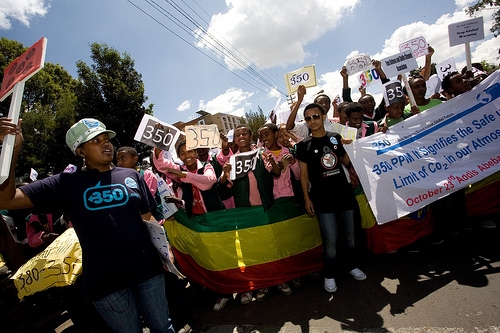
Of all the amazing stories that emerged from last month’s historic International Day of Climate Action, the one that really caught my eye (and made my jaw drop in disbelief and admiration) was that of 15,000 Ethiopian students swarming though the streets of Addis Ababa brandishing 350 signs and whooping it up big time in support of bold global climate solutions.    

If you haven’t seen the video yet, check it out. It’s definitely something to behold.

Less jaw-dropping was the turnout at our action in D.C. which topped out at less than a thousand. Considering the massive outreach and buzz-building effort my fellow organizers and I invested in the event, that number should have been much closer to what they got in Addis Ababa. But somehow we didn’t even come close. So what exactly did the Ethiopians have going for them that we didn’t?

Sunny weather, sans monsoon-style rain was certainly one factor. But there had to be more to it than that. After all, this was supposed to be the mother of all climate actions, our last big change before Copenhagen, before one of the most vitally important meetings in human history to give our leaders the kind of big grassroots push they need to really do something. With so much at stake how could anyone who cares about this issue have let a little rain keep them away from marching with us? Why wasn’t everyone there?

Roz Savage asked the same question about the turnout at her Oct. 24 rally in London, and she suggested a pretty good answer: global warming is a downer. People just don’t want to think about it. They’ve got enough problems to deal with in their everyday lives. And, you know, she’s absolutely right. The real reason for American activist apathy is that to most Americans, climate change is just another problem—one of a million things to worry about instead of the ultimate crisis. Worse, for most of us it actually sits pretty low on the totem pole of problems. In polls Americans consistently rank the economy, war, and health care well above climate change in the triage of issues to worry about. And this isn’t because people don’t appreciate how serious climate change is. It’s just that we only appreciate it intellectually. We don’t yet feel it in our everyday lives with the same kind of visceral immediacy with which we feel economic or health care problems, and for that reason most people just aren’t ready to take to the streets for it, rain or shine.
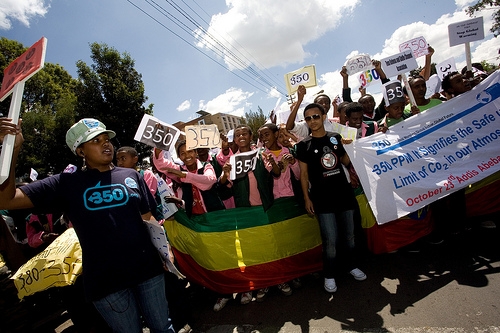
Ethiopian 350 protest. Photo courtesy 350.org via Flickr And this brings us back to those kids in Ethiopia. Sunny weather and good organizing aside, I’d wager that what really drove them to the streets was the one thing that the climate movement in America (and most of the industrialized world) is missing: a sense of urgency, a visceral appreciation of the problem. The kind of urgency and visceral appreciation that comes from experience with the kinds of hardships that catastrophic climate change will impose: drought and famine, political, social, and economic instability. Ethiopia’s effort to escape such miseries has been slow and arduous, and the fall back into their grip wouldn’t be very far. The country ranks at 171 out of 182 countries on the U.N. human development index, making it one of the most vulnerable countries in the world to the catastrophic impacts of runaway climate change. Such vulnerability has a way of inspiring serious street stomping action on the scale that we just saw in Addis Ababa.

So does this mean Americans may have to experience a few climate induced disasters like an agricultural collapse or a string of additional Katrinas before our climate movement can reach the kind of scale that we really need right now? Maybe, but I certainly hope not. I hope the movement expands along the lines suggested by my colleague Ted Glick—not as an explosive reaction to a national trauma, but as a kind of outgrowth and blossoming of the many seeds climate activists have been planting recently via the mounting anti-coal demonstrations and big days of action like the 24th. But however that growth occurs, one thing is for certain: if it’s going to have any serious impact on policy in the time frame that we need, it has to happen fast. And to make that happen we’re going to have to somehow quickly shake off our remaining climate complacency and start feeling the kind of visceral urgency that seems to be inspiring the Ethiopian climate movement.

That’s right, America: In order to help save the world, we’ve got to wake up and start thinking and acting a lot more like Ethiopians.


Keith Harrington is the Maryland/DC Field Organizer for the Chesapeake Climate Action Network.

Advertisement
Advertisement
  1. Rip Van Winkle's avatar

    Rip Van Winkle Posted 4:12 pm
    03 Nov 2009

    Don't forget also that many of the political revolutions throughout Africa, including Ethiopia, have been driven by students. In my generation here in the States, there seems to be a cultural of insitutionalism- young people just aren't as quick to take to the streets as our parents and grandparents in the 60's. I wonder how the culture of activism among Ethiopian students compares with our's here.
  2. Rip Van Winkle's avatar

    Rip Van Winkle Posted 4:13 pm
    03 Nov 2009

    And if any of you guys from the march in Addis read Grist, please post here to let me know.
  3. Billhook Posted 5:26 am
    04 Nov 2009

    Those Ethiopians may have had some personal fear of starvation, but I suggest that such personal fears are a minor part of the motivation for marching -

    The really potent driver as far as I've seen over the decades is people having a sense of solidarity with some vulnerable community who are being threatened by some malign or callous policy.

    Thus I think that what the climate movement needs very urgently is to waken a sense of SOLIDARITY ! with the Ethiopians and others who are right in the path of the genocide-by-famine that American policy is advancing. Nothing less will do the job.

    Regards,

    Billhook
  4. LoriP Posted 12:23 pm
    04 Nov 2009

    It's truly fabulous that Ethiopians took to the streets for climate change. You're right that a warming climate will badly impact most Ethiopians, so their fear is very real. Sadly, the Ethiopian government is promoting the opposite of what they should be to climate-proof their population: a series of river-killing large dams that will affect hundreds of thousands of people, and make their ability to adapt to climate change almost impossible. Dissent within the country on this "hot topic" is repressed. If the gov't was serious about addressing the adaptation needs of its people, it would be protecting key water resources, and building decentralized energy and water supply throughout the country, especially in rural communities. (For more info: http://www.internationalrivers.org/en/node/4180)
  5. randino Posted 5:22 pm
    04 Nov 2009

    This is not just an issue of the climate. The progressive community helped elect Obama, and then went home. On issue after issue - health care, Afghanistan, the banks, climate - the passivity has been thunderous. Internet activism is proving to be a double edged sword. It has removed a lot of the drudgery of past activism, but at the same time it is an activism of an isolated individual, at a lap top or PC, venting by text, twitter or e-mail to the powers that be. Coming together as a group, face to face, the intimacy and social nature of activism has been eroded. Some of us remember just the opposite experience of activism - the power of turning out a big demonstration, the inspiration of marches, and let us not forget how much fun we had. I am not a Luddite, but one thing we have to do is quit hiding behind our computers, and start building the community of activism that we once had, and can still have. That is only done with face to face relationships.

    Randy Cunningham
    1. HealthyHiker Posted 6:23 pm
      04 Nov 2009

      Randy, I completely agree. We need to restore direct, face to face organizing.

      There needs to be more organizing training so that people know how to lead and respond in this way.
  6. HealthyHiker Posted 6:18 pm
    04 Nov 2009

    Hello Keith,

    If you are interested in my perspective, I don't take part in climate action events because I believe it will take change in many areas of environmental policy to achieve climate change carbon reduction goals.

    So, I push for policy that will shift our manufacturing to producing products that are durable and non-toxic. I support sustainable land use so that natural resources are used efficiently. This also includes advocating the preservation of forests- which provide enormous carbon capture.

    I also commit to efforts that will ensure our electoral system is reformed so that we can elect candidates who truly represent our concerns and will work for the policies we want implemented.

    Regarding marketing for your event, I only recently learned what 350 even meant. For your average American, they probably had no idea.

    Best of luck with turnout for your future events.
    1. Billhook Posted 6:29 am
      08 Nov 2009

      I'm intrigued by the logic of your position :

      "I don't take part in climate action events because I believe it will take change in many areas of environmental policy to achieve climate change carbon reduction goals.

      So, I push for policy that will shift our manufacturing to producing products that are durable and non-toxic. I support sustainable land use so that natural resources are used efficiently. This also includes advocating the preservation of forests- which provide enormous carbon capture."

      While campaigning on climate policy is not everyones' idea of a happy way of life, I wonder if you recognize that without success at the global and national policy levels then all other actions for the sustainable integration of society within the natural ecology are critically undermined ?

      There is also the issue of displacement arising from well meant conservation efforts in one place simply causing greater extraction of resources elsewhere - forestry being a case in point. Where I live in Wales much of the woodland is preserved, meaning that even mighty oaks must be left to go past their prime, age, fall and rot, and that local hardwood demand is then met by imports of rainforest hardwoods or of the yields from the ongoing rape of the Russian temperate forest cover.

      For this reason I wonder if you might be persuaded to support sustainable productive forestry, as opposed to mere preservationism ?

      With regard to the received wisdom of forests providing "enormous carbon capture" it would be helpful to describe how this occurs. I see of course that forests hold huge volumes of carbon as standing 'Carbon Banks', but, the world's great natural forests are essentially static in their scale and carbon capacity, so where is the sink ? The soils of both Boreal and Tropical forest tend to be similarly stable - e.g. the Amazon rainforest, at about 60 million years old, has an average of a foot of topsoil under it - Some temperate forests can develop substantial soil depths, but they are a very minor part of global forest cover, and so have little effect on the average carbon sequestration rate per hectare of forestry globally.

      So can you say where this enormous carbon capture is occuring ? Or could it actually be a myth propagated by the rainforest-preservation lobby attempting to get its special interest loaded onto the climate bandwagon ?

      Regards,

      Billhook
  7. Des Emery Posted 10:56 pm
    04 Nov 2009

    Yeah, there are many reasons for our apathy over here. One reason is that we have it so good nowadays that our pre-occupation is with making even more money (and yes, I know that unemployment is on the minds of most of us, most of the time). Then we drive our cars to the corner store. We turn down the air conditioning or push up the central heating in the winter. We know the bus will be along every five minutes and we hope the kids will like the new (every few months) video game we just got them.

    We find it too comfortable using what we already possess before we have to start thinking about what the future might hold - except for the good things, like more money, another car, a quieter air conditioner, a louder video game.

    When Marie Antoinette was told that the crowd outside was screaming because "there was no bread" she famously said "Well then, let them eat cake!" But she wasn't being facetious nor insulting. She really had no comprehension of what it meant to be hungry since the concept was so totally foreign to her, living in her castle all her life, with her every need or want or whim promptly met.

    Until there is no gas to pump into your car or your lights brown-out when you adjust the thermostat or your kid starts crying because there is no new video game to plug into the TV, then Ethiopians will have to march alone.
    1. randino Posted 5:51 am
      05 Nov 2009

      There was a term from the old 1960s Weather Underground that sums up your attitude, Des Emery. "The masses are asses." It is a complete non-starter as a tactic or strategy. It is a posture and pose of superiority and we really don't need it. We have enough problems.

      Randy Cunningham

Add a Comment

You are not logged in. Thus, you cannot post a comment. If you have an account, log in. If you don't have an account, well, by all means go make one! Meet you back here in five.

Hello, Visitor!    Why not register?

Advertisement