(Part of the How to Talk to a Global Warming Skeptic guide)
Objection: There was global cooling in the '40s, '50s, and '60s, even while human greenhouse-gas emissions were rising. Clearly, temperature is not being driven by CO2.
Answer: None of the advocates of the theory of anthropogenic global warming claim that CO2 is the only factor controlling temperature in the ocean-atmosphere climate system. It is a large and complex system, responsive on many different timescales, subject to numerous forcings. AGW only makes the claim that CO2 is the primary driver of the warming trend seen over the last 100 years. This rise has not been smooth and steady -- nor would it be expected to be.
![]()
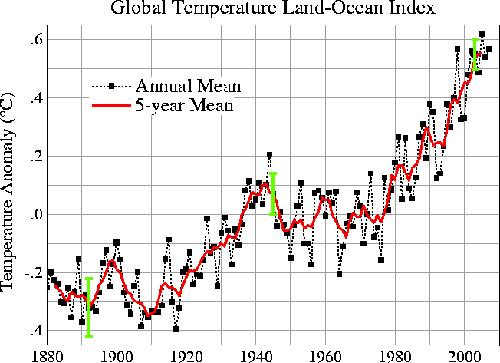
If you look at the temperature record for the 1990s, you'll notice a sharp drop in '92, '93, and '94. This is the effect of massive amounts of SO2 ejected into the stratosphere by Mount Pinatubo's eruption. That doesn't mean CO2 took a holiday and stopped influencing global temperatures; it only means that the CO2 forcing was temporarily overwhelmed by another, opposite forcing.
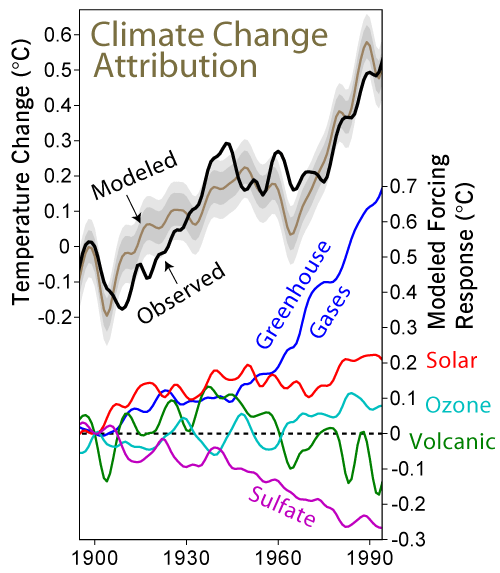
The situation is similar to the cooling seen in the '40s and '50s. During this period, the CO2 warming (a smaller forcing at the time) was temporarily overwhelmed by by other factors, perhaps foremost among them an increase in human particulates and aerosol pollution. Pollution regulations and improved technology saw a decrease in this latter kind of emissions over the '60s and '70s, and as the air cleared, the CO2 signal again emerged and took over. Below, courtesy of Global Warming Art, is an image of the current understanding of the factors and their influence for the climate of the past century.
![]()
As the graph shows, in addition to aerosol pollution (the sulphate line), volcanic influences were increasingly negative during the period of global cooling, and solar forcing slightly declined. All forcings taken together and run through the model are a very good match for the observations. (Please see the source page for details of what model and what study this image is derived from.)
Rather than confounding the climate consensus, mid-century cooling is actually a good test for the climate models, one they are passing quite convincingly.
Addendum: The opposing effect of cooling from airborne pollutants is often referred to as "Global Dimming", and Real Climate has a couple of articles on it:
One emerging concern is that as the pollution causing this effect is gradually cleaned up, we may see even greater greenhouse gas warming.

Comments
View as Flat
Delay And Deny Posted 5:00 am
03 Mar 2007
AGW only makes the claim that CO2 is the primary driver of the warming trend seen over the last 100 years.
Well, if it's the "primary" driver then it should have overwhelmed the SO2 during that period.
All you've done is proved that NGHers (Naturogenic Global Heaters) that the natural production of sulfur dioxides is far more powerful regulator of temperature than tail pile CO2.
The Texeme Construct offers international text memetics construction and textcasting services.
Permalink
Delay And Deny Posted 11:20 am
07 Mar 2007
Not only does the argument not make sense here, but the reverse makes no sense either. Take this chart
Exhibit A
Well, check out the temperature change from 1910 to 1950. It's goes from 13.5 to 14.1. Then there's the "SO2 lull" as you like to think it.
Ok, then from 1980 to now it only goes up about 0.5 rather than 0.6
So how could the CO2 "hockey stick" of the last 30 years push the temperature up less, or even, just as much as the non-hockey stick period?
There is no correlation whatsoever with temperature and CO2 -- anthropogenic or naturogenic!
The Texeme Construct offers international text memetics construction and textcasting services.
Permalink
Alastair Posted 7:14 am
17 May 2007
If you look at the temperature record for the 1990s, you'll notice a sharp drop in '92, '93, and '94. This is the effect of massive amounts of SO2 ejected into the stratosphere by Mount Pinatubo's eruption. That doesn't mean CO2 took a holiday and stopped influencing global temperatures; it only means that the CO2 forcing was temporarily overwhelmed by another, opposite forcing.
If you take a closer look at the graph, you'll see that there are dozens of similar sharp drops to the one in the early 1990's, they seem to occur with a frequency of 5 to 10 years. The sharp drop in the early 1990's is completely unremarkable in this sense therefore I see no sound basis for suggesting that the cause of this drop was due to the Mount Pinayubo eruption.
Permalink
GreyFlcn Posted 9:17 am
17 May 2007
http://www.greyfalcon.net/forcing2.png
http://www.nasa.gov/centers/goddard/news/topstory/2007/ae ...
Permalink
Alastair Posted 10:22 pm
17 May 2007
Permalink
cce Posted 5:34 am
25 May 2007
Permalink
Alastair Posted 2:38 am
24 Jun 2007
Early 20th century temperature rise was due to the increase in solar activity and the increase in ghg. The mid century lull was due to increasing particulate emissions, especially sulfates, at a rate much faster than GHG. Post ~1980 warming is due to much faster increasing levels of GHG, and flattening and then declining SO2 emissions.
It's very unlikely that the mid century cooling effect was due to sulphates. The reason for this is sulphates largely originate from sulphur which forms a part of all fossil fuels especially coal has a large percentage of sulphur. So since the beginning of the industrial revolution sulphates and greenhouse gas emmissions would largely have increased together, ie in relative terms sulphate emmissions would have been higher than greenhouse gases (in relative terms) much earlier on in the industrial revolution before there were any environmental regulations governing sulphur pollution. However, since the industrial revolution wasn't accompanied by cooling the suggestion that cooling this century was caused by sulphates can more or less be dismissed.
Since it can be shown that mid century cooling cannot have been caused by sulphates, it strongly suggests that the dominant mechanism governing global temperature is natural.
Permalink
cce Posted 7:53 pm
09 Jul 2007
Permalink
fulldroolcup Posted 2:49 pm
12 Aug 2007
controls adopted in the West.
They can say "Hey, shall we leave the sulfates in, and cool the planet, or take them out, and cook it"?
IOW they will go all virtuous on us and say that their sulfates are counter-acting global warming, and you will be faced with a brand-new argument, which is that whatever their other deleterious affects, sulfate emissions have a "good" side --- as does CO2 (essential to plant life and all that).
And errr...ummmm....you aren't using that bogus hockey stick as a reference are you?
Finally, please read this:
http://en.wikipedia.org/wiki/Sulfate
"The indirect effects probably have a cooling effect, perhaps up to 2 W/m2, *although the uncertainty is very large.*
Sulfates are therefore implicated in global dimming, which may have acted to offset some of the effects of global warming."
Can you please explain how that very large uncertainty gets fitted so nicely on that graph?
Permalink
carboncat Posted 9:58 am
03 Sep 2007
It's easy to fit a model to existing data. And you don't have to be consciously trying to cheat either. It's a natural human tendency.
For example, around 1900 the data and the model fit almost perfectly. Yet nobody was doing climate modeling of this kind in 1900.
Therefore, the chart is nothing more than an exercise in PR. It's not science.
Permalink
rcglinsk Posted 5:37 am
24 Mar 2008
The problem with the response to this argument is it paralels a sceptic claim about the problems with the global warming theory. Sceptics would say there's no real evidence any of this warming was not due to natural causes. The response to the argument about mid century cooling takes the form of: there's no real evidence any of this cooling was not due to natural causes. You can't have your cake and eat it too.
Permalink