Dear Umbra,
I live on Long Island, N.Y., and am interested in getting solar power for my home. I am not sure, however, if that is viable in this area. Do you have any recommended reliable sources that I can reference? There is just so much confusing information in the marketplace.
Thanks,
Rick
Port Washington, N.Y.
Dearest Rick,
Don't thank me until you've tried my recommendations in the marketplace.
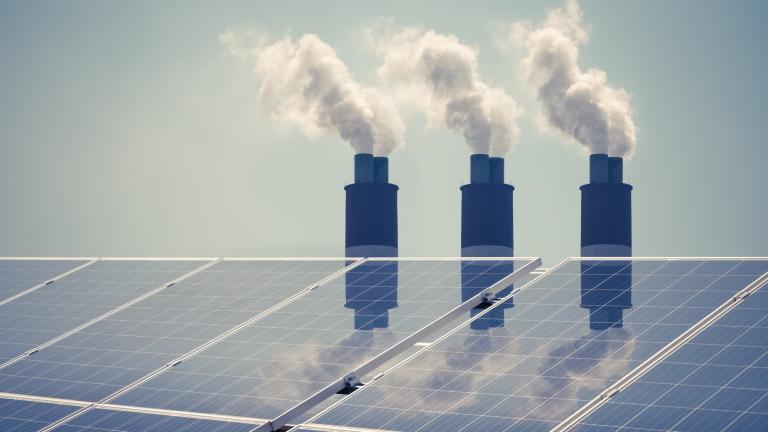
Solar power to the people.
Photo: iStockphoto
Your county's rating for solar is "good," according to Findsolar.com, a private/public collaborative website that has various worksheets helping you figure out what solar can do in your area, what size array you might need, how much it will cost, etc. (I am missing the necessary information that would help me give you a more complete answer, such as your utility.) Findsolar also has contractor listings and many handy tips on preparing for, choosing, and installing solar systems. There are other resources to divine your solar potential, such as NASA's very detailed Surface Meteorology and Solar Energy data retrieval site, and the moderately detailed National Renewable Energy Laboratory solar performance calculator. But Findsolar is a good first step.
I'll talk about solar water heating and passive solar design in the next few weeks, but you sound like you're thinking about solar electricity. Sun availability is one concern, another is what zoning laws apply to your solar daydreams, a third is whether net metering is available to you in Port Washington, N.Y. When your photovoltaic system supplies your home electric usage, any extra is sold to the local utility, making your electric meter run backward, and you still buy power from the utility when the solar doesn't provide power. This is net metering, and is generally the relatively easiest and cheapest way to go. If Port Washington doesn't permit net metering, you would need to buy storage batteries; this can be prohibitively expensive where the municipal power grid is easily available (if you are far from power lines, solar can be financially comparable to bringing power lines to your home). Your questions should be easily answered by a contractor or the local land-use and planning office.
If you do decide to invest in solar panels, the payback period is a long one, and you will be highly motivated to conserve -- because if you are net metering, you want to use your own power whenever you can, not buy it from the utility. Additionally, when you buy solar (as when you buy a home heating system) an important planning aspect is sizing the correct system to your needs. So before going solar, it makes sense to tightly button down your house. The smaller your needs, the cheaper the system. Do your best to make your power usage as small as realistically possible before you get someone to size your array. All the basic conservation measures apply, from light bulbs to efficient washing machines to power strips turned off at night. The internet can offer thousands of conservation checklists and home energy audits to start you on your load-reduction project; here's one from Lawrence Berkeley Laboratory.
After you've worked on the changes necessary to make your house more energy efficient and received your new energy bills, return to investigating your solar potential. Do a few calculations of your own using the Findsolar resources, and then I think you'll just need to start calling contractors. Best of luck.
Sunnily,
Umbra
Comments
View as Threaded
JPGunshinan Posted 3:08 am
11 Jun 2007
Permalink
JPGunshinan Posted 3:10 am
11 Jun 2007
Permalink
danielbarker123 Posted 5:47 am
11 Jun 2007
In California, the average consumption of electricity is one kwatt. How much do you use?
Assume you reduce power consumption to one kwatt. Then you will need a kwatt system. At five dollars a watt, that is five thousaand dollars.
The system will procuce one kwatt for about four hours a day, peak sunlight hours of ten to two. It will produce less other times of day. So you will need additional power panels, bringing the cost up to about ten thousand dollars.
Then you factor in cloud cover, which averages forty percent. So you need additional solar panels.
Next, the solar panels produce DC, and your house runs on AC. You will need a power invertor. The prices have dropped dramatically, a three kwatt invertor is about three hundred dollars.
Last, you will need batteries to store your power when the sun isn't shining, which costs thousands of dollars.
All told the system could easily run forty thousand dollars.
Now here is how you make one change and reduce the cost by at least ninety percent.
Decades ago a French physicist studying solar cells increased voltaic output by reflecting additional light on the cell. At the end, he was able to produce an astounding one thousand times the rated output, an increase of one hundred thousand percent!
What does this mean? Simple - instead of merely mounting solar cells on your roof, install reflecting cells (which cost a fraction of the price) and project the sunlight off the house and onto the solar cells. This has two benefits.
The first one is obvious - by concentrating the light, we do not need the tens of thousands worth of solar cells. Can you guess what the second benefit is? In the summertime, reflecting sunlight off the house eliminates heatbuildup, keeping the house cooler. The solar system can easily be designed to do a parallel job, reflecting infrared (heat) rays on the west side of the house which will also help keep the house cooler.
I hope you find this encouraging to go solar.
Permalink
kyotousa Posted 7:10 am
11 Jun 2007
If you want to know what's in the works around the country, see Vote Solar at http://www.votesolar.org.
And finally - a word about the question "What's the payback on the solar system"? When you buy underwear, soap, food, cars, and all of life's necessities (OK, maybe not everyone will agree on the underwear), does one ask the salesperson about the "payback period"? Of course not! And it's about time we stopped asking it about renewable energy. It's now or never!
Permalink
DeCapeJack Posted 12:16 am
12 Jun 2007
Umbra's suggested considerations are spot on, as usual. However, there is possible gov't assistance available, depending on your state regs and utility. Here in Delaware, I may receive a grant towards the installation of PV panels, and this would cover up to $6000. Also, Uncle Sam offers a $2000 annual tax rebate for those that qualify. As the ad says, your millage may vary, but you may want to check out if your tax dollars can work for you.
Permalink
greenerpastures Posted 1:26 am
12 Jun 2007
Permalink
Delay And Deny Posted 4:57 am
13 Jun 2007
Well, according to "FindSolar.com" if I outfitted my one bedroom apartment for solar, it would have a ROI better than most of my stocks and mutual funds!
65%
I would save 80.0 tons of CO2.
Installation costs would be $36,000.
However, this is an apartment, so I would think that landlords of these big suburban complexes should really think about solar.
Oh, and on the other side, more people should think about living in big suburban complexes, which are a really nice sweet spot between sprawl and hypercompactness of urbanism, if for no other reason that the seem really primed to be retrofitted to solar, fuel cells, and so on...
Permalink