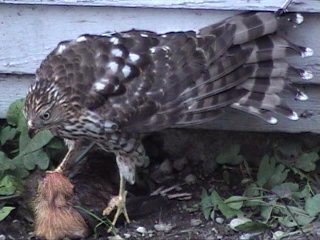
I received a strange phone call yesterday from my youngest daughter. "Dad, a hawk is eating Pinkfoot!" Pinkfoot was my daughter's Bantam hen, which won Best in Show at the fair this summer. I raced home to find a fairly large hawk making short work of said hen and it had no intention of leaving until finished with its meal. I don't know what species it is. Maybe someone can identify it in the comments. My daughter was upset but not unduly so. She wants to be a farmer when she grows up and knows chickens have eyes on the sides of their heads for a reason.
I heard a robin going ballistic earlier in the day and had wondered about it. You don't usually hear the sound of upset robins except in the spring when they're defending their nests and fledglings from crows and cats. In hindsight I realize that the robin was probably harassing this particular hawk. Our neighbor has a pear tree that attracts lots of birds. My guess is that the plethora of birds attracted this hawk, which was probably sitting in the pear tree watching my daughter's chickens in their coop. We won't be letting the chickens out into the yard for the next several days. Coincidentally, two of my relatives (who both live in cities) have also had birds eaten by hawks in their back yards this year.
Farmers have and always will be locked in a battle with biodiversity. I view farms as unnatural necessary evils. We have to eat, but they drive species to extinction all over the planet -- the fewer, the better. The last thing we should be doing is expanding them to fuel our cars.
Comments
View as Flat
sunflower Posted 12:02 pm
24 Sep 2008
Permalink
PBrazelton Posted 2:03 am
25 Sep 2008
I understand that a decent sized hawk could take a bantam, but what about a standard? We have bantams and full sized birds, and I'm wondering if a hawk would try to tackle on of my Dominiques. They're BIG birds.
Permalink
Biodiversivist Posted 2:51 am
25 Sep 2008
In the end, it all comes down to biodiversity. Poison Darts--Protecting the biodiversity of our world
Permalink
sunflower Posted 8:53 am
25 Sep 2008
It could be worse. A champion breeder of carrier pigeons released his stock out here and our nesting Peregrine Falcons took one out directly above us. Spectacular flight drama. Fast birds. Peregrines love pigeons. He lost $500 or several thousand dollars if it was one of his two champions, said he will never again release birds on Fox Island.
Permalink
caniscandida Posted 3:52 pm
25 Sep 2008
I agree that the hawk is either a young Sharpie or a female Cooper's. The proportions -- small head, long legs, long tail -- are right for Accipiter. The shape of the tail ought to be diagnostic, but this one has fanned out its tail, so its "true" shape is hard to tell.
Its size also is hard to tell from this photo. But inasmuch as it killed a chicken, that would favor its being a Cooper's. Sibley says of the 11"-long Sharpie: "Hunts from concealed perch or in low patrolling flight; captures small [!] birds by surprise in lightning-quick strikes, using bushes and ground as cover. Our smallest [!] accipiter ... " And of the 16.5"-long Cooper's: "Feeds on small birds and mammals captured in surprise attack. A medium-size accipiter; always larger than Sharp-shinned Hawk, but size difficult to judge." Still, size might not matter; in Central Asia, eagles have been trained to kill wolves, mein Gott!
Two curious features:
Neither Sibley nor Peterson shows white on the scapulars, which is plainly visible in this photo. But Donald L. Malick, illustrating both Sharpie and Cooper's in the National Geographic field guide, shows white on the scapulars in both. Also, both eligible forms are identified as immature females.
The most distal dark stripe on the tail does not seem so broad as the next one in, something which none of my illustrations shows. But that could be the effect, again, of the spreading of the tail.
By the same token, if we were to observe the tail in a less dilated posture, it is likely that the white at the tips would seem broader, which would tend to rule out the Sharpie and favor the Cooper's.
Chickens deserve our true friendship! So do fish! So do other sentient beings! Let us learn to be kind.
Permalink
naught101 Posted 2:19 pm
02 Oct 2008
Anyway, farms might be necessary, but farmed animals aren't. Go permaculture/vegetarian, and you're sorted.
Otherwise, you could just grow more chickens, enough to increase the population of hawks, then eat some hawks as well...
check out http://www.envirowiki.info, the knowledge database for environmentalists and activists.
Permalink
Biodiversivist Posted 3:05 pm
02 Oct 2008
In the end, it all comes down to biodiversity. Poison Darts--Protecting the biodiversity of our world
Permalink
sunflower Posted 11:34 pm
02 Oct 2008
Permalink
Whiskerfish Posted 5:53 pm
28 Nov 2008
- vertical streaking on breast, general brown top tells me it's a juv.
(Note: juvenile birds will often go for easier prey; domestic animals do not usually have the same predator avoidance awareness as wild animals. Most raptors that come into conflict w farmers are juvs who haven't yet learned to take on more 'difficult' wild prey.)
Why a Cooper's and not a Sharp-shinned?
I can't tell the size of the bantam exactly, but if it's the size of 'regular' bantams then this hawk is way too big to be a sharpie. Sharpies are tiny. Really tiny.
also, streaks on breast are narrower and less rufous than you would expect streaks on breast of a Cooper's to be, although the image doesn't show these so well.
Accipiters are notoriously tough to ID -- at least in N America you only have 3 to choose from. In the rest of the world it's often another story. (I had Accipiter rufiventris displaying over my house a coupla days ago. I also often see Accipiter tachiro overhead, and occasionally also Accipiter melanoleucus. Ha ha. Where am I?)
Cheers
Whiskerfish
Permalink
Whiskerfish Posted 5:57 pm
28 Nov 2008
And you thought bird ID was simple ;) I have 20 yrs experience and I still get caught short!
Cheeers
Whiskerfish
Permalink
Whiskerfish Posted 6:01 pm
28 Nov 2008
Cooper's Hawk is colloquially known as Chickenhawk particularly in the south of the US. That's not an accident.
Whiskerfish
Permalink
Biodiversivist Posted 2:05 am
29 Nov 2008
Just yesterday my brother-in-law (in response to reading about our hawk problem) told me about a bald eagle he saw eating a duck on the end of a dock. The dock owner made the mistake of trying to shoo the eagle away and got chased off the dock instead.
In the end, it all comes down to biodiversity. Poison Darts--Protecting the biodiversity of our world
Permalink