Among the barrage of energy-related bills already unleashed by the 110th Congress, one of the most progressive comes not from the newly empowered Democrats, but from Republican Sen. Ted Stevens of Alaska, a zealous proponent of drilling in the Arctic National Wildlife Refuge. Just as peculiar, one of the bills that most rankles environmentalists comes from Democratic golden boy Barack Obama, the junior senator from Illinois.
Stevens flabbergasted many on Capitol Hill last week when he introduced legislation that would require passenger cars sold in the U.S. to get an average of 40 miles per gallon within a decade — a 12.5 mpg increase from today’s standards.
Enviros could quibble with the particulars — the bill ignores SUVs and other light trucks, doesn’t move as quickly as many would like, and includes a caveat that would let automakers off the hook if the costs of fuel-economy upgrades were determined to outweigh the benefits — but actually they’re just happy that a prominent Republican is joining the battle to raise Corporate Average Fuel Economy standards.
The importance of the Stevens bill “isn’t in the details,” says the Sierra Club’s Dan Becker. “The importance is that an extremely conservative Republican and longtime opponent of CAFE has come out with a fairly decent and very interesting fuel-economy bill. His turnaround on this issue is a profound signal of change — on par with Nixon going to China.” Becker says he heard from Capitol Hill staffers that Stevens introduced the bill because he’s worried that his home state is melting.
“By increasing fuel efficiency, we will reduce greenhouse gases,” Stevens said in introducing his bill — not a radical statement by most standards, but a startling one coming from a senator who, as recently as last year, was considered one of the most influential and dogged climate-change skeptics in Congress. “Sen. Stevens is for energy independence and he’s for reducing [greenhouse-gas] emissions,” said his spokesperson Joe Brenckle. “He sees this as part of a holistic vision that will serve both goals.”
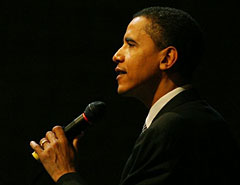
Barack Obama.
Photo: David Katz
Barack in a Hard Place
On Jan. 4, the same day Stevens introduced his fuel-economy bill, Obama joined with Kentucky Republican Jim Bunning to introduce the “Coal-to-Liquid Fuel Promotion Act of 2007.” Coal-to-liquid (CTL) technology uses a highly energy-intensive process to convert coal into diesel fuel for cars or jet fuel for airplanes — an appealing prospect to the coal industry in Obama’s home state of Illinois, but not to enviros and others concerned about global warming. Obama, who got a 100 percent approval rating from the League of Conservation Voters for his environmental voting record in the Senate last year, is now getting grumbles from greens and thumpings from the press for backing the dirtiest of all fossil fuels.
The Bunning-Obama bill, which would expand tax incentives for CTL and help jumpstart the industry with public-private partnerships, was first introduced by the senators in spring of last year. Back then, it didn’t get traction in either the Senate or the media, but now that Obama is publicly toying with the idea of a presidential campaign, the proposal is getting real attention — much of it unwanted.
“[The CTL bill] raises the strong possibility of increasing global-warming pollution,” says Frank O’Donnell, executive director of Clean Air Watch, a D.C.-based watchdog group. “Obama may be a climate crusader, but in this case he’s marching in the wrong direction.”
Obama’s office seems taken aback by the criticism from the enviro community. They’re responding by stressing the national-security advantages of using homegrown coal to power the nation’s transportation sector, and talking hopefully about the possibility of making CTL greener. Says Obama spokesperson Tommy Vietor, “Sen. Obama believes investing in coal technologies is an important part of weaning the United States off foreign oil. He also believes that through investment and innovation, we can make these technologies cleaner.” Vietor pointed to ongoing research into sequestering the carbon released by coal gasification and suggested that similar strides could be made with the coal-liquefaction process.
Environmental advocates aren’t so optimistic. David Doniger, policy director of the Natural Resources Defense Council’s Climate Center, has supported coal gasification as a viable alternative to coal-burning power plants, but explains that CTL is not as promising an alternative to conventional gasoline or biofuels. “Coal-to-liquid is, in the best-case scenario, no worse for the climate than oil-derived gasoline — and no better,” he says. The best-case scenario assumes that CTL producers find a way to capture their carbon emissions. Problem is, none of the current CTL projects actually involve carbon capture. Without that step, the climate impacts of CTL fuel are far worse than those of gasoline. According to an NRDC analysis, a 35-mpg car powered by the CTL fuel that’s currently available would generate as much carbon dioxide pollution as a far less efficient 19-mpg car that runs on conventional gasoline.
Enviros have been nudging Obama in recent months to retract his support for CTL technology, to no avail.
Vietor told Muckraker that Obama “is very concerned about the role carbon emissions play in global climate change, which is why he has been such a strong supporter of increasing the use of biofuels like ethanol and raising fuel-economy standards that would eventually save us 4.3 million barrels of oil a day and reduce global-warming pollution by 760 million metric tons of greenhouse gases.” Vietor added that Obama supports a cap-and-trade program for greenhouse-gas emissions as part of a federal strategy to fight climate change, and that the CTL industry would have to operate within that framework.
Green reactions to Stevens’ and Obama’s bills reveal a tension between energy security and environmental protection that’s likely to escalate in coming months and years. As NRDC’s Doniger says, “There are solutions to global warming that are also solutions to energy security, but there are solutions to energy security that go backwards environmentally, that make global warming worse.”
Environmentalists want energy legislation that attacks both of these big problems, rather than one at the expense of the other. As strange as it seems — and it seems deeply, deeply strange — Ted Stevens has got a better start on this in the new congressional session than many of his Democratic counterparts.