Nary a Drop to Drink

A review of Water: The Fate of Our Most Precious Resource 0

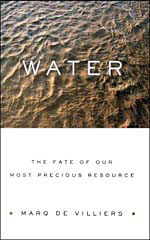
The underlying premise is simple: without water we die. As a Turkish businessman quoted in Marq de Villiers' impressive book, Water: The Fate of Our Most Precious Resource, says, "Millions have lived without love. No one has lived without water."

Water: The Fate of
Our Most Precious Resource

By Marq de Villiers
Houghton Mifflin Co.,
352 pages, 2000

In Water, de Villiers, who grew up in South Africa and lives in Nova Scotia, tours the world to examine the state of its most vital resource. What he finds is not encouraging. From Africa to Asia and Australia, from Europe to the Middle East and the Americas, too many people depend on too little -- and increasingly limited -- water. Despite Herculean engineering schemes constructed to water deserts and to store and deliver water where it would otherwise not be available, demand for water will almost surely continue to outstrip supply unless we dramatically alter our behavior.

In addition to the problems of supply and demand, de Villiers describes the ecological damage incurred by the use and abuse of water sources. Through pollution, diversion, and degradation, industrialization of the world has taken a heavy toll on water quality. On every continent, rivers have been straightened to ease navigation, bermed and banked for flood control, dammed and diverted for irrigation, and used as receptacles for noxious and toxic waste. To facilitate development, wetlands have been drained, natural flows and stream channels altered. The result is a world where most major rivers and lakes no longer retain their full ecological function. This reality, as de Villiers explains with many illuminating examples, severely hampers how water sources replenish and renew themselves.

Now, with surface water exploited nearly to the maximum extent possible, countries around the world have begun tapping groundwater -- the primary water source in areas with little rainfall and few lakes or rivers. As underground aquifers begin to be depleted, there is concern about further upsetting the ecological balance. Diverting water from one river basin to another -- which, until now, has been largely a matter of economics and geopolitics, as in Southern California -- quickly becomes a matter of survival in a developing nation like Namibia, as over-allotment of water in one area leads to desertification in another.

Rooting his narrative in memories of his grandfather's farm in arid South Africa, de Villiers is fierce about recognizing the value of clean, uncompromised water. He has done his homework thoroughly and brings both ecological and historical knowledge to bear in his frank criticism of how the world's water resources have been managed. At his bluntest, he says, "Humans consume water, discard it, poison it, waste it, and restlessly change the hydrological cycles, indifferent to the consequences: too many people, too little water, water in the wrong places and in the wrong amount. The human population is burgeoning, but water demand is increasing twice as fast."

Thanks to de Villiers's humane tone and nimble curiosity, Water ends on a progressive note, despite all its sobering and distressing information. There is much to be learned here, and all would profit if we began to act on Water's lessons.

From his youth in Australia to career experiences in Europe, Africa and all parts of the United States, Terry has developed expertise in business, farming, education, non-profit, the environment, the arts, and government.

A United States Coast Guard-licensed ship captain, Terry has long been drawn to the undersea world, starting in the 1960s with a family-run tropical fish breeding business in Australia and continuing with studies on conch depletion in the Bahamas, manatee populations in Florida coastal waters, and mariculture in the Gulf States with Texas A&M University.

On land, Terry managed the largest sheep ranch east of the Mississippi, assisting the University of Minnesota in developing new methods of livestock disease control. Terry also managed a multi-million dollar real estate company, owned/operated a successful recreational services business, and assisted the west African nation of Nigeria with the creation of their first solid waste recycling program.

An accomplished author, Terry’s latest book, Lives Per Gallon: The True Cost of Our Oil Addiction (Island Press), is a timely examination of our dependence on oil and a strategy to evolve to more sustainable energy sources. He has also authored a series of best-selling “Ultimate Guides” to pools and spas (McGraw-Hill) and several theatrical works on the life of William Shakespeare. Terry is an avid airplane and helicopter pilot and speaks German, Dutch and Spanish.

In 1993, Terry founded the Santa Monica BayKeeper and served as its Executive Director for six years. He co-founded Waterkeeper programs in San Diego, Orange County, Ventura, and Santa Barbara. He also served for five years as Executive Director of the Environment Now Foundation in Santa Monica, CA and co-founded the Frank G. Wells Environmental Law Clinic at the School of Law, University of California Los Angeles.

In the summer of 2003, Terry helped Arnold Schwarzenegger win the historic recall election and become Governor of California. He was appointed as the Secretary of the California Environmental Protection Agency in November, 2003, and Cabinet Secretary, the Chief Policy Advisor to the Governor, in December, 2004. He continues to advise the Governor on energy and environmental policy. In April, 2007, he was named the Cullman Senior Fellow and Director of the Climate Policy Program of The New America Foundation, a non-profit, post-partisan, public policy institute. In September, 2007, he was appointed as an Operating Advisor to Pegasus Capital Advisors. Pegasus Capital Advisors, L.P., is a private equity fund manager that provides capital to middle market companies across a wide variety of industries.

Terry currently travels throughout the United States and the world, lecturing and providing private consulting services to a variety of clients, including several Governors and Canadian Premiers on climate and energy policy.

Advertisement
Advertisement

Add a Comment

You are not logged in. Thus, you cannot post a comment. If you have an account, log in. If you don't have an account, well, by all means go make one! Meet you back here in five.

Hello, Visitor!    Why not register?

Advertisement