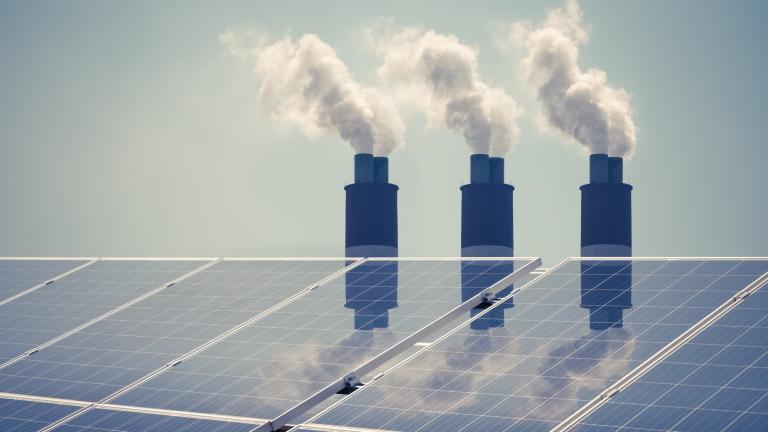
To achieve maximum technologically feasible GHG reductions, or not to, that is the question

EarthJustice challenges the legality of the draft plan for California’s A.B. 32 5

EarthJustice is challenging the legality of the draft release of California's climate change program, A.B. 32. They say it fails to follow all of the statutory requirements. Specifically:

This letter focuses on three primary deficiencies in the Draft Scoping Plan: first, the Draft Scoping Plan uses the 2020 greenhouse gas emission limit as a ceiling on the amount of greenhouse gas emission reductions required, when in reality the emissions limit is the minimum amount of reductions to be achieved by 2020; second, the Draft Scoping Plan ignores that AB32 requires "maximum technologically feasible" emission reductions; and third, it proposes to link to the Western Climate Initiative's cap and trade system, a system that in its current form is inconsistent with AB32.

For more on the first two arguments, see Ken Johnson here and here. As to the third, farther down it says that WCI's intention to allow unlimited banking banking of permits violates the statutory requirement for "maximum technologically feasible" reductions in A.B. 32.

Inside baseball, but incredibly important: California's been pushing the envelope on standards for years; it would be a shame if they scaled back their ambitions in this, the most important climate bill in the country short of the still-mythical federal system.

David Roberts is staff writer for Grist. You can follow his Twitter feed at twitter.com/drgrist.

Advertisement
Advertisement
  1. josullivan58 Posted 9:14 am
    17 Aug 2008

    Interesting after a quick readingThe legal basis is the standard basis for challenging agency actions, the proposed rule does things that the law does not permit.
    Earthjustice wants the state to come up with a plan that does a better job of meeting the requirements of the law. Ambiguities and wiggle room that would create loopholes need to be removed.
    Earthjustice wants clear authority for citizen suits to be included in the final plan, based on the provisions already in the Clean Air Act. This request is at the end of the attachment, but its very important. Lawsuits are one of the most valuable tools environmentalists have.
  2. guade00 Posted 5:06 am
    18 Aug 2008

    I like the sentiment expressed, but...The legislation quite explicitly reads as follows:


    By January 1, 2008, the state board shall, after one or more public workshops, with public notice, and an opportunity for all interested parties to comment, determine what the statewide greenhouse gas emissions level was in 1990, and approve in a public hearing, a statewide greenhouse gas emissions limit that is EQUIVALENT to that level, to be achieved by 2020.


    Part 3, s. 38550, EMPHASIS added.
    It does not say, approve a limit that is lower than that level. So it appears the DSP may have gotten this right.
    Also, the Earthjustice comment states that the FSP fails to identify the term "maximum technologically feasible" into the Plan, and the comment proceeds to give the board a few examples of how this should have been done.
    But the Board is in the troublesome position: while AB 32 defines "cost-effective," it does not define "maximum technologically feasible." Nor does AB 32 provide specific authority to define that term. This may explain why the term is not identified. And an additional quirk in the bill's text directs the Board to adopt greenhouse gas reduction activities that "can be implemented in an EFFICIENT and cost effective manner." AB 32, Part 4, s. 38561(a), p.10. So, is it efficiency or technological feasibility, or both, or what?
    And interpreting "monetary and non-monetary incentives" to mean a private right of action is a bit of a stretch, but I'll go there with Earthjustice. Private rights of action are occasionally worthwhile. But beware, they sometimes backfire--see Lujan v. Defenders of Wildlife. A court decision may just ruin your day.
  3. guade00 Posted 5:08 am
    18 Aug 2008

    I like the sentiment expressed, but...The legislation quite explicitly reads as follows:


    By January 1, 2008, the state board shall, after one or more public workshops, with public notice, and an opportunity for all interested parties to comment, determine what the statewide greenhouse gas emissions level was in 1990, and approve in a public hearing, a statewide greenhouse gas emissions limit that is EQUIVALENT to that level, to be achieved by 2020.


    Part 3, s. 38550, EMPHASIS added.
    It does not say approve a limit that is lower than that level. So it appears the DSP may have gotten this right.
    Also, the Earthjustice comment states that the FSP fails to identify the term "maximum technologically feasible" into the Plan, and the comment proceeds to give the board a few examples of how this should have been done.
    But the Board is in the troublesome position: while AB 32 defines "cost-effective," it does not define "maximum technologically feasible." Nor does AB 32 provide specific authority to define that term. This may explain why the term is not identified. And an additional quirk in the bill's text directs the Board to adopt greenhouse gas reduction activities that "can be implemented in an EFFICIENT and cost effective manner." AB 32, Part 4, s. 38561(a), p.10. So, is it efficiency or technological feasibility, or both, or what?
    And interpreting "monetary and non-monetary incentives" to mean a private right of action is a bit of a stretch, but I'll go there with Earthjustice. Private rights of action are occasionally worthwhile. But beware, they sometimes backfire--see Lujan v. Defenders of Wildlife. A court decision may just ruin your day.
  4. Ken Johnson's avatar

    Ken Johnson Posted 6:03 am
    18 Aug 2008

    I think Earthjustice got it (mostly) rightThis is significant because it seems to be the first time (as far as I know) that an institutional stakeholder has noticed the AB 32 requirement for "maximum technologically feasible and cost-effective greenhouse gas emission reductions" and recognized that it means something more than just achieving the 2020 limit. (Note: Earthjustice is representing the Center for Biological Diversity on this issue.) It would be interesting to get the perspectives of other groups (e.g. NRDC, UCS, Sierra Club, etc.) on the Earthjustice arguments. (I've posed 10 questions to CARB to try to sharpen the focus on this and other broader concerns relating to the draft scoping plan.)
    I have several disagreements with the arguments. Firstly, Earthjustice has bought into the idea of "maximum feasibility", as though AB 32 required "maximally feasible" emission reductions. In fact, the statute says nothing about maximum feasibility; what it requires is maximum emission reductions (subject to certain conditions and limitations, including feasibility). This may be a matter of semantics, but semantic ambiguity and confusion seems to be one reason why no one has been taking the maximum reduction mandate seriously.
    Another semantic point relates to the qualifier "cost-effective", which the California Air Resources Board basically interprets to mean "least-cost" - as though the statute required maximum cost reductions. This is how economists use the term "cost effective", but it's clearly not what the legislators had in mind in writing the "maximum ... emission reductions" requirement. (I said a lot more about this in my comments [PDF] for the June 3 Economic Analysis meeting.)
    Perhaps the most fundamental omission in the Earthjustice brief is any clear discussion or understanding of how the 2020 emission limit and the maximum reduction mandate can work together and coexist. If the regulations are based on "maximum ... emission reductions", then what purpose does the 2020 limit serve? It would seem that the 2020 limit would not influence the achieved emission level unless it exceeds the threshold of feasibility and cost-effectiveness (??).
    As a practical matter, the 2020 limit is needed because without it CARB could adopt a standard of "cost effectiveness" that wouldn't reduce statewide emissions even from present levels. The statute does not define "cost-effective" in the adjective sense - that's left up to CARB. But CARB has to adopt a cost effectiveness standard that is at least consistent with the 2020 limit. (CARB has actually gone a step further in proposing a cost effectiveness evaluation methodology that is functionally equivalent to the 2020 limit, which would make the maximum reduction mandate meaningless because it would add nothing to the statute.)
    The maximum reduction mandate also calls for a fundamentally different kind of regulatory approach. Earthjustice asserts that "the statute requires an assessment of maximum technologically feasible reductions and cost-effectiveness for every proposed emission reduction", the implication that it is CARB's statutory responsibility to do the assessment. This approach isn't practical. Not only would it entail an enormous regulatory burden, but the assessment would be wrong because regulators always get it wrong. They always underestimate technology and overestimate costs in setting emission targets. The requirement for "maximum ... emission reductions" is basically a "best effort" requirement that is better addressed by incentive-type policies, which would effectively delegate the task of feasibility assessment to "the market" (i.e., people who are actually paid to be right). Such policies could complement and operate harmoniously with the caps-and-standards regulations that are the focus of CARB's current plan.

  5. Mikaels Posted 1:05 pm
    01 Oct 2008

    sentimentBut the Board is in the troublesome position: while AB 32 defines "cost-effective," it does not define "maximum technologically feasible." Nor does AB 32 provide specific authority to define that term. This may explain why the Seks HikayeleripornopornoTeknolojiterm is not identified. And an additional quirk in the bill's text directs the Board to adopt greenhouse gas reduction activities that "can be implemented in an EFFICIENT and cost effective manner." AB 32, Part 4, s. 38561(a), p.10. So, is it efficiency or technological feasibility, or both, or what?

Add a Comment

You are not logged in. Thus, you cannot post a comment. If you have an account, log in. If you don't have an account, well, by all means go make one! Meet you back here in five.

Hello, Visitor!    Why not register?

Advertisement