The USDA goes all lukewarm on cellulosic ethanol

In related news, the ‘07 corn harvest will break records 16

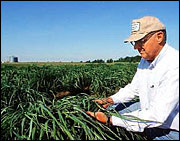
Cellulosic bust? Photo: whitehouse.gov

For decades now, the USDA has been dumping cash into cellulosic ethanol research (most recently through a joint venture with the DOE).

So the USDA's analysts should know something about the prospects for mass production of cellulosic ethanol, hailed by its boosters as a panacea that can wean us not only from oil, but also from corn as an ethanol feedstock.

So what's the latest from USDA analysts on this miracle fuel? From a report released last week:

Although cellulosic-based production of renewable fuels holds some longer-term promise, much research is needed to make it commercially economical and expand beyond the 250-million-gallon minimum specified for 2013 in the Energy Policy Act of 2005.

What? Okay, let's break this statement down.

"Some longer term promise," huh? I realize that government analysts like to affect a dry, phlegmatic tone, but that's hardly the sort of language boosters want to see from the agency most responsible for nurturing a technology.

Then there's this bit: The analyst doubts cellulosic can be "commercially economical" enough to get beyond 250 million gallons by 2013. According to the same report, corn-based ethanol producers churned out 5 billion gallons in '06 and will likely hit 10 billion by '09.

What the researcher is saying is that six years from now, in 2013, cellulosic still won't be economically viable.

For decades now, cellulosic boosters have been promising a major breakthrough within five years. And the future cellulosic utopia keeps receding ever-further into the future.

Meanwhile corn, our most environmentally devastating crop, entrenches its grip over the nation's cropland. The USDA report projects corn acreage to hover near 92 million acres through 2016. In the decades before the big ethanol surge in 2005, corn typically took up 80 million acres.

So the government-mandated ethanol boom has gained us an extra 10-12 million acres bombarded by synthetic fertilizers and herbicides, and monocropped in the latest patent-protected, genetically altered Monsanto seeds -- and precious little else.

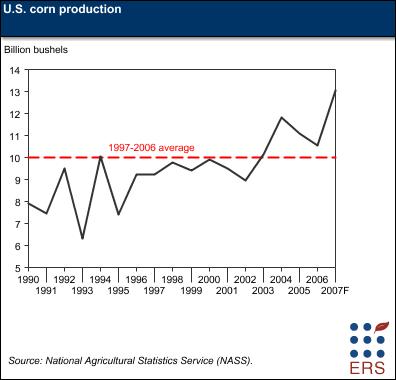
In other news, the USDA released its latest forecast (PDF) on the 2007 corn crop. They're expecting 13.3 billion bushels -- by far the biggest harvest ever, and up a jaw-dropping 26 percent from last year.
corn production

Grist food editor Tom Philpott farms and cooks at Maverick Farms, a sustainable-agriculture nonprofit and small farm in the Blue Ridge Mountains of North Carolina. Follow my Twitter feed; contact me at tphilpott[at]grist[dot]org.

Advertisement
Advertisement
  1. Biodiversivist's avatar

    Biodiversivist Posted 6:21 am
    13 Sep 2007

    You forgot to mentionthat conservation reserve carbons sinks are going under the plow to pull this off, oh, and food prices are screaming upwards as grain stocks drop. The world has failed to produce as much grain as it has consumed for six out of the last seven years. But this was a post on cellulosic, not ethanol in general so I'll let you ride.

    In the end, it all comes down to biodiversity. Poison Darts--Protecting the biodiversity of our world
  2. GreyFlcn Posted 7:35 am
    13 Sep 2007

    Cellulosic Ethanol? Not likely.Well, as compared to our current 140 billion gallons of gasoline produced per year.
    And nearly 6 billion gallons of grain ethanol produced per year.
    I thought it was rather interesting when a US Energy Information Agency Administrator, Guy Caruso, mentioned that:

    On one occasion he stated that the EIA does not foresee that cellulosic ethanol is going to scale up to even a billion gallons by 2030, and one senator said "Isn't that in direct contrast to what the president thinks?" Then some pretty nifty tap-dancing ensued.

    http://i-r-squared.blogspot.com/2007/05/comments-on-senat ...


    One thing thats interesting to mention is that cellulosic ethanol has more than a few hurdles to overcome.  Some of which may make it impossible, or atleast unrealistic.
    http://venturebeat.com/2006/11/05/why-cellulosic-ethanol- ...

    http://www.biofuelwatch.org.uk/inf_paper_2g-bfs.pdf

    http://www.stopbp-berkeley.org/CellulosicBiofuels.pdf
  3. Joel Wilke Posted 7:46 am
    13 Sep 2007

    Acually...I'm not a fan of Corn Ethanol, but please at least get the facts right.  
    You say: "You forgot to mention that conservation reserve carbons sinks are going under the plow to pull this off". TFA makes it seem as though most of the new acres are coming from what would have been soybean production.
    "According to USDA's Acreage report, (June 29, 2007), farmers planted nearly 93 million acres to corn this year, up over 14 million acres, or 18.6 percent, from 2006."..."much of the 2007 increase in U.S. corn acreage will come from reduced soybean plantings, which are down more than 11 million acres (15 percent) from 2006."  
    Now Wikipedia weakens your case even more:"Due to the increasing prices for Maize and Soy, a larger than 3 million acres (12,000 km²) outtake of area from the conservation program was anticipated. The impact of this outtake is even smaller as "only 354,771 acres [1436 km²)] were in the top five corn and soybean producing states"
    Now for your argument: "food prices are screaming upwards as grain stocks drop."  
    Not so much actually, CPI food prices are screaming upwards mostly because energy prices are increasing.  "Increases in energy prices for example exert a

    greater impact on food prices than does the price of corn. A 33 percent increase in crude oil prices -

    which translates into a $1.00 per gallon increase in the price of conventional regular gasoline -

    results in a 0.6 percent to 0.9 percent increase in the CPI for food while an equivalent increase in

    corn prices ($1.00 per bushel) would cause the CPI for food to increase only 0.3 percent."
    So please, if you are going to argue against corn, use a different tactic.  A few of the better ones are the poor energy balance, reduction in biodiversity, damage to cropland from poor rotation decisions, fertilizer runoff, etc.
  4. GreyFlcn Posted 7:48 am
    13 Sep 2007

    The real interesting thing isThe real interesting thing is that Bush has mandated 35 billion gallons of "alternative fuels" by 2030. But he insists that whether it results in less emissions than gasoline, is required.
    But biofuels haven't got a prayer in becoming more than just turning copious ammounts of dollars into a liquid. An expensive sharade.
    So of course what is this all about?

    Coal-to-Liquids.  The other hydrocarbon liquid which realistically could entirely replace our fuel demand.
    The catch being that the carbon-to-hydrogen ratio of coal is the highest out of any hydrocarbon.
  5. GreyFlcn Posted 8:01 am
    13 Sep 2007

    OopsBut he insists that whether it results in less emissions than gasoline, is NOT required.
  6. GreyFlcn Posted 8:08 am
    13 Sep 2007

    Depends.Now for your argument: "food prices are screaming upwards as grain stocks drop."
    Correct. Domestic markets haven't really been effected. International markets have been hit very hard.
    http://greyfalcon.net/grocerybill.png
  7. GreyFlcn Posted 8:43 am
    13 Sep 2007

    Point #2Now Wikipedia weakens your case even more:"Due to the increasing prices for Maize and Soy, a larger than 3 million acres (12,000 km²) outtake of area from the conservation program was anticipated. The impact of this outtake is even smaller as "only 354,771 acres [1436 km²)] were in the top five corn and soybean producing states"
    Thats just the Conservation Reserve Program land.

    http://www.nrcs.usda.gov/programs/crp/
    _
    Many corn farmers rotate between corn-soy, and may even switch to cotton.
    And what you have is a process of planting corn-on-corn.
    Which not only depletes the soil, but also drastically shrinks the market availibility of soy/cotton.
    That said, much of the Soy market demand has been met by surging increases in Soy/Cotton in the Amazon rainforrest.
    Isn't that just grand?
    http://greyfalcon.net/soy2
  8. Joel Wilke Posted 9:36 am
    13 Sep 2007

    And..Isn't that exactly what I said would be a better argument against corn ethanol?  "damage to cropland from poor rotation decisions"
  9. Tom Philpott's avatar

    Tom Philpott Posted 9:53 am
    13 Sep 2007

    Joel,Not sure I get your point. You give a great list of wonderful cellulosic projects, but you ignore the central point of this post: that the USDA, cellulosic's great patron, thinks the technology is still years and years away from coming online. Let me repeat the quote:
    Although cellulosic-based production of renewable fuels holds some longer-term promise, much research is needed to make it commercially economical and expand beyond the 250-million-gallon minimum specified for 2013 in the Energy Policy Act of 2005.
    I suspect that most of the nifty projects you mention exist not because hard-headed investors think the companies have hit upon a winning technology; but rather because those investors are convinced the government will keep throwing cash as cellulosic projects, results be damned.  

    Victual Reality
  10. Joel Wilke Posted 10:03 am
    13 Sep 2007

    somewhatFor most of those projects, yes, they are initially depending on government funding to get off the ground.  One of them comes to mind however which is receiving nothing.
    http://ethanolproducer.com/article.jsp?article_id=3175&am ...
  11. Joel Wilke Posted 10:08 am
    13 Sep 2007

    oopsposted it starting with page 3
    http://ethanolproducer.com/article.jsp?article_id=3175&am ...
  12. Karen Lee Orr Posted 10:22 am
    13 Sep 2007

    Taxpayer financed cellulosic plant in EvergladesThe University of Florida will build a taxpayer financed cellulosic ethanol plant in the Everglades
    In a unanimous vote on August 22nd, a UF site selection committee unanimously chose West Palm Beach-based Florida Crystals (Fanjul family) from a list that included five other contenders to construct an ethanol-from-cellulose plant.
    The $20 million project is being financed through a state grant to encourage the development of alternative energy resources.
    December McSherry, an Alachua County farmer who serves as chairwoman of the Sierra Club's state agriculture committee and who sits on the organization's national agriculture committee, said the Okeelanta site next to the Everglades is inappropriate.
    It poses a threat to the ecosystem from pollution, water withdrawal and soil depletion, she said.
    "This is a foot in the door to a huge industrial complex right in the middle of the Everglades. Our land should be used for growing food for people, not cars," said McSherry, who attended Tuesday's meeting but was not allowed to speak.
    "This whole ethanol thing will fail," she said. "There is not enough water to go around...The Everglades is an international biosphere reserve and a world heritage site. It is a wetland of international importance."
    Florida Crystals also partnered with Florida International University earlier this year to do additional cellulosic ethanol research.
    Palm Beach Post article:
    http://www.palmbeachpost.com/business/content/business/ep ...
  13. GreyFlcn Posted 2:11 pm
    13 Sep 2007

    Well the interesting thing to note1. Cellulosic ethanol currently only produces a 4% alcohol solution.

    Considering it takes 20% of corn ethanol energy to from 95% to 99.5% purity.

    Going from 4% to 99.5% is much more intensive.

    http://i-r-squared.blogspot.com/2006/11/cellulosic-ethano ...
    2. Then you get into the logistics of moving highly bulky plant matter in huge quantities.

    http://i-r-squared.blogspot.com/2007/03/logistics-problem ...
  14. Biodiversivist's avatar

    Biodiversivist Posted 2:42 am
    14 Sep 2007

    Joel, I spend enough time refuting strawmenYou say the increase in the price of food has nothing to do with corn ethanol. Go to this link and tell me agrofuels are not increasing the price of food. A few headlines:
    Why 25% of your income could soon go on food

    Japanese consumers feel the pinch of biofuel demand

    New bid to halt rising food bills

    Food inflation out of hand?

    Low grain harvest, rising food prices and China's ethanol plan

    Rising food prices The agonies of agflation

    Oh, wait, you didn't say it has "nothing" to do with the price of food? That's right, I just created a strawman so I could refute something you didn't even say. Welcome to my world. You just spent 108 words refuting something I didn't say, specifically "most" of the increase in the price of food was the result of corn ethanol.
    Now let's touch on your other claim that no conservation reserve land or carbon sinks are being put under the plow as a result of corn ethanol. Not true at all. In fact, some food producers are calling for government to open up reserve land to corn farmers to ease their costs:
    Earlier this year, USDA said it did not plan to admit land into the Conservation Reserve in 2008 or 2009, except for filter strips along waterways and similar high-priority land. An estimated 4.6 million acres will leave the reserve from 2007-10 as contracts expire, USDA said on March 9. Some 1.8 million acres were in contracts that expire on Sept. 30, USDA figures indicated
    The National Grain and Feed Association says an additional 4 million to 5 million acres of wheat, corn and soybeans will be needed in 2008 to prevent crop shortages. It urged Johanns two weeks ago to act "relatively soon" to release land. Grain processors and livestock groups want farmers to be able to return the land to crop production without penalty.
    In addition, every acre of soy displaced by corn is made up somewhere else, like South America, which often involves the usurpation of another carbon sink.
    Oh, wait, you didn't say that "no" conservation reserve land or "no" carbon sinks are going under the plow? That's right, I just created another strawman so I could refute something you didn't even say. Welcome to my world. You just spent 130 words refuting something I didn't say, specifically " most of the new acres are coming from" conservation reserve land.
    So please, if you are going to discuss these issues, use a different tactic than strawman arguments. One more word of advice, since we are sharing advice; avoid sources like The American Coalition for Corn Ethanol when looking for corn ethanol "facts."


    In the end, it all comes down to biodiversity. Poison Darts--Protecting the biodiversity of our world
  15. Ron Steenblik Posted 11:40 am
    14 Sep 2007

    In response to Joel's exampleFor most of those [cellulosic ethanol] projects, yes, they are initially depending on government funding to get off the ground. One of them comes to mind however which is receiving nothing.
    The company to which Joel refers, Colusa Biomass Energy Corp. (CBEC), has plans for turning a difficult agricultural waste, rice straw, into ethanol. The story in Ethanol Producer Magazine, says that planned 12.5 million gallon a year plant has not received any funds (to date) to build their project.
    But let's not forget that, as with any ethanol plant built in the United States, this plant would nonetheless benefit from all the subsidies available for ethanol from corn-fed plants -- to wit, product prices that are elevated by the renewable fuels standard (RFS) mandate, the $0.54/gallon import tariff, the $0.51/gallon federal volumetric ethanol excise tax credit (VEETC), and California's 9-cents-per-gallon reduction in the fuel excise tax for E85. In addition, since the plant will produce less than 15 million gallons of ethanol a year, it will receive an additional $0.10 per gallon federal "Small Ethanol Producer Tax Credit" on evergy gallon it produces.

Add a Comment

You are not logged in. Thus, you cannot post a comment. If you have an account, log in. If you don't have an account, well, by all means go make one! Meet you back here in five.

Hello, Visitor!    Why not register?

Advertisement