In the Middle East, water-poor nations are using petrol profits to buy farmland in economically depressed countries like Pakistan and Sudan. China, with its own farmland under pressure from development and pollution, is using some of its vast export income to snap up land in Africa and Southeast Asia.
Meanwhile, Brazil — the globe’s emerging agricultural powerhouse and an increasingly important food supplier to China — recently threatened to nationalize its fertilizer deposits. Such a move would rankle huge U.S. grain-trading firms like Cargill and Bunge, which dominate Brazil’s ever-expanding fertilizer market.
In other words, food production is rapidly emerging as a key geopolitical issue. As food prices rise along with oil futures and climate change looks set to disrupt global agriculture patterns, we can expect more of the same. Indeed, hardheaded investors — the kind who made a killing earlier this decade snapping up oil futures — are increasingly playing the food-as-geopolitics angle. “Big private investors are starting to make bolder and longer-term bets that the world’s need for food will greatly increase — by buying farmland, fertilizer, grain elevators and shipping equipment,” The New York Times recently reported.
If food is the new oil, then we’re lucky that the ace geopolitical reporter Paul Roberts has turned his attention to the dinner table. His 2004 book The End of Oil crystallized the perils surrounding humanity’s reliance on fossil energy. Crude oil prices have doubled and doubled again since Roberts wrote that book, yet it remains a valuable and even timely resource.
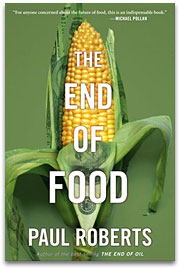
Now he’s attempted a similar feat with our globe-spanning industrial food system. His new book The End of Food is the kind of work you wish policy makers and presidential candidates were grappling with, but you’re pretty sure they’re not. It also deserves to be read by food-justice activists, locavores, and other critics of industrial food.
By switching from oil to food, Roberts has boldly stepped into a crowded field. In the last decade, books by Eric Schlosser, Michael Pollan, Marion Nestle, and many others have helped revive public awareness about food production here in what Schlosser aptly dubbed the “fast-food nation.” Collectively, these books documented the nearly unchecked way our food industry exploits workers, the environment, and farm animals; and how, tragically, these efforts result in ever more nutritionally vapid and heavily marketed food “choices” (which end up consisting mainly of clever combinations of corn and soybeans). These books also ably teased out the government’s role in the food industry’s rise — both through perverse farm-support policies and the craven co-optation of would-be guardians of public health such as the FDA and the USDA.
What could Roberts possibly add to this vast literature? Plenty, it turns out. These “where your food comes from” books ably indict the food industry and the government that coddles it. But I fear that in important ways, they tend to reflect certain prevailing conceits of what might be called “post-agricultural society.” Today (as these books often point out), fewer than 1 percent of the population owes its living to farming, and most jobs in food production are left to unloved (yet utterly relied upon) immigrants. But this distance from the land not only blinds us to where our food comes from; it also lets us forget what a monumental challenge food production has been through most of human history.
That latter point seldom gets the emphasis it deserves. Reading through the recent food-politics bookshelf, it’s too easy to take away an “industrial food bad, local food good” attitude. But how many modern-day locavores would readily embrace the life of, say, a 19th-century prairie farmer, tending to livestock, grain crops, and a vegetable patch without electricity or machine power? Shopping at farmers markets and joining CSAs — activities I wholeheartedly support — present a necessary challenge to a global food system gone mad, but are unlikely to prove sufficient for transforming it. To mount a real challenge, we’ll need a clear-eyed grounding in the history and economics of food production, in addition to locavore zeal. And that’s were Roberts makes an important contribution.
Fat of the Land
The book opens with a brief, necessarily selective history of human food production. It will leave few readers pining for a lost past of agrarian splendor. Indeed, for Roberts, the closest we’ve come to achieving food nirvana was back in the Cro-Magnon day, when big-game hunters skulked through grasslands in search of mastodon, bison, and woolly rhinoceros. Cro-Magnons were “likely healthier than their modern descendants,” Roberts writes, and their fossils “show none of the diet-related chronic diseases that plague us today.” Even so, “infant mortality was high, work was dangerous, and treatment for injury or infection was non-existent.” Life expectancy? Eighteen years.
In a sense, it’s all downhill from there. The rise of agriculture 10,000 years ago was a revolutionary event. Yet it hardly amounted to an easy answer to the food problem. For those looking for antecedents to today’s globalized and geopolitically tense food system, Roberts presents ancient Rome. “The outlines of the Roman empire followed the borders of the wheat regions in Europe, Central Asia, and North Africa,” he reports. Even then, food miles were a concern: “By 100 BC, a third of Rome’s wheat was coming from Egypt, nearly a 1,000 miles away.” Rome’s military power kept the whole thing humming, and when that failed, “its food system collapsed” — and so did the empire.
Critics of today’s meat industry (myself included) will take little comfort in Roberts’ account of European agriculture around 1600. After centuries of rising grain yields and stagnant population growth, farmers suddenly had a grain surplus — which they promptly fed to livestock. “Meat consumption skyrocketed,” Roberts writes. “By the 16th century, the average German was eating a half a pound of meat a day (almost as much as a modern American!).” Roberts conjures an image that evokes Upton Sinclair’s The Jungle or today’s vast factory-style slaughterhouses: “Cattle and sheep farmers built enormous herds in Scotland, Denmark, and Poland, which they then drove cross-country to sell in massive slaughtering yards in large cities, where prices were highest.” One doubts that animal welfare ranked high among these farmers’ priorities.
But the rise of this nascent meat industry represented an agricultural boom — and it soon went bust. As Europe’s population expanded along with its appetite for meat, its farmers couldn’t keep up. Famine, a specter that had haunted societies since agriculture’s beginnings, came roaring back. France, known for its fine cuisine, regularly failed to keep its population fed. The country experienced 26 major famines between 1600 and 1800, “plus uncountable smaller, local shortages,” Roberts reports. (Average daily meat consumption in Germany, for the record, tumbled to just two ounces per person.) Across the continent, most people began to live in a state of what Roberts calls “nutritional purgatory”: enough food to survive, but not enough to thrive. Things were scarcely better in Asia, where “famines in 1555 and 1596 killed millions and emptied entire regions.” “For centuries,” Roberts writes, “hunger effectively destroyed the mental, social, and productive capacities of entire populations.”
Astonishingly, these conditions persisted through the Industrial Revolution. In 1880, at the peak of the British Empire, a member of London’s vast working-poor population could expect to live just 20 years — “about the same as our Paleolithic ancestors.” Chronic malnutrition began to crimp imperial ambitions. In 1901, amid the buildup to quell the second Boer rebellion, Britain’s elites found that “one third of the army recruits were too week to endure basic training and too short for the army’s minimum height requirement of five feet.”
Feed the World, Tuppence a Bag
Readers of the “where your food comes from” books will know what comes next: the rise of input-heavy, monocrop-oriented agriculture and the modern food industry. Roberts spends much of the rest of the book teasing out industrial food’s vast environmental, social, and public-health liabilities. He does as good a job as anyone else has at this task, even if he lacks Pollan’s writerly narrative power and Schlosser’s investigative knack. (Roberts’ account of the brutal economics of modern food conglomerates — their relentless drive to maintain profits by pushing costs down — is the best I’ve seen.)
But Robert’s historical frame drives home a key point that his predecessors didn’t quite nail down: In many ways, modern food production is an attractive response to centuries of chronic food insecurity. Who wants to spend nearly all of one’s income on food, and rely on sugared tea as a key source of calories, as did the 19th-century British working class? Who wants to spend hours a day preparing food as peasant women did, not by choice but for survival? By the dawn of the 20th century, people quite understandably longed for food security and freedom from drudgery. The modern food system — for all of the new problems it created — largely met those desires, at least in the United States and Europe. The locavore movement will eventually have to confront them head on.
Meanwhile, the task of feeding the world will only grow more burdensome as global population expands, fossil-fuel supplies wane, and the climate changes. Roberts is at his best discussing the geopolitical consequences as the world’s most economically powerful nations scramble to respond to these challenges. He shows that the U.S. agricultural machine once dominated global food-crop production, acting as a kind of OPEC of grain. But now Brazil, spurred on by the need to repay debt to foreign lenders, is rapidly emerging as the globe’s food-export powerhouse. Brazil already leads the world in production of sugar, coffee, and beef, and will soon overtake the United States in soybean production. The country’s soy farms “are expanding at the rate of 4,000 square miles per year,” and its soy exports have more than tripled since 1998. China, flush with export earnings and pushed by an increasingly meat-hungry population, is sucking up a huge portion of that bounty and using it as livestock feed.
Roberts senses the “emergence of a new global [food] trade axis, with Brazil and Argentina at one end and India and China at the other.” The main role the United States plays in this new order is through U.S.-based transnationals like Cargill, Monsanto, Tyson, and Mosaic — which have maintained their dominance of food production through these geopolitical shifts. The consequences aren’t pretty. On the China side, you get the rise of U.S.-style meat factories, and all of the environmental damage they imply; on the Brazil side, you get ever-increasing pressure on the Amazon rainforest, the globe’s greatest carbon sink, in an era of rapid climate change.
Roberts challenges the locavore movement to think about these forces. He makes painfully clear that confronting them requires not just better consumer choices but also long-term political organizing. I don’t agree with all of Roberts’ analysis and conclusions. He raises hard questions and offers no easy answers. But I’m glad he’s crashed the dinner party and is shaking things up.