There is good news on the climate policy front. The Europeans have ratcheted down their emission targets; the Chinese are getting serious about solar power and energy efficiency; and Washington, after opening a multi-billion dollar stimulus spicket for clean energy, is lumbering towards a carbon cap.
This is progress-inadequate, but still important progress — towards what many of us used to think we had to do: cut global warming pollution 80 percent by 2050. These cuts would stabilize the thickness of the heat-trapping carbon dioxide blanket surrounding the earth at 450 ppm (parts per million) and, we thought, provide insurance that the global average temperature increase would not exceed 2 degrees Celsius from 1990 levels.
But 450ppm, it turns out, is so 2005.
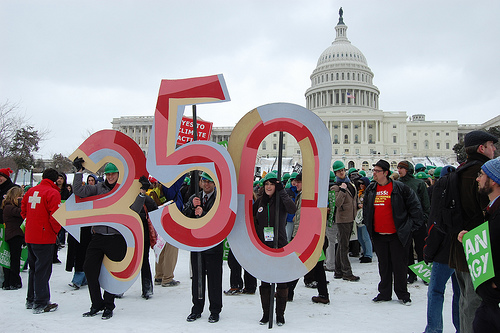
In the last 4 years, climate scientists, lead by NASA’s James Hansen, have dramatically altered the bar. To avoid global warming catastrophe-collapse of the continental ice-sheets and sea level rise of dozens of feet — many scientists are now telling us we have to get down to 350 ppm, and quickly.
And so, what four years ago was a heroic target of 450 ppm has suddenly become a mind-boggling target of 350 ppm. Instead of global emissions cuts of 80 percent from 1990 levels by 2050, 350 requires 97 percent reductions: a complete conversion to renewable energy systems by mid-century, with the world economy virtually free of carbon emissions. This is a far more demanding goal than any of the leading policy proposals under discussion today.
Game over?
No. Just time to adjust our thinking about what is possible.
We, along with four other authors, recently completed a report [PDF] for Economics for Equity and the Environment Network (E3), surveying the economic studies informed by recent science. The report found that quicker action aimed at more ambitious targets makes good economic sense. The report outlines what it will take to achieve 350 and finds that a comprehensive global strategy is still well-within the range of what most reasonable people are willing to pay today to avoid far greater damages from climate change down the road. With likely investments of about 1-3 percent of global GDP, we could rewire the planet with clean energy, rebuild global forests to trap billions of tons of carbon, create jobs, and stabilize the climate. And depending on factors such as the price of oil, these investments might actually save us money.
The bad news on the climate front is NOT that the costs of preventing climate change are becoming too expensive. Estimates of the costs have remained relatively stable, while estimates of the likely costs of inaction are becoming unbearable. Whether the final number is 450 or 350, we face no insoluble technical or economic challenges. This is still a problem we can afford to solve. Stopping global warming remains fundamentally a problem of political will.
Why 350?
At the Rio Earth Summit in 1990, the international community agreed to work to prevent “dangerous anthropogenic interference” with the global climate. This statement solidified into a goal of holding further warming to no more than 2 degrees C (3.6 degrees F) above 1990 levels; operationally, this suggested that we needed to stabilize CO2 concentrations in the atmosphere at below 450 ppm.
So for the past few years, 450 has been the number. And it is a daunting one: at current rates of emissions, we will blow past 450 ppm in less than 30 years. Stabilizing at 450 ppm requires rich countries to immediately cap carbon and begin steep cuts. By 2025, the 450 ppm goal means that emissions have to be falling across the entire planet. Yet now, in 2009, governments and businesses are just beginning to come to grips with 450. In the developed world, the architecture for a multi-decadal cap-and-cut system is emerging, and in China there is a growing commitment to clean energy technology, and an inching towards the acceptance of carbon cuts.
But now the scientists have stepped back in.
Even if we achieve 450 ppm CO2, according to the Stern Review, we still face a 70 percent chance that the globe will heat up more than 2.4 degrees C. The last time the earth was that hot sea levels were 75 feet higher.
On top of this, increasing evidence suggests that the earth’s climate system is much more sensitive to the build-up of C02 than conventional wisdom would have it. Initial warming appears more and more likely to trigger processes that will lead to additional warming: methane released from thawing tundra and drying arctic wetlands; carbon emitted from burning forests and drying soils.
Given this new evidence, Hansen and others have argued that to avoid triggering the collapse of the ice-sheets, and eventual flooding of the great coastal cities of the world, we have to hold warming to less than 2 degrees C.
And so, in the year 2007, the new number arrived: 350.
Is 350 Possible?
Hansen (Figure 1) described a detailed scenario for reducing greenhouse gas emissions with the goal of reaching 350 ppm CO2 by 2100. It included phasing out coal completely (or achieving 100% carbon capture) by 2030, along with a combination of large-scale reforestation, avoided deforestation and carbon capture and storage to withdraw huge quantities of CO2 from the atmosphere. To reach the 350 target by 2100, the world would have to quickly go beyond reductions to achieve net negative emissions-removing more greenhouse gases from the atmosphere than are emitted each year.
Our report for the E3 Network contrasts Hansen’s scenario with a less demanding but still quite ambitious trajectory which does not require the world to achieve negative net emissions. In this scenario, the world reaches 350 ppm CO2 by 2200. Emissions are reduced to 54 percent of 1990 emissions by 2020 and 3 percent by 2050, and then zero out, but do not go negative.
The bottom-line on the technical side: Decarbonizing by 2050 is possible with, roughly, the suite of technologies now available or on the near-term horizon. Very aggressive policy, however, will still be required very soon to drive down the costs of renewables, to redesign cities, reimagine transport and agricultural systems, and insure that all efficiencies are captured. Doing all this gets the world to 350 by 2200. Taking the additional steps to achieve negative emissions (and 350 by 2100) would require the development of large-scale, cost-effective sequestration technologies that go well beyond reforestation.
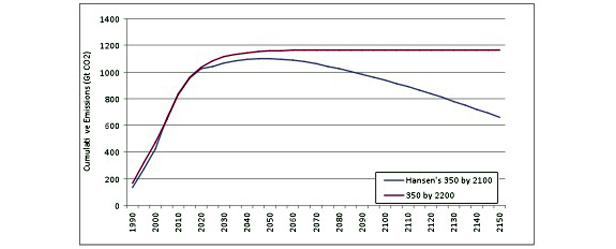 Figure 1: Comparing cumulative emissions for a 350 ppm CO2 trajectory Source: Ackerman et al. 2009.
The Economics of 350
What will it cost to get to 350? Business lobbies have argued that even the moderate reductions called for in recent U.S. legislation would cripple the economy. In fact, there is a large body of research projecting that recent U.S. legislative proposals would have very little economic impact, and that the much more ambitious emission reductions required to reach 450 and 350 ppm respectively, will have moderate net costs.
At least four research groups have modeled global scenarios that lead to 350 ppm CO2. One finds that in a world with unemployed labor and other resources, the stimulus from new climate investments might accelerate economic growth. The other three groups find net annual costs that are generally between 1 percent and 3 percent of world output. These studies are consistent with the Stern Review, the reports by McKinsey, and others, suggesting that achieving 450 ppm would cost around 1 percent or less of global GDP.
Both of these targets, 350 or 450, become a lot cheaper if oil prices return soon to $150 a barrel. If peak oil drives prices that high in the coming decade, then decarbonizing at a pace to hit 350 could lead to economic gains.
At first glance, 1-3 percent of global output may seem too high a price to pay, but if examined in its proper context, the initial sticker shock fades. Suppose, for instance, that the cost of climate protection turns out to be 2.5 percent of global GDP. In an economy like the U.S. that is growing at 2.5 percent per year, spending 2.5 percent of GDP on climate protection each year would be equivalent to skipping one year’s growth, and then resuming. Put another way, if climate policy is at the high end in terms of cost, Americans in 2050 would have to wait one additional year, until 2051, to be as rich as they otherwise would have been had they not been steadily investing in the transition to clean energy.
Or consider another comparison. Military spending is greater than 4 percent of GDP in both the United States and China. On the strength of a different narrative about potential future dangers, both countries are already diverting from annual consumption, year after year, more than the high end estimates of what it would take to stop global warming.
350 and the Bottom Line
Dropping the global climate target from 450 ppm to 350 ppm of atmospheric CO2 may appear to present an impossible task. In fact, it leaves us with qualitatively the same challenge. Achieving 350 simply requires accelerating a global technology revolution that will yield many benefits — in terms of climate stability, energy security, and economic payback. And estimates of the scale of the investment needed to complete that revolution — and complete it on time — are affordable.
Our report for E3 Network is notable for what it didn’t find. There are no reasonable studies that say that a 350 ppm stabilization target will destroy the economy; there are no studies that claim that it is desirable to wait before taking action on climate protection. On the contrary, there is strong, widespread endorsement for policies to promote energy conservation, development of new energy technologies, and price incentives and policies that will redirect the world economy onto a low-carbon path to sustainability.
The constraints on allowable CO2 emissions, for stabilization at a level as low as 350 ppm, are painfully tight. A realistic policy scenario, therefore, demands not only maximum progress in pursuing energy efficiency and promoting renewable energy, but also for measures that remove carbon from the atmosphere. Many of the technologies that will be needed for large-scale sequestration do not yet exist in mass-produced, commercially available forms, if at all.
What are the limits to what we can achieve through energy efficiency, solar power, carbon capture and storage, and other new technologies? This is a question about an unknowable future: a century ago, just before the outbreak of World War I, who could have anticipated mobile phones, laptop computers, and the internet? It is, however, clear that the pace of the clean energy revolution will determine whether we hit a concentration target of 350, 450, or fail to do so. It is also clear that failure to stop global warming will impose very high costs on our children and grandchildren. The world is taking important initial steps toward addressing the climate crisis, with increasingly widespread acceptance of the need to avoid 2 degrees C of warming, and a carbon target of 450 ppm. It now appears that avoiding dangerous climate change will require us to do better than that. The best available estimates suggest that we can, indeed, afford the economics of 350. What we cannot afford is too little climate policy, too late.