Most people interested in climate change have seen the plots showing strong correlations between CO2 and temperature going back several hundred thousand years:
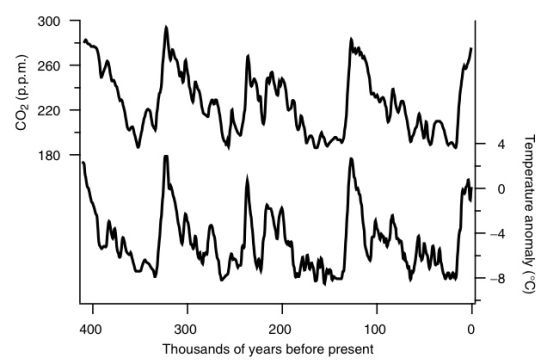
FIGURE: Data from the Vostok ice core in Antarctica, from 410,000 years ago to the present. The top curve shows abundance of CO2 (in parts per million) from air bubbles in the ice core. The bottom curve shows the temperature anomaly in the Antarctic region, relative to the present, from isotopic measurements of the ice. After Fig. 3-6 of my book.
Many advocates use this as evidence that our emissions of CO2 will warm the Earth. Skeptics point out that the CO2 rise actually followed the temperature changes, questioning the direction of the correlation.
The truth is, as usual, more complicated than either interpretation. There is clear and unambiguous evidence that ice ages are initiated by small variations in the earth’s orbit. This includes changes in the eccentricity of the orbit, changes in the tilt, and the day of year of closest approach to the sun. More on this can be found here.
However, these slight orbital changes are small — too small, in fact, to explain the wide temperature swings in the historical record. Something must be helping the orbital variations produce the observed variations.
What most scientists think happens is that the orbital variations cause a small initial warming. This small initial warming leads to CO2 being released, which then leads to further warming.
Thus, CO2 indeed lags the initial warming. However, that does not mean it’s not playing a crucial role in the warming. In fact, its role in warming is pivotal.
In making the argument that CO2 is causing global warming, I tend not to talk about this long-time-scale correlation. As you can see from this post, while the correlation looks simple, the causality is more complicated than one might initially think. There’s a much better argument anyway, which I laid out in my last post. And there are other problems — e.g., we do not know with great confidence exactly what mechanism causes CO2 rise in response to the slight orbital-caused warming.
In summary, in the parlance of climate scientists, we would say that CO2 was acting as a “feedback” over the time period in the figure above. In the past century, however, humans have taken over the carbon cycle and now dominate the year-to-year atmospheric changes. Thus CO2 has now become a “forcing.”