Put that fruit juice down and grab a Coke.
Haven't you heard? High-fructose corn syrup -- the ubiquitous sweetener found in everything from soft drinks to ketchup -- isn't bad for you at all. It's true, because I saw it on TV.
Back in June, the Corn Refiners Association embarked on what the Wall Street Journal described as an 18-month, $20-30 million campaign to "rehabilitate the reputation of the longtime sweetener." The blitz includes full-page ads in more than a dozen newspapers and prime-time television spots.
The industry is evidently worried about losing its grip over a key consumer demographic: kids. To stave off that unhappy fate, the corn refiners are currying favor with those who monitor kids' food choices. "The lion's share of the ads will run on media that specifically target moms," the Journal reported.
It's easy to see why the industry is fretting. As the accompanying chart shows, corn sweetener consumption peaked in 1998 and has been dropping since, pressured by growing concern over diabetes and obesity. Yet high-fructose corn syrup remains the dominant U.S. sweetener -- Americans consume about 50 pounds of it per capita every year, versus a little more than 40 pounds of refined sugar.
And corn-processing powerhouse Archer Daniels Midland -- which owns about a third of the domestic HFCS market-- still makes considerable money from it. In the year ended June 30, 2008, sweeteners delivered $529 million to ADM's bottom line. That's more than its much-ballyhooed ethanol division brought in ($432 million) and about a sixth of the company's overall operating profit.
So that's what's at stake for the industry: a sweet source of steady profit. But what about consumers? Are they really in for what the industry's marketing campaign calls a "sweet surprise" -- that they can go on blithely consuming (and feeding their kids) high-fructose corn syrup without health consequences?
Bitter Ironies
First of all, the ads' claim that HFCS is "fine in moderation" glosses a hard truth for an industry that thrives on immoderation. The golden age of HFCS -- roughly 1978 to 1998 -- was an era of mindless bingeing on sweetened foods. This was the time of the Big Gulp and of liquid substances that "contain fruit juice" but owed most of the their flavor to a sweet blast of HFCS.
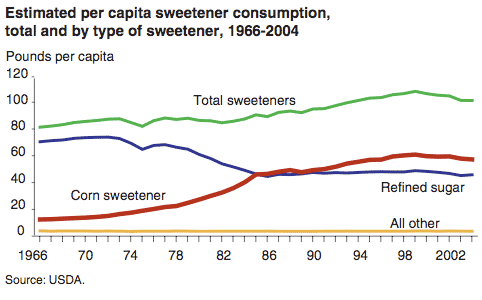
As the chart shows, corn sweetener consumption jumped from 20 pounds per capita per year in 1978 to more than 60 in 1998. That 200 percent jump more than offset a decline is refined sugar use. Overall, sweetener use rose steadily over the period. By the end, HFCS was showing up not just in soft drinks but also in stuff like hamburger buns. In other words, the U.S. sweet tooth suddenly began ramping up in the late 1970s, and the corn industry was there to satisfy it.
Why did HFCS consumption take off in the early 1980s? The catalyst did not come from any change in consumer preference or quirk of the free market. Rather, corn sweetener owes its ubiquity to changes in government policy -- ones pushed through by the industry itself, especially its biggest player, Archer Daniels Midland.
As Richard Manning shows in his Against the Grain, HFCS failed to gain a foothold in the soft drink in the 1970s -- and without conquering Coca Cola, Pepsi, et al, HFCS was doomed to be a marginal player in the sweetener business. In short, despite its best efforts, Archer Daniels Midland couldn't engineer a corn sweetener that was cheaper than sugar.
Stymied in the lab, the corn-processing giant searched for solutions in the political arena. ADM was arguably the most politically powerful corporation of the 1970s. Then-CEO Dwayne Andreas gained legendary status as a double-dealer during the Watergate investigations, when the congressional hearings revealed that he had cut the $25,000 check used by Richard Nixon's "plumbers" to finance the infamous hotel break-in. From the same hearings it emerged that Andreas had illegally donated $100,000 to Minnesota Sen. Hubert Humphrey in 1968 -- Nixon's Democratic opponent in that year's election and a longtime Andreas favorite.
According to Manning, ADM began in the late 1970s to finance a lobbying effort to strictly limit the amount of foreign sugar that could be imported into the United States. In 1982, another Andreas friend, President Ronald Reagan, signed into law draconian sugar quotas that remain in effect to this day. (The free-market champion must have felt sheepish signing this blatantly interventionist act.) The domestic price of sugar immediately spiked, and food manufacturers -- including, crucially, soft-drink bottlers -- quickly began substituting HFCS for sugar.
And as corn prices generally dropped through the 1980s and into the '90s -- pushed down in part by U.S. farm policies also promoted by ADM -- the industry began to churn out more and more HFCS, and its price came down. That's why manufacturers began putting it seemingly in everything -- and U.S. sweetener consumption boomed along with obesity and diabetes rates.
Fat of the Land
Insofar as the rise of the HFCS industry gave the U.S. diet a jolt of empty calories, it almost surely contributed to surging obesity and diabetes rates.
The question remains about whether, as some researchers suggest, HFCS triggers more weight gain than equivalent amounts of refined sugar. Both are fragmented substances, stripped of trace nutrients to deliver pure sweetness. In HFCS production, complex carbohydrates are broken down industrially with enzymes -- some of them genetically modified -- to produce a combination of fructose and glucose.
According to the industry, the body metabolizes HFCS and refined sugar just the same. On its website, the Corn Refiners Association points to six academic studies [PDF] showing no difference in metabolism. But as CBS News recently reported, "Three were sponsored by groups that stand to profit from research that promotes HFCS. Two were never published so their funding sources are unclear. And one was sponsored by a Dutch foundation that represents the interests of the sugar industry."
Industry cash doesn't nullify academic work, but it surely influences what questions get asked. And other research contradicts the studies trotted out by the Corn Refiners Association. For example, in a paper published in the American Journal of Physiology -- Regulatory, Integrative and Comparative Physiology (funded by the National Institutes of Health), University of Florida researchers found that fructose-heavy diets "can induce leptin resistance, a condition that can easily lead to becoming overweight." Leptin is a substance produced by the body to trigger feelings of satiety; it tells us when to stop eating.
Clearly, more independent research needs to be done about high-fructose corn syrup's effects. More clearly still, we continue gobbling up too much refined sweetener. Sweetener consumption has dropped in recent years but remains at levels well above those that held sway before the advent of HFCS. Instead of casually pouring her kids a highly sweetened beverage, the mother in the Corn Refiners ad should dump it down the drain.

Comments View as Flat
Cornrefiner Posted 6:48 am
17 Oct 2008
High fructose corn syrup
High fructose corn syrup, sugar, and several fruit juices are all nutritionally the same.
High fructose corn syrup has the same number of calories as sugar and is handled similarly by the body.
The American Medical Association in June 2008 helped put to rest misunderstandings about this sweetener and obesity, stating that "high fructose corn syrup does not appear to contribute to obesity more than other caloric sweeteners."
Consumers can see the latest research and learn more about high fructose corn syrup at www.HFCSfacts.com and www.SweetSurprise.com.
Audrae Erickson
President
Corn Refiners Association
Permalink
cavecanem Posted 7:16 am
17 Oct 2008
AMA
Audrae - that rhetoric is highly questionable.
1.) Per http://www.webmd.com/diet/news/20080618/sweetener-gets-un ...
"We do recommend consumers limit the amount of all added caloric sweeteners to no more than 32 grams of sugar daily based on a 2,000 calorie diet in accordance with the Dietary Guidelines for Americans," Dolan says.
The AMA acknowledges that obesity rates have soared in recent decades, in sync with the growing use of high fructose corn syrup."
2.) HFCS doesn't actually exist anywhere in nature. It is a manufactured product created by using enzymes (two natural, one synthetic) to increase the fructose content of corn syrup to about 90%. This super high fructose syrup is then blended "down" with a 100% glucose corn syrup to create various mixes. HFCS 55, for example, which is 55% fructose and 45% glucose is the mix used most commonly in beverages. HFCS 42 is the blend used more commonly in baked goods.
3.) Yes, it's absolutely true that high fructose corn syrup is made from corn, but it doesn't mean anything. Biodiesel is made from corn too, and you wouldn't want to see that used as a food additive.
4.) The AMA also states: "But [the AMA] called for further independent research to be done on the health effects of high fructose syrup and other sweeteners."
They then went on to say:
"We do recommend consumers limit the amount of all added caloric sweeteners to no more than 32 grams of sugar daily."
...and "Currently, there are few available studies on the health effects of high fructose syrup and most are focused on the short-term effects."
5.) It is in everything and Americans eat a lot of it - nearly 60 lbs. per capita in 2006. The claim is it is "healthy" when consumed in moderation - the problem is it is not consumed in moderation. Your company's lobbying efforts have directly caused this.
The fact is, high-fructose corn syrup is reviled for contributing to everything from the obesity epidemic to rising rates of childhood diabetes.
Permalink
WWAGD?! Posted 3:19 am
18 Oct 2008
Too Much of A Bad Thing
The argument muddles a point -- how much "sweetener" of any kind should we be eating.
And has fructose become inescapable and put into many products that have no business being sweetened.
Take frozen "fruit juice". One has to go to Harvard Law to understand the fine versus the big print on what exactly is the source of the juice -- it is truly natural, are there additives, is the natural content of sugar "boosted" (even with natural juice) to make it sweeter?
Permalink
ian Posted 11:44 pm
18 Oct 2008
Is HFCS really the same as sugar?
My friend Jim and his kids are allergic to HFCS (and all corn products such as corn starch), but not to cane sugar. He goes hunting for sodas, cakes, pizzas etc. that won't give him the jitters. So my question is this: is it not possible that the difference between sugar and HFCS that his body detects is the same difference that causes obesity? Oh, BTW, he is one skinny dude.
Permalink
Maeve Posted 4:30 am
20 Oct 2008
Coincidence?
I was reading through my weekend back-up of RSS stuff, and came across an article at CrunchGear about HCFS - link here.
The same Audrae lady responded with a similar canned blurb, though far longer.
Seems awfully coincidental. I expect they've got people on press duty to scan the Web send out this kind of crap anytime one of them finds anything online that even slightly infers anything not good about HCFS.
-
I read food labels for many things these days, but main among them is HCFS. I notice that I feel much better without it in my diet and generally only splurge if I'm going out to eat and want a soda (not often). Usually I just get club soda instead.
(yes, this comment is damned similar to the one I posted on CrunchGear... I'm at work and lazy...) ;)
Permalink
PermieWriter Posted 12:47 pm
20 Oct 2008
Nice casting
I'm pretty sure the actress playing Paranoid Mom is the same one who played Buffy's roommate in the first couple episodes of season 4. The one who turned out to be a demon.
It's nice to see the gears of the agro-chem industry grinding on an issue that doesn't have such high stakes. Like transgenic crops, for example.
Permalink
moregreeneachday Posted 11:22 pm
20 Oct 2008
NO MENTION OF GMO!!! How can this be?
I find it very hard to believe that "genetically modified corn" is NOT mentioned once in this article! NO GMO corn for me! KISS GOODBYE HFCSs!!!
Permalink
amazingdrx Posted 12:48 am
22 Oct 2008
Cane, beet, corn
Which sugar would win without subsidies? Cane, it's a more efficient sugar producing plant.
Which one needs the least chemical processing? Cane sugar. Which one provides healthy nutrition? None of them.
Which sugars do not involve slavery? Beet or corn sugar. Sugar cane is mostly harvested by slaves. The Fanta brothers even have sugar slaves in Florida, imported from the Carribean.
Honey and maple sugar are the only locally available least processed sources of sweetness for most of the US. Water is more satisfying and healthier than sweetened beverages.
I see local honey and maple syrup producers making healthy incomes again, as people become more conscious of corporate food scamming.
Permalink
mkeating Posted 2:55 am
22 Oct 2008
Cane, beet, corn....AND SORGUM!
It figures that someone from Northern Wisconsin would cite honey and maple syrup as natural, sustainable sweeteners but forget to mention sorghum! As an adopted Southerner, I've come to appreciate just how wonderful AND nutritous sorghum is. Really, there is no substitute for honey - its enzymatic properties as a living food make it so therapeutic. But if you're looking for sweetness with some nutrition, sorghum is for you. Sorghum is drought tolerant and much less spoliled than corn - one reason why it has been a traditional food, feed and fiber source for poor farmers in the South and Midwest. In another few years, we'll probably be growing sorhum in Northern Wisconsin as maple syrup production moves up to the Arctic Circle!
Permalink
amazingdrx Posted 7:39 am
22 Oct 2008
Hope not!
"In another few years, we'll probably be growing sorhum in Northern Wisconsin"
We'll still have bees, maybe? Anyway, thanks for the tip, M. I'll try some. Maybe it would grow up here with a cold frame season extender?
Permalink
ryanwanger Posted 8:56 am
28 Oct 2008
This Campaign was a HUGE Mistake
The number of people googling "high fructose corn syrup" has hilariously SKYROCKETED since this campaign launched. What do they see? All results questioning its safety.
Thanks to the commercials, people who didn't know they had a problem are curious now, and doing their own research. OOPS!
I just wrote a post about this with stats and commentary. http://www.thereluctanteater.com/2008/10/proof-sweet-surp ...
Permalink
waku2waku Posted 7:07 am
18 Nov 2008
Diabetics seem to notice a difference with HCFS
At other forums for diabetics, some posts indicate that diabetics experience a difference in their blood sugar levels with high fructose corn syrup compared to cane sugar.
One guy made an experiment out of it. He had HCFS. Measured his blood sugar level. Then he had cane sugar. Measured his blood sugar. His blood sugar level with HCFS was twice as high as his blood sugar level with cane sugar. His comment is just above here http://tudiabetes.com/forum/topics/583967:Topic:261850?pa ... {I couldn't figure out a direct link - sorry}
I've seen posts from Audrae Erickson and the Corn Refiner's Association from the past month at several other blogs and websites. I wish she would reply a second time to this and other people's comments.
And a shout out to sorghum, maple syrup, and honey. That string of comments gave me a laugh.
Permalink