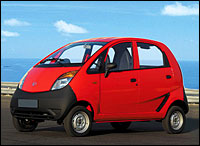
Photo: TaTa Motors
The world's cheapest car was unveiled in India today by Tata Motors, which hopes that its new $2,500 subcompact will help make car ownership a reality for tens of millions of people. The Tata Nano gets respectable gas mileage, up to 58.8 miles per gallon, and meets India's emissions standards, but its introduction was met by protests from greens fearful that more-accessible autos will have a negative effect on the country's pollution and greenhouse-gas emissions. The auto industry, however, lauds the small five-seater -- which has one windshield wiper and no radio, passenger-side mirror, central locking, power steering, or air conditioning -- as a huge advance in mobility for the people of India, where two-wheeled transportation is common but only seven in every 1,000 people own a car.

Comments
View as Flat
Wolverine Posted 5:45 am
10 Jan 2008
Permalink
dearjulia Posted 6:32 am
10 Jan 2008
carbon monoxide, suspended particulate matter, sulfur dioxide, nitrogen oxides and hydrocarbons...
By comparison a car would facilitate carpooling...
Or am I being a hopeless optimist...
Permalink
Delay And Deny Posted 8:40 am
10 Jan 2008
This car is so "unsexy" that anyone driving one is never going to get any play.
This will help decrease India's birth rate and solve global warming.
Permalink
Pathos Posted 8:46 am
10 Jan 2008
Kind of funny when you think about it, isn't it?
My favorites have always been "legitimate bastard" and the phrasal verb "to butt heads."
Fun rhetorical figures aside, I'm afraid you may be being overly optimistic, Julia. You see, the people of India are already in the habit of carpooling--on motor scooters. It is not uncommon in an Indian city to see a family of four piled on a scooter, with a young child on the handlebars, the father driving, and the mother behind him with a baby in her arms. It sounds ridiculously unsafe (I have no idea what the actual stats on accidents and injuries are), and it's certainly uncomfortable, but it's done, because in many cases, there's no other option. If the Tata catches on--and it certainly will--the days of this phenomenon will quickly become numbered.
So, if you wish to remain hopelessly optimistic, you still can, and with good reason. Rejoice in the fact that for many Indian families, the standard of living is about to take a quantum leap. They won't have to worry about cold wind or rain in their faces as they drive to school and work each morning anymore. Their chances of surviving an accident will skyrocket. Those with older children will have the option of traveling as a family. But every silver lining has a cloud, and in this case, it's a cloud of greenhouse gas emissions.
If the Tata is going to do anything to the environment besides hurt it, they're going to have to market it in places where lots of people already drive cars--and find a way to catch the interest of the large sedan and SUV cultures. But those places and those cultures aren't likely to be found in India.
Permalink
Tasermons Partner Posted 12:19 pm
10 Jan 2008
Or am I being a hopeless optimist...
Eh, most indians don'r really "commute", at least, not in the way that Americans do. Many live fairly close to their work.
Plus, most Indian cities have fairly extensive bus and rail systems, which are utilized more heavily than the private automobile (in comparison of total numbers of riders).
Increasing the number of indiviual autos may be a step back, even if it decreases scotter use, since it may also reduce bus and rail usage.
Plus, the Tata is extremely lackin' in basic safety features.
How this will work out remains to be seen.
Permalink
racc Posted 1:34 pm
10 Jan 2008
Note, however, that many Indian cities are investing heavily in rail and public transit. I think these kinds of stories are covered a lot just to justify our continued overuse of the automobile.
Unfortunately, even with their step backwards, they are still far ahead of us. We are so far behind India it is pathetic. It is time we ditched cars and roads and invested heavily in public transit and rail. It is about we showed some leadership
Permalink
Tasermons Partner Posted 3:14 pm
10 Jan 2008
They may lead is in the fact that more people use mass transit, but much of their infrastucture is generally very old and decayed. It wouldn't meet most American safety standards.
Likewise, India has almost no restrictions on air pollution. They have less cars overall, but they pollute much more than our vehicles do. Even our worst cities on our worst days don't compare to what many of their cities endure on a near-daily basis in relation to air pollution.
Permalink
ruttle Posted 11:38 pm
10 Jan 2008
Correct me if I'm wrong.
If you are an hopeless optimist just keep on hopin' that people will start acting reasonably one day.
Permalink
su Posted 11:53 pm
10 Jan 2008
On the other hand this will most definitely increase emissions disastrously. There arent any details about the kind of fuels that the car supports and the fuel efficiency with alternative fuels.
but look closer....the car is most certainly going to need more fuel that a scooter...fuel is not getting any cheaper in india either; so maybe they'll use CNG- very abundant. However, Zooming out some more . . . How is Tata turning out these cars so cheap? even missing a lot of features, theres a fair amount of externalization going on here. Who is paying for these cars?
(for a simplified explanation of externalized costs go here; http://www.storyofstuff.com)
The car is symbolic like most cheap consumer toys of economic oppression at on level, and greedy pockets on another.
and oh- about population, i think its a basic enough observation, that population explodes in places with a high level of poverty and hence low levels of health, awareness, and CHOICE! keeping a large section of the worlds population in such a state is only going to worsen the problem, unless we want to start culling humans like rabbits and kangaroo.
Permalink
Matt G Posted 3:00 am
11 Jan 2008
Add car-based commuters and the situation will change completely. Roads will fill up, which will slow down busses. With limited mobility downtown areas can become more dense (good) and sprawl will increase (very bad).
That being said, I think that's the future of India whether this car exists or not. And believe it or not, I doubt vehicles are the major polluters in India right now. You can't go more than a few blocks without walking by a garbage pile on fire in the street.
Also, infrastructure is quite bad. Between cities the streets are in very poor condition (often dirt or gravel) and on major routes the average travel speed is perhaps 30mph. This will decrease with added traffic. So as long as infrastructure doesn't change perhaps cars will be valued less as they become less useful.
Permalink
Wolverine Posted 6:04 am
11 Jan 2008
Permalink
su Posted 8:25 am
11 Jan 2008
Permalink
su Posted 8:27 am
11 Jan 2008
Permalink
su Posted 8:29 am
11 Jan 2008
Permalink
amarct Posted 9:23 am
11 Jan 2008
http://www.theaircar.com/
Tata signed an agreement with MDI to develop that car for the Indian market:
http://www.theaircar.com/tata_agreement.html
Then watch how it runs and much more about a similar project in Australia:
http://www.youtube.com/watch?v=QmqpGZv0YT4
Permalink
red green Posted 1:17 pm
15 Jan 2008
Let's review some basics: The Nano is said to have a fuel economy rating of 54 miles per gallon (though, of course, we all know there are many different test cycles, and it remains to be seen whether this rating holds up). The 54 mpg is roughly double the current US CAFE average.
Indians on average drive one-fourth the distance that Americans drive in a year.
The Nano seats five and Indian motor vehicles are typically used to full capacity, and then some. The average number of occupants per car in the US is something like 1.4.
Put all of this together and you end up with a factor of about 29--the average US car is likely to consume 29 times the energy of a Nano.
Yes, there is disturbing strength in numbers: assuming that millions of Nanos may ultimately be sold, they will have a major impact in terms of carbon emissions. And Indian cities hardly need more vehicles on their roads (it's already enough traffic chaos and air pollution).
But as Westerners, perhaps we ought to focus our energies on changing our own massively destructive car habits (people in Western countries plus Japan own two thirds of the world's motor vehicles) before pointing a finger at Indians.
Permalink