This is part of a series of interviews with presidential candidates produced jointly by Grist and Outside.
Update: Tom Tancredo dropped out of the presidential race on Dec. 20, 2007.
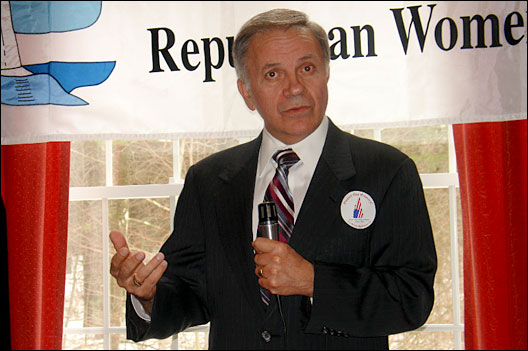
Colorado Rep. Tom Tancredo — best known for his zealous opposition to illegal immigration — bills himself on his campaign website as “a solid pro-life, pro-gun, small government Republican.” What’s not mentioned on his site is anything about the environment or energy issues. (Considering that he’s got a lifetime approval rating of 11 percent from the League of Conservation Voters, perhaps that’s no surprise.)
But when asked about these issues, Tancredo makes a patriotic call for energy independence, just like the rest of the presidential contenders. And while he likes to joke that Al Gore’s An Inconvenient Truth is the last book of fiction he’s read, Tancredo also pays lip service to a shift away from carbon-based energy sources and the withdrawal of subsidies from fossil-fuel energy. Still, his free-market-driven vision of America’s energy future includes lots more coal mining and oil drilling, as well as nuclear power.
I caught Tancredo by phone while he was campaigning in New Hampshire and tried to get a better picture of how environmental goals fit into his conservative platform.
For more info on his platform and record, check out Grist’s Tancredo fact sheet.
You support a fence along the U.S.-Mexico border to curb illegal immigration. Environmentalists have raised concerns that such a fence could be harmful to wildlife and the broader ecosystem in the area. Do you think this is a legitimate concern?
What is even more disturbing is the environmental damages caused by illegal aliens crossing the border. On average, an alien crossing the border will drop about eight pounds of trash on a one- to three-day journey. This amounts to hundreds to thousands of pounds of garbage left in an ecosystem completely unprepared for that type of pollution.
What do you see as the most pressing energy and environmental issues facing the nation?
We can take care of a couple of issues with one sort of strategy. If we successfully reduce our reliance on oil produced by countries that are dangerous to us — and that’s a good thing from a national-security standpoint — you will automatically reduce the amount of carbon we produce in the United States. A major initiative to move away from carbon-based products would accomplish a great deal.
How do you envision such an initiative? Is this a priority for you?
Yeah, it certainly is, because it’s a national-security issue, primarily.
I don’t doubt that global warming is a true phenomenon. I’m saying the extent to which you can attribute it directly to man’s actions, I think, is still at least debatable. But that doesn’t matter if we move in the direction I’m saying.
So what can the federal government do? Besides investment in research and technology, which of course I think it must do, we could require, for instance, all federal vehicles to be alternative-fuel vehicles. A lot of things are happening right now as a result of the market, and I am, frankly, reluctant to tamper with the market to a great extent.
I’ve heard you say you trust the market far more than you trust government. If the market were a level playing field and all subsidies were removed from the energy sector, what would happen to the renewable and alternative energy industries?
You would see the most efficient develop; the most inefficient would lag behind or not survive. I don’t think that subsidies are a good way to go. Even now, the markets are already working. You look at the number of alternative-fuel and hybrid vehicles that are being purchased, it’s really quite significant. Toyota took over GM’s spot as the No. 1 auto producer in the world, and why? Something called the Prius.
Would you, as president, remove subsidies from fossil-fuel industries?
Yeah, I say remove subsidies, I certainly think that’s appropriate.
However, R&D is a subsidy, and I would support efforts in research and development. We can obtain a lot more fossil fuels from things like shale, but it may require some R&D to find ways to make it cheap enough so that you can extract the oil from the shale.
I also think that it is appropriate for us to remove restrictions on the development of fossil-fuel resources within the continental United States and off of the continental shelf.
Again it goes back to national-security issues. What I’m trying to do is rely less and less on any sort of fuel from countries that are potentially very dangerous.
Would you fund R&D for emerging technologies like wind and solar?
Yes, and it can be broader than that. It can be R&D into biotechnology and biofuels. There are two reasons I am willing to do that: One, the national-security thing. The other is that we have OPEC, so there isn’t truly a free market. You have to have some degree of government involvement in this because the OPEC nations can and do control the market to a certain extent. When emerging technologies become a threat to oil, OPEC can [flood the market with oil], driving the price down to make it impossible to compete, and that new technology goes down the toilet.
Can you clarify your take on global warming? It sounds like you think it’s a problem but not necessarily one that’s human-caused.
It may certainly be a phenomenon that’s got nothing to do with the impact of humanity on the environment, or very, very little anyway. It may be a cyclic thing that we will simply have to deal with. I don’t know. There’s plenty of reliable research on both sides.
So I say, look, it really doesn’t matter. The thing we must do is reduce our reliance on potentially violent countries. If in reducing carbon emissions we actually have a positive impact on this global-warming phenomenon, then great.
Do you support a cap on carbon emissions?
I really think there are a lot of problems with that, especially in terms of enforcement — you are talking about the possibility of a lot of fraud. I’d look very skeptically at any type of cap-and-trade scheme. Let’s put it this way: It’s not impossible, but I’d be very skeptical.
What role should the U.S. play in crafting a new international agreement on climate change?
We should encourage countries to rely on markets more than anything else to accomplish the goal.
You’re a strong supporter of nuclear power in the U.S. What do you see as the advantage of increasing nuclear power?
I believe that we have developed the technology to where it is very safe. The biggest problem we have, of course, is with storage [of the nuclear waste]. We’re having a hell of a time trying to get Yucca Mountain certified [as a waste-storage site]. In the meantime, we’ve got communities in Texas that are saying, “Let’s do it here.” Why? Because there are a lot of jobs involved, there’s a lot of money involved. It’s a great market-oriented solution. It also allows us to have an alternative fuel that is clean and plentiful. What more could you ask for?
So your waste-storage solution would be Yucca Mountain or a distributed storage plan?
Absolutely, we can keep looking at Yucca Mountain as the important place, but it’s not the only place. There are already sites in Texas that we are working to try to open. It will happen. We will get the storage. It’s all about supply and demand.
What role do you think coal should play in America’s energy future?
I think coal gasification, especially if we can perfect the in-ground storage of carbon. [Oil] prices are high enough now that it makes it feasible to move in the direction of coal gasification.
What about liquefied coal?
Same thing — lots of it. Again, the trade-off there is the carbon issue. As you know, there’s a lot of technology being developed to try and store the carbon.
What about ethanol?
Same thing. That’s another point where markets will be helping to determine this, because at a certain point [ethanol] becomes less than efficient both in terms of the energy trade-offs that are involved and just the sheer cost. When you mandate a certain amount of fuel like we do now, it is an indirect subsidy. Subsidies for the creation of biofuels — that’s not something I’m crazy about, theoretically speaking.
There’s growing belief among evangelicals and other communities of faith that we need to be stewards of the earth and protect the planet from global warming. What’s your take on this?
I think it would be better for them to deal more directly with issues relevant to their communities of faith.
There are some Republicans in Colorado who have been disgruntled by the increased drilling for oil and natural gas in the state. What’s your take?
I’m supportive of the drilling, especially [for natural gas] on the Roan Plateau. It’s an important source of clean fuel, and the footprint is very small. Everyone wants to use the energy, everyone wants to claim that they are supportive of a greater environment — and yet here when we can accomplish that, when we increase the use of coal-bed methane and natural gas and a variety of other alternatives to petroleum-based products, they are screaming, “Not in my backyard.”
It’s sort of the hypocrisy of the Kennedys, in a way. They talk about how much they want the rest of us to make sacrifices in order to accomplish [environmental] goals, but they are not willing to have a wind farm where they can see it from [Cape Cod].
We all have to accept the responsibility. I don’t like it when states are talking about “you can’t drill off of our coast” or “you can’t drill here,” but they have no reluctance about consuming all of the oil production that originates from the rest of America. There’s a lot of hypocrisy there.
What environmental achievement are you most proud of?
My work on the Healthy Forests [Initiative] — frankly, I think that’s enormous. If we could begin to implement that in a more effective way, I think we could see a lot of really important developments, not the least of which is the reduced risk of major, catastrophic forest fires. Healthier forests are also healthy for the environment because they suck up out of the environment what we don’t want, and produce what we do.
Who is your environmental hero?
I have none.
Can you talk about a memorable outdoor experience you’ve had?
I just got done with a competitive shooting event here in New Hampshire, outdoors. It was great! First you shoot trap, and then you move to a target range with a rifle, and then you move to a target range with a pistol. I finished all three a little bit ago. I did really well.
Do you enjoy hunting?
Yes, I do. A while back, Mitt Romney said he’s been hunting all his life, but he just got his first license last year. I actually have been hunting all my life.
I had golden retrievers for years. You get mesmerized by them and sometimes miss a good shot because you’re watching the dogs work. They’re just wonderful. They’re in their element, doing exactly what they were born for.
If you could spend a week in a natural area, where would it be?
I actually love the grassland, the Pawnee National Grassland in northeastern Colorado. It’s quite beautiful. I know most people don’t think of grasslands as offering that kind of beauty, but to me they do. You just look over that sea of waving grass, and I think it is breathtakingly beautiful.
What have you done personally to reduce your environmental footprint?
I have a 2005 Prius. It’s a great car. It also lets me drive in the restricted lane on the way to work.