Dearest Umbra,
I recently heard an interesting interview on NPR, and the speaker was talking about how, to stop global warming, all humans would have to limit their carbon emissions to just one ton of carbon per person, per year. I've never weighed my carbon emissions, but I'm going to guess that I throw a lot more weight around than one ton. What would I have to do to slim my ton to one? I'm approaching my carbon tonnage like a diet -- I need to know how many "calories" I'm bringing in through what I consume, drive, and engage in. Is there a carbon calculator I could use? Some rule of not-so-green thumb? How do I calculate the impact of a megawatt of home heat? A five-mile drive? A 1.5-hour airline ride? A short mocha every other day? If I'm truly going to get under one ton a year, I'm going to need some way to quantify my habits. Any ideas?
Tons a Lot!
Sarah in Seattle
Dearest Sarah,
There are many carbon weight loss programs out there. One area that is ripe for study is the comparative difficulty of losing carbon weight vs. body weight. Does carbon weight loss come with the same basic problem as regular old weight loss? Is it difficult to keep the weight off once you've reached your goal? These questions will hopefully be what is absorbing us three years from now. In the meantime, we need to enter a phase of obsessive dieting. The typical American is responsible for 20 tons of carbon a year -- we're basically carbon obese. Whether or not one ton is the exact carbon weight allowable to each Earthling, it's laudable to try to reduce by any significant amount.
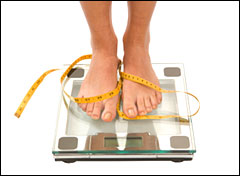
Not low carb, low carbon!
Many tools exist that help us evaluate the emissions of our homes and our transport, using our utility bills and odometer. The short mocha is a bit harder to calculate, as we do not pay the café's utility bill. Let's just start today with the easier stuff and see how thin we can become on a low-math diet. Two ways to go here: You can use an online calculator, and trust its calculations; or you can get the plain old numbers from a trusted source and use your home calculator. For ease of use, I would choose the former.
The Bonneville Environmental Foundation's calculator illustrates both of these approaches and shows a bit of what you should look for in a calculator. BEF sells personal carbon offsets; its calculator is geared toward people planning to buy said offsets, but you can use it even if you have no such intention. The format of the calculator is typical. The user follows easy instructions, typing personal data into boxes: kWh, dollars spent on heat, zip code, car mileage and miles per gallon, air travel miles, and more. Zip code is an important detail that tells the computer how your electricity is made. The computer then calculates the resultant carbon dioxide or carbon dioxide equivalent (other greenhouse gases are converted into "CO2e" in order for science to have a common workable unit), and pops out with a summation of your tonnage.
Down at the base of the BEF calculator, it says, "How Do These Calculations Work?" The pop-up window is helpful -- it shows that BEF is using generally accepted numbers from the Energy Information Administration, EPA, and other federal agencies. You can see the actual mathematical calculations used, and a clear description of why certain calculations were chosen. Don't bother using a calculator whose creators don't explain how they make their calculations. The more detail you can get, the more you can understand how to reduce your emissions and how one calculator compares to another.
That said, I have not evaluated all the carbon calculators on the market; I'm not sure anyone has, and they've been proliferating like bunnies. From one perspective, any decent calculator is fine for the first phase of your diet. After all, because your emissions are certainly far more than one ton, what you are after is relative emissions loss at this point, not absolute emissions loss. It's like the Weight Watchers suggestion: Weigh yourself once a week using the same scale every time, and even if that scale is off, you'll know how much weight you've lost.
To soften that shockingly broad statement, I have a few suggestions of reputable sites that may help you be a bit more exact. The EPA's own calculator is very basic and is certainly using solid, accepted emissions factors. It has a feature I appreciate, namely showing the emissions in each category as you go, rather than just one big number at the end. One big number is not entirely helpful for winnowing down our waists -- that's like knowing that all food contains calories, but not which foods contain the most.
If you feel more comfortable trusting the EPA calculator but wish to include a little more detail on travel emissions, you could add that data using two other sites I've noticed: Travel Matters calculates your transport emissions for a month-long period (easier than a year), and includes details such as carpooling, bus travel, walking, and biking. Atmosfair calculates air travel and is respected for including many small details in its calculator (length of flight, radiative forcing, etc.).
If you would like to do your own math for the whole calculation, use the emissions factors on the EPA pages. Or EPA itself links to a variety of calculators you can peruse if you would like to find one that suits you better than the few I have mentioned. Because it can be overwhelming once you start looking at lots of them, remember: Right now, you just need the basics to get started.
I hope this information will kick off an effective dieting strategy. If this first phase of the diet is too easy, we can turn to the short mocha next.
Foamily,
Umbra
Comments View as Flat
meaniegreenie Posted 3:48 am
04 Jun 2008
Carbon Dieting Book
There is a book to help you carbon diet at home. It doesn't really account for your away from home actions, like the stop at Starbucks or similar, but it can help you with other things.
The title of the book is -
The Low Carbon Diet: A 30-Day Program to Lose 5,000 Pounds.
Good luck!
Permalink
IHeartBiochar Posted 4:02 am
04 Jun 2008
Big footprints, but I do like government services
I didn't hear the NPR interview, so I don't know how the speaker was imagining a per-person carbon footprint. If you count just the things an individual is directly responsible for, like personal transportation and home energy use, maybe (maybe) you could get your footprint down to one ton. In general, these are the kinds of things measured by the personal carbon calculators out there.
But if you use a more complete calculation, which includes a share of the emissions you benefit from (businesses whose products you buy, government services like libraries and police), MIT students have found that the lowest carbon footprint an American can have is 8.5 tons. However, this kind of calculation works in a top-down fashion (total emissions from all sectors divided by population) and wouldn't be very easy to calculate - or change - for individual people.
Don't be discouraged, though. All this shows is that it will take both individual and institutional changes to reduce our overall carbon footprint. In a democracy, institutional changes don't usually happen until individuals have proven those actions doable and effective. So good luck with the diet!
Permalink
IHeartBiochar Posted 4:17 am
04 Jun 2008
Carbon footprint over time
to chime in again...
For people really serious about reducing their carbon footprint, one potential weakness with many of the carbon calculators out there is that they're snapshots - you can't track your reductions like you might with an actual diet (stepping on the scale periodically to see how you're doing). The UK has a head start on the US for sites that let you track your footprint over time, though there's at least one business-focused site in the US. Here are the ones I'm aware of:
Edenbee (UK)
Carbon Diet (UK)
OpenEco (US, business-focused)
Permalink
redambrosia99 Posted 4:28 am
04 Jun 2008
good start
Well, based on the EPA calculator, I'm using 14,117 lbs per year. But there's nothing for buses and walking everywhere so based on the Travel Matters calculator I'm using 403 lbs per month. Which brings me up to 18,953 per year.
This is where it would be nice to be able to afford to either buy my own house or live in a eco-friendly joint. Affordable housing generally doesn't do much in the way of eco-friendly-ness, which sucks, cause it would be way more affordable with a lower energy bill.
Permalink
LizC Posted 4:28 am
04 Jun 2008
Quick reference for those not wanting to calculate
Having just gone through the process of trying to figure out exactly what we need to do to reduce our carbon footprint, let me recommend a couple of easily available sources that will give you a list of things to do. Yes! magazine, Spring 2008 issue, has a short article about a fairly typical family reducing their footprint in 10 years. This is the easy stages approach. The link is http://www.yesmagazine.org/article.asp?id=2287. Second, I found The Carbon Buster's Home Energy Handbook by Godo Stoyke to be concise and informative. There's a 2 page list of things to do, actually 2 lists: one for optimizing money saved, and the other for optimizing carbon reduction. So if you don't want to calculate, just flip to the lists and start doing the items. If you want to know why and how much without calculating it all yourself, the rest of the book has that info. I checked it out of the King County Library, and have now added it to my Amazon wish list to be purchased Real Soon Now.
Permalink
edenz Posted 4:42 am
04 Jun 2008
90% Reduction
Another site to check out is the Riot for Austerity - 90% Reduction Page. This is a group that is commited to reducing their envioronmental impact to 90% of the average American's (Monbiot's estimate for achieving 350 ppm of carbon in the atmosphere).
It's in seven categories (Transportation, Electricty, Heating, Water, Trash, Food, and Consumer Spending) that attempt to cover the vast majority of your impact. There are goals, guidelines, and a yahoo group.
http://www.riot4austerity.org/blog/?page_id=2
Permalink
jcolman Posted 5:26 am
04 Jun 2008
Carbon footprint calculator
The Nature Conservancy offers an easy-to-use carbon footprint calculator that is both validated by science (we use a lot of EPA data and validate all of our sources) and includes indirect emissions, which makes it the most accurate carbon calculator on the web today.
http://www.nature.org/initiatives/climatechange/calculato ...
Permalink
Asher Posted 5:32 am
04 Jun 2008
Suggestions re: footprint calculators
Unfortunately, carbon footprints are a bit of a tricky business. The first issue is that you're dealing with approximations and averages, so even detailed footprint calculators have to infer a significant amount of data.
The second, more critical issue, is that few calculators use life cycle assessments---they instead just collect data from directly attributable data (home energy use, driving and flying). The reason why is because it's very difficult to even estimate the carbon footprint of all kinds of lifestyle/indirect impacts: everything from drinking water to plastic bags to computers, manufacturing cars, etc. The data is simply not there yet.
In terms of good calculators out there. I would first recommend University of Berkeley's LCA calculator: http://bie.berkeley.edu/calculator. It makes a valiant attempt at integrating all of those indirect co2e emissions we're all responsible for.
A few others that include recommendations for actions to take to reduce your impact are below:
Make Me Sustainable: http://www.makemesustainable.com
Earthlab: http://www.earthlab.com
Yahoo Green: http://green.yahoo.com/calculator
The last three are part of "pledge" sites, which allow you to choose certain actions you can take and track your footprint reductions over time.
The unfortunate thing with these is that they don't really walk your through the process. Umbra's reference to weight loss programs is very apropos. I've been working with some local Bay Area groups to launch a campaign that utilizes the best of the web and the support of real-life networks to help people make reductions that are achievable and relate to their lifestyles. It's called Climate Relay: http://www.climaterelay.org.
Hope that helps,
Asher
Permalink
sindark Posted 6:24 am
05 Jun 2008
Per capita emissions
Working out an appropriate level for per capita emissions is challenging. I took a stab at it here.
There are questions both about the physical nature of the world and about the ethical basis for distribution. There are also questions about how quickly we can or should make the transition. An individual can abandon society and live in the woods, but to transition to a sustainable society requires infrastructure changes that will take decades.
Permalink
sindark Posted 6:26 am
05 Jun 2008
Per capita emissions
Also: Per capita emissions and fairness
"Everybody knows that emissions in the developed world are too high...
What is less often acknowledged is that emissions in the developing world are already too high. Chinese per capita emissions are 3.9 tonnes, while those in India are 1.8. The list of countries by per-capita greenhouse gas emissions on Wikipedia shows three states where per-capita emissions are below 750kg: Comoros, Kiribati, and Uruguay. Even the average level of emissions for sub-Saharan Africa is almost six times above the sustainable level for our current world population."
Permalink
traceyfisher Posted 2:16 am
03 Aug 2008
NLP For Weight Loss
Well i have tried all the fad diets and the only thing that realy worked was NLP Hypnotist what have you got to lose a few pounds of pork i can now fit into a size 10 it helps stop the cravings.
Permalink