"America is the only country that went from barbarism to decadence without civilization in between," Oscar Wilde once quipped.
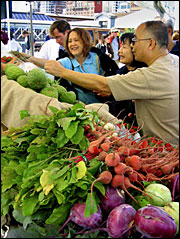
Fresh, yes, but is it affordable?
Photo: Ferry Plaza Farmers' Market
Such observations didn't always endear him to Victorian-era Americans. Wilde's 1881 lecture tour of the United States, while ultimately viewed as a triumph, occasionally drew hecklers.
This spring, another famed European aesthete with the gift of gab swept through the U.S.: Carlo Petrini, the Italian founder of the Slow Food movement. And like Wilde, Petrini's blunt generalities about New World customs sometimes rankled his would-be admirers.
In Petrini's case, his tour foundered on the stubborn enigmas of food and class in the United States. Rather than being hailed as a hero at San Francisco's iconic Ferry Plaza Farmers' Market earlier this month, Petrini found himself exchanging heated words with farmers who felt insulted by a passage in his new book Slow Food Nation.
In the controversial passage, Petrini portrays the Ferry Market as a kind of foodie "boutique," a place where well-rested farmers peddle pricey vegetables to an elite of "actresses" who then flaunt their heirloom squashes like the latest accessory.
A couple of weeks ago, not long after the Ferry Plaza affair, I caught up with Petrini and his entourage in North Carolina's Piedmont area, where the tour made its final stop.
Furor at Ferry Plaza
Before I describe that meeting, some background on the Ferry Plaza affair. There's little doubt that the passage in question, titled "Green California," contains gross distortions, overstatements, and questionable assumptions. In this impressionistic account of a 2003 trip to the United States, Petrini seeks to expose the excesses of our Eden of sustainable ag, the Bay Area -- and comment on the paradoxes of food and class in the process.
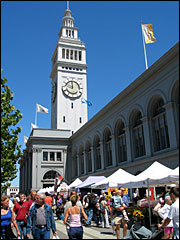
A fine day at Ferry Plaza.
Photo: Ferry Plaza Farmers' Market
Alice Waters, the doyenne of the U.S. sustainable-food movement, squires him to the Ferry Market Plaza, which Petrini finds "luxurious and very important." Here's how he describes the farmers he finds there: "amiable ex-hippies and young dropouts-turned-farmers ... well-to-do college graduates, former employees of Silicon Valley, many of them young ..." Intentionally or not, such language suggests that Petrini prefers his farmers old, broke, and uneducated -- an unfortunate impression to give in the United States, where farmers are scarce (fewer than 2 percent of the population), in fact quite broke, and aging (average age: 55 years).
Petrini recounts conversations with two farmers, one who peddles "excellent" organic olive oil from olives grown on a 300-acre monocrop grove, and another who, Petrini suggests, fetches such a king's ransom for his produce that he comes to the market only two weeks per month, taking his family surfing the other two weeks.
The implication: the farmers at Ferry are prospering by selling to a clientele divided among the "wealthy and very wealthy," and (at least in the olive farmer's case) betraying the ideals of organic agriculture, which favors biodiversity over monocropping. Meanwhile, while the wealthy brandish organic squash at Ferry, Petrini points out, the Bay Area's low-income labor force queues up for sustenance at McDonald's.
By all accounts, both in the blogosphere and in conversations I've had with people who know the market, the first farmer doesn't exist; the second is a hardworking fellow who surfs two weeks per year.
Not surprisingly, among vendors at the Ferry Plaza Market, the passage went over like a head of conventionally grown iceberg lettuce. For the definitive account of the affair from the farmers' side, see Steve Sando's blog, starting with this post and clicking through the next several. In short, the vendors are incensed at the misrepresentations and the fact that Petrini has not explicitly apologized for them.
Petrini did apologize for offending the farmers, but stopped short of admitting to making things up. He backed off from language that seemed critical of the growers, blaming translation problems. But Sando and other farmers remained incensed by the passage and unsatisfied with the apology.
It was in the wake of these awkward events that I -- someone who helps run a small vegetable farm with a CSA and a farmers' market stand in western North Carolina -- intersected with Petrini in the Chapel Hill area in North Carolina last week, where he was in town promoting his book and appearing at events in support of the sustainable-ag scene there.
Rolling With Carlo
Working with the Slow Food USA office, I had arranged two meetings with Petrini. On May 22, I toured with him and his entourage through farm country, visiting a couple of farms. I understood that any discussions would be informal and off the record. A day later, I got 15 minutes for a formal interview before a reception.
All of my interactions with him were mediated by a translator, sometimes two; my Italian has atrophied to the point of nonexistence, and Petrini doesn't speak English. Still, I spent hours with him over a two-day span, and found him immensely appealing.
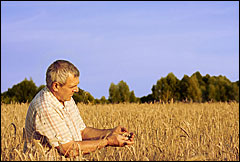
America's farmers are growing older and poorer.
Photo: iStockphoto
He dresses stylishly but without ostentation, like you want a 60-ish northern Italian man to dress: light blazer, slacks, loafers. As we toured farms, he gently quizzed growers through his translators, listening intently as they described their crops, growing practices, and challenges. He speaks in intonations that might strike English speakers as singsong, with plenty of hand gestures; he laughs and smiles easily. It's not hard to imagine him becoming amused by the goings-on at a tony American farmers' market.
In our brief interview, I didn't press him about the details of the Ferry Plaza affair; I thought it would be more interesting to discuss the underlying tension: food and class.
The interview was, by nature of our language gap, convoluted. His Italian assistant translated my questions to him, and Erika Lesser, Slow Food USA's executive director, translated for me. In his answers, he stuck mainly to generalities about how small-scale farmers deserve a decent price for their goods. In the confines of our highly mediated conversation, he seemed much more interested in reestablishing his pro-farmer image than in addressing the class politics of sustainably produced food.
By the end of our anticlimactic conversation, it occurred to me that for all its heat, the Ferry Plaza affair had generated very little deep discussion, within the food community or elsewhere, of food and class.
Food and Class
For all its good work -- and despite its roots within the Italian labor movement -- Slow Food has itself been hounded by charges of elitism. The critique goes like this: Who but a rich few can spend time wringing their hands over whether, say, a cheese that's been made in some Tuscan village for hundreds of years goes extinct -- a cheese that only the well-off can afford anyway?
Yet Slow Food's class problem really applies to the sustainable food movement in all industrialized nations, including the U.S. In short, our economy runs on cheap food; many people rely on it to feed themselves; and advocates of farmers' markets, CSAs, and organic food are asking people to pay more for food without giving them a strategy for raising wages.
Thus we get situations like that of Dan Barber, that tireless champion of sustainable agriculture. At Barber's restaurant on a pristine organic farm outside of New York City -- perched on Rockefeller family land -- the "farmer's feast" runs $110 per person, much more than any farmer could afford, and well out of reach of most New Yorkers' budgets.
Indeed, Blue Hill's main clientele is almost surely the city's expense-account-wielding elite -- the very people whose demand for second homes and suburban mansions takes prime agricultural land out of cultivation, making locally grown food more scarce and thus expensive.
If the sustainable-food movement is to make good on its environmental and social promises, it will have to figure out ways to resolve these vicious contradictions. For all the buzz surrounding farmers' markets and CSAs, for all the popularity of Slow Food USA and its burgeoning local convivia (chapters), the vast majority of people in the U.S. remain priced out of the trend -- and many of them are unaware of the alternatives to industrial food.
In a nation that has seen median wages stagnate for 30 years even as real estate and health-care costs ratchet up, it's no easy thing to ask low-income people to pay more for their food. At the same time, we can't rightfully ask small-scale organic farmers growing for nearby markets to charge less for their produce. They're competing against a highly consolidated, lavishly subsidized industrial food system -- and few of them are doing much better than just scraping by.
This misalignment between local-oriented growers and most consumers stands, I think, as the sustainable-food movement's most vexing paradox -- and resolving it is its No. 1 challenge.
And that, to me, was Petrini's real failure. Missing an opportunity to write a truly provocative commentary on the California scene, Petrini lapsed into easy caricature. Rather than being challenged to consider the class dynamics of Ferry Plaza and by extension similar markets across the country, the farmers justifiably became defensive: Petrini had apparently gotten key facts wrong.
Up to this point, Slow Food has played a key role in the sustainable-food movement, teaching gourmands that wonderful food isn't a birthright of the privileged that appears by magic. Rather, Slow Food has shown, it's a cultural artifact under relentless pressure from the very source that creates privilege in modern society: the machine that is consumer capitalism.
Evidently, Petrini wants to move Slow Food beyond that insight. Rather than merely address a food-obsessed elite, he's pushing to democratize the pleasures of the table. But to do so effectively, he'll have to find ways that don't insult farmers or trivialize their struggle to make a living from the earth in our post-agricultural society. Judging from his life's work, not from a single passage in his new book, I have high hopes that he'll do just that.
Comments
View as Flat
Gregory Dicum Posted 3:16 am
07 Jun 2007
Permalink
caniscandida Posted 5:06 am
07 Jun 2007
My guess is, the story of Petrini's visit to Ferry Market is more complicated than either his account or those of the offended farmers and their blogger-allies suggest. For one thing, we need to understand Alice Waters' role in preparing Petrini for the visit, and in interpreting for him what he saw. For another, given that he does not speak English and requires the assistance of a translator, it is easy to see how he may have missed some essential information at that time, and even now may not fully understand what his antagonists are saying.
Anyway, there is indeed reason to hope that he is now taking in all these money-related and class-related issues, including, Tom, your own very interesting observations on these subjects; and that before long, after some consideration, he will have something to say which is more satisfactory.
By the way, as a Latin teacher I am tickled that the Slow Food people use two Latin words as formal terms. "Convivia" is the plural of the neuter-gender noun "convivium," which means feast or banquet, and also the company assembled for a feast. "Presidia" is the plural of the neuter-gender noun "praesidium" (with a late-Latin simplification of the diphthong "ae" to "e"), meaning protection, defense, that which defends, guard, fortification, and so forth. Hence, to return to the Bay Area, the name of the San Francisco landmark a bit west of the Golden Gate Bridge, "the Presidio," is simply the Spanish word for "fort," Spanish being one of a number of forms of what can be called Modern Latin. Strictly, Slow Food's term "Presidia" ought to be treated grammatically as a plural-number noun. Roz Cummins did not do so; whether Petrini & Co. do so, I do not know.
Permalink
Farmer Janet Posted 5:14 am
07 Jun 2007
Organic food and farmers market food is not really too expensive for the poor and average income folks as much as it is unavailable. Isn't the location of the market in question as much of an issue as the price of the products? Farmers market foods are usually much lower in price than highly processed, high calorie foods found in convenience stores which is often the only food source available in poor neighborhoods. Mr. Philpot alludes to the real issue--conventionally produced commodities are sold at a loss at the farm gate and the system would not be sustainable except for subsidies.
Permalink
tinyinkling Posted 6:56 am
07 Jun 2007
Permalink
Roz Cummins Posted 7:44 am
07 Jun 2007
It is my own feeling that the work they do in supporting the maintenance of heritage breeds and connecting chefs and farmers (through national meetings and international meetings like Terra Madre) is very worthwhile. I certainly hope that the efforts of an entire organization aren't judged on the statements of one man, even if that man is the organization's figurehead.
I hope to address the issue of elitism is an upcoming column. It's the elephant in the room, but it's an elephant that isn't necessarily well understood. (For example, I think that a lot of the reason why people have trouble affording food has less to do with the price of food as it does with the price of housing and healthcare.)
As for my lapsed Latin gammar (as noticed by Canis Candida) I make it a policy to use whatever term an organization uses. I feel your grammar pain, though. When I say things like "campi" instead of "campuses," nobody knows what the hell I'm talking about.
Permalink
Steve Sando Posted 9:50 am
07 Jun 2007
I hope Slow Food US can get it together.
At this point it almost seems an aesthetic rather than a movement.
Permalink
hoot Posted 1:18 am
08 Jun 2007
part of the problem, i think, is that we all keep talking about how big a problem it is! cost is not the problem, access and stigma are the problems. we need to have more markets in poorer neighborhoods and we need to make people feel welcome to shop there. ebt (food stamps) need to be accepted and shoppers need to be able to purchase staple items as well as "boutique" foods.
i feel fortunate to live in new york city where greenmarket does an amazing job tackling these issues. i hope they can be a model organization for other cities and towns across the country.
Permalink
deliberately Posted 9:26 pm
08 Jun 2007
Permalink
Delay And Deny Posted 4:21 am
09 Jun 2007
The food there, of course, was excellent. The standards of almost everyone were at a level that Americans could not imagine. An Italian walking through our finest supermarket would feel as if he were walking through a garbage dump.
However, you can't tell someone with a 1/2 hour lunch break to "eat slower". That will only end up with him being hungry because he couldn't finish his Ciabatta burger from JITB.
Permalink
GonzoDon Posted 3:09 pm
09 Jun 2007
On my upper-middle-class block of homeowners, there are only a couple of us who actually bother to cut our own grass and no one besides me, as far as I can tell, who actually uses their bicycle for any other purpose than recreation. Dollars to donuts most of them won't park a single space farther away from the front door of our local Safeway than they absolutely have to, even on a beautiful day ...
So when you talk about taking time to find, prepare and enjoy quality food, you're talking about a cultural shift that doesn't fit in well with those clip-on-the-ear cell phones and driving kids all over town to scout meetings and soccer practices. "I just don't have time" is the refrain you hear over and over ... and maybe it's true, in many cases, especially for single moms or families trying to eke out a living working multiple shifts.
But methinks it goes back to priorities ... interestingly, many of those same "too busy" people seem to find time to watch American Idol and work the extra hours it takes them to buy an SUV they really can't afford anyway, and don't really need.
Simplify, slow down, live intentionally. Americans should try it some time.
Permalink
jscorse Posted 12:49 pm
10 Jun 2007
Instead, let's focus on policies to increase everyone's income and standard of living so what is now elitist becomes mainstream, while at the same time improving efficiency and the environment. A tremendous challenge? Of course....it's not called the environmental movement for nothing.
J.S.
Permalink
Anna Lappe Posted 3:20 am
11 Jun 2007
great blog... i really appreciate your take on this. for those interested in hearing more about petrini's philosophy, read this transcript from a speech he gave at the kellogg foundation food and society conference a couple of years ago.
the translation is excellent, but reading it on the screen doesn't really capture petrini's personality. for full effect, as you read, gesticulate wildly, smile broadly, and chuckle to yourself.
anna
Permalink
Bobbi Katsanis Posted 2:13 am
12 Jun 2007
I can understand why someone from another country would be shocked at the prices at Bay Area markets, and especially the Ferry Plaza market. I recently brought a Congolese friend to one of the Berkeley markets (mainly because he didn't believe there were farmers in the US who practiced hand cultivation, and I wanted him to meet some), and he remarked that what he paid for two leeks there ($2 a pound) could buy a bushel back home.
All of this is a way of getting round to saying that in my view, locally grown food is affordable, but not cheap. Locally grown does not externalize costs to the environment and human health the way big-box grocery retailers and their suppliers do, so often pound-for-pound, specific items can be more expensive - but not always. Supporters of locally grown understand that they are supporting sustainable farming practices, local economies, and the health of the planet and their own bodies, and are willing to pay more for it. It's a form of preventive health maintenance, both for the planet and ourselves.
It is also the case that millions of dollars of food stamps are redeemed at farmers' markets across the nation each year, so it's simply not true that the poor do not have access to locally grown organic food. However, people who are used to processed food products, who lack the time and inclination to cook from fresh ingredients, or who have trouble understanding that there is not any way to do straight cost-comparision between the farmers' market and Safeway, are going to need some help getting on board with locally grown. America does not have a tradition of good food the way Italy does, and it is true that our poor often eat shockingly badly. Understanding and finding ways to address class issues within the various aspects of the environmental movement is a crucial challenge for all of us within that movement.
Permalink
jedimomma Posted 6:07 am
14 Jun 2007
And yes, generally, farmer's markets are no more expensive than supermarket foods, especially considering the expense of convenience foods typically purchased at supermarkets. But farmer's market foods are not only inaccessible for lower classes to buy, the are also inaccessible for most of them to use. Purchasing and using fresh whole foods takes both acquired skills and time--two things that most people in the lower classes do not have. There are ways of streamlining cooking, preparing whole foods, etc., that can make it workable for someone holding down 2-3 jobs, but these are learned skills, and right now, no one is teaching them. A pound of kale might be cheaper than a TV dinner, but when you have no time to cook, and no idea what to do with kale in the first place, that TV dinner becomes far more feasible.
Permalink
LJRphoto Posted 3:24 am
15 Jun 2007
But, like so many have already mentioned the real obstacle is our cultural attitudes toward food (bigger, faster, longer lasting). Americans in general seem to feel that food is only for filling that empty space in their gut rather than for pleasure or a time for families to come together and reconnect. And, I have to admit, even with all of the putting up of my own food, this spring has been rough in the food department with all of my kids' after school activities.
Permalink
alanrhunt Posted 11:48 am
16 Jun 2007
Also, in the US, the federal goverment has been in the business of helping lower income people, women and children, and seniors purchase food.
Farmers' markets are included in those efforts, through two programs-
Women Infants and Children Farmers Market Nutrition Program - provides vouchers to be used at farmers markets, communtiy supported agriculture and farm stands to purchase fresh foods. http://www.fns.usda.gov/wic/FMNP/FMNPfaqs.htm
Senior Farmers Market Nutrition Program - provides vouchers for low income elderly to purchase fresh foods at farmers' markets, communtiy supported agriculture and farm stands. http://www.fns.usda.gov/wic/SeniorFMNP/SeniorFMNPoverview ...
These programs aren't a lot of money, but they are a response to ensure equity in accessing the fresh, healthy foods that our local farmers produce. The US congress looks like it will allow more funds to support these porgrams, but we're not out of the woods yet, until they finsih writing the Farm Bill this fall.
We're also working to get farmers markets plugged back into food stamps since it went to debit-style card (most markets aren't wired places).
We need all the help we can get in DC to move these issues along, and ensure that local foods are accessible all.
To tell Congress to support fresh, local foods for all go to http://www.healthyfarmbill.org.
Permalink
spaceshaper Posted 11:13 pm
18 Jun 2007
But talking of elitism though, I'd like to comment on the unfortunately increasing use of the word "gourmand" as a substitute for the perceived-as-elitist "gourmet". Unfortunate because to the French "gourmand" also suggests a glutton, one who is overly obsessed with food and eats too much of it. My English dictionary also confirms this traditional distinction: "a person who is fond of good eating, often indiscriminatingly and to excess". Not so good for breaking the stereotype of American greed and overconsumption. Tom, any problem with the locally-grown "foodie"?
Permalink