Elizabeth Kolbert.
Over the past year, a perfect storm of scientific studies, dire weather events, and media coverage lifted global warming onto the mainstream national agenda. No writing had more impact than a series of closely observed pieces in The New Yorker by journalist Elizabeth Kolbert, which have now been collected and expanded into a book: Field Notes From a Catastrophe: Man, Nature, and Climate Change. (Read a review of the book.)
While most writing on climate change has relied on dry data and statistics, Kolbert’s is vivid, technicolor reportage. She went on expeditions with some of the world’s top climate scientists to Greenland, Iceland, and Alaska to witness the ongoing devastation firsthand. And she ventured to Washington, D.C. — one place that’s not changing quickly.
Though her writing is never hectoring or overtly ideological, what she found left her deeply alarmed. The book ends with these chilling words: “It may seem impossible to imagine that a technologically advanced society could choose, in essence, to destroy itself, but that is what we are now in the process of doing.”
I met with Kolbert just before she gave a presentation on climate change to several hundred people at Seattle’s Town Hall. She professed an aversion to public speaking, and with her wiry, nervous energy, she did seem more suited to on-the-ground reporting. But as we talked, it was easy to see the passion and concern that has pushed this New York City journalist into the unlikely role of global-warming evangelist.
Tell me about your experiences with the scientific community. Why has the one group of people that’s really taken climate change to heart not been able to break through the public’s apathy?
The norms of science are such that they work against communicating alarm to the public. If you read [scientific] papers on global warming, or generally just talk to these guys, they will tell you, for instance, that discharge of ice into the Atlantic has doubled; but they will never say what the implications of this are — why this is, you know, horrifyingly dangerous. Scientists speak a certain language, they tend to speak mainly to each other, and the norms are such that you’re never supposed to go beyond the data. Their attitude is that the data speaks for itself.
 Field Notes From a Catastrophe, by Elizabeth Kolbert, Bloomsbury, 192 pgs., 2006.Unfortunately, most people don’t find those data very compelling. They don’t know what the implications are. So you have one community speaking to itself and getting increasingly alarmed, and the rest of the world saying, well, the scientists haven’t really figured it out yet.
And I would add that the norms of journalism also work against communicating this. So when you add those two together, you’re in deep doo-doo.
Complaints about the “he-said, she-said” school of climate journalism are common. As someone who’s seen the inside of The New York Times and The New Yorker, can you explain where it comes from? Surely reporters hear this constant litany of complaints about it. What enforces it?
On one hand there is a very, very clever campaign to turn this into a political issue, as opposed to a purely scientific issue. And I suppose there were once enough halfway credible people making the case against warming that journalists felt they had to go to them.
My hope is that you’ll see that less and less. I think the message is getting out there that this is not a two-sided issue. Naomi Oreskes did a paper looking at the scientific literature, and there just is no debate. I hope that phenomenon will taper off, but it hasn’t ended. I read the papers like everyone else, and I still see quotes from these thoroughly discredited people, and I honestly don’t understand it myself at this point.
Why do you think there’s this immense disconnect between the information available and the level of public outrage?
I grappled with that question, and I still do. Eventually I came to think there are three major reasons.
One is catastrophe overload. The end of the world has been going to come several times, and we’re all still here. So it’s: “Wake me up when the real end of the world is coming.”
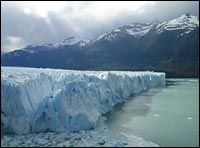
The ice shelf crumbleth.
Photo: stock.xchng.
Then there’s: “If this were really as bad as you say, I would feel it by now. There’d be water lapping at my first-floor windows.” The problem is that the climate operates on a very long time lag, so if you wait until there’s water lapping at your first-floor windows, you can be sure there’s going to be water lapping at your second-floor windows. I don’t think the message has gotten out: changes 30 or 40 years from now are already inevitable. There is warming in the pipeline already.
And then there is this question of what to do. People don’t like to confront problems they don’t have a clear answer to. And the answers here — to the extent there are answers — are very, very complicated. They’re very hard. We know what causes people to be overweight, and we can’t even stop that! And with global warming it’s not as simple as “eat less, lose weight.” It’s “do a million things.” As the mayor of Burlington, Vt., said to me, there’s not one thing we have to do; there are hundreds and hundreds of things we have to do. And we have to do them on a global scale.
So that’s pretty daunting to people. It’s very much easier to pretend the problem doesn’t exist.
Do you think a Kerry/Edwards administration would have done substantially different things?
The frightening thing is that we’re in such a bad situation now, so many people in Congress have dug in their heels, I don’t think anyone could say a Kerry/Edwards victory would have radically altered our path.
On the contrary, some people take a sort of “Nixon goes to China” attitude: if there’s one person who could do something about this, it’s George W. Bush.
What did you think of the energy section of the State of the Union speech — the “oil addiction” phrase? Not exactly “Nixon goes to China,” but perhaps “Nixon acknowledges China’s existence.”
“Nixon goes to Chinatown.”
[Laughs.]
I thought they were nothing. It’s nice to say we’re addicted to foreign oil — and we are — but oil’s only part of the problem. We’re addicted to coal, too.
It’s one thing to point out the problem, but it’s a totally different one to find a solution. People were looking for it; he could have easily done it. He could have said, “We need to conserve, and we need to find new carbon-free sources of energy, and here’s 20 or 30 billion dollars to start doing it.” He didn’t do that. Since he didn’t put any money behind it, I don’t think anyone can take it terribly seriously. That’s how Washington works: No money, no commitment.
Do you think hard carbon-emission limits are inevitable? Are they the only real sign we’re taking it seriously?
I do think they’re inevitable. George Bush, in his heart of hearts, probably thinks they’re inevitable. Christie Whitman told me they’re inevitable. Everybody knows they’re inevitable. The only question is how much damage we do between now and then. Unfortunately, the answer could be a tremendous amount.
Is that the only sign of commitment? Yes. Reducing “greenhouse-gas intensity,” which is what we’re doing now … you know, the atmosphere doesn’t care about greenhouse-gas intensity. It only cares about aggregate emissions.
There’s some feeling on the right that the left is using global warming to achieve ulterior ends: slowing economic progress, redistributing wealth, etc.
You do find people who say the whole thing is a big lefty plot to destroy our way of life. I don’t know how you respond to that.
It’s very striking: When I went to Europe, I talked to the Dutch minister for the environment. In this country he would have been considered far left. He was a member of the Center Right party. His views were: obviously the industrialized world is going to have to cut its carbon emissions way, way down. The developing world is going to be using a lot more carbon, and how could we say they can’t? After all, our own wealth is based on that.
You thought you were talking to a member of Greenpeace, but you were talking to a member of the Center Right ruling party in the Netherlands.
The politics are just so different over there. We have a level of political discourse here that’s considered by a lot of the world to be just … wacky.
Hard to argue with that. Do you think international pressure is having any effect on this government? Or that it might be having the opposite of the intended effect?
I think it’s having no effect. The one moment you thought they might have to throw a little bone was the G8 last year, where Tony Blair, who had risked so much for this crew, was asking them to do something. And they did nothing.
Listen in Windows Media.
Listen in RealPlayer.
On the other hand, I think the inverse is true as well: The fact that the U.S. has been so absurd on this issue — so criminally negligent — has made the Europeans … there are a lot of people who say if George Bush hadn’t withdrawn from Kyoto, Kyoto never would have been ratified. The Europeans were content to shuffle along indefinitely, but when he actually pulled the plug and said, “We’re not participating,” they stepped up to the plate and said, “We’re going to do it.” So in a weird sort of way his recalcitrance has unified them, and now they’re committed to that path.
On the flip side, do you think the bottom-up pressure that seems to be building is going to do the trick?
I do think it’s having an effect. There are some bills supposed to surface in Congress, and there’s a sense that some Republicans who had opposed them might sign on to them. They’re very watered-down things, but there’s some movement. I think it’s a combination of having taken 10 or 15 minutes to actually look at the science, and hearing from constituents.
Some of the religious groups are in there now; some of the business groups are in there now — really, business is ahead of the Congress at this point. People these guys trust, and rely on, and who have always been supportive, are telling them we’ve got to do something. There might be something percolating up.
What’s your assessment of the state of the climate-contrarian industry?
It’s in deep, deep trouble. Even companies like Exxon, who had been big contributors, don’t want to be seen anymore financing these things. They’re all running ads about reducing their carbon emissions. They don’t want the money trail to be traced to some of these wackos anymore.
So you think overt, socially acceptable climate denial is dead?
It’s been reduced to guys you can count on one hand.
One of your recent New Yorker pieces was about the evolution of contrarian arguments. What’s the 2006 model?
If you read the Wall Street Journal editorial page, you know where things are headed.
The new argument is: yes, there’s more CO2 in the atmosphere, maybe it’s global warming maybe it’s not, but it really doesn’t matter, because all these problems — drought, flooding, hunger, starvation — are the same old problems of poverty and natural disaster. We should just address those directly; we shouldn’t spend all this money trying to reduce carbon emissions, because we could just funnel the money directly to the latest flood victims.
That argument sounds good in the very, very short term perhaps, but [global warming] doesn’t stop. You’re going to have a perpetually changing climate. It’s actually kind of surprising to me, given the close nexus between this administration and the defense community: this has the potential to be so geopolitically destabilizing, you would think some of those guys would latch onto it as the next source of real turmoil in the world.
Climate change is such a distant, abstract issue, so slow-moving, with such a time lag, it’s hard even for people who have an intellectual grasp of it to feel it viscerally. Has it gotten to your gut yet?
It has. It takes over your life, and it’s not a happy development.
You have kids, right?
I have kids. And I have a hard time imagining their futures. That is very painful.
But even for me, do I imagine absolute disaster for the world during the course of their lifetimes? I’m not sure I do. I hold out hope we will avert that.
It’s a heavy number as a parent. And it’s a heavy number for kids. Kids are increasingly aware of it; my kids certainly are. It hangs over them. Of course, when I was growing up the threat of nuclear war hung over us. I suppose it’s been a while since kids have grown up in a carefree world.
There’s a dilemma of sorts: scientists feel uncomfortable with advocacy, journalists feel uncomfortable with advocacy, and advocates are ignored. Environmental groups have been marginalized, stereotyped as Chicken Littles.
We are absolutely crying out for political leadership.
But look at John McCain, somebody who has been pretty upfront on this issue. You can’t say he’s really been listened to. Arnold Schwarzenegger is out there sounding the alarm.
So what do we need? I really don’t know. We need someone in a position of national leadership, [Sen.] James Inhofe [R-Okla.] or somebody, to stand up and say, “I have seen the light, I am convinced we need to do something.” As I say, George Bush could have been that person.
One often hears — at least inside environmentalism — that things won’t change on global warming until there is a something like a spiritual change, recapturing the values of mutual care and so on. I can’t decide whether that’s more or less depressing than the lack of a technical solution.
[Laughs.] I completely agree.
One guy in the book who I admire, he’s very smart and sober-minded — Dave Hawkins at NRDC — gets up every day and thinks he’s going to convince the Chinese and the Americans not to emit CO2. And you have to admire that. Is he kidding himself? I don’t know. But thank God someone is doing that.
A message from
Your support keeps our climate news free.
Grist is the only award-winning newsroom focused on exploring equitable solutions to climate change. It’s vital reporting made entirely possible by loyal readers like you.
At Grist, we don’t believe in paywalls. Instead, we rely on our readers to pitch in what they can so that we can continue bringing you our solution-based climate news. Donate today to keep our site free.