As we strolled through downtown Seattle in search of coffee, Rabbi Michael Lerner casually pointed over my shoulder and said, “That’s where I was in jail.”
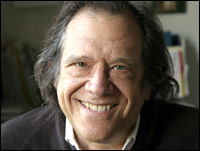
Rabbi Michael Lerner.
Photo: Mark Werlin.
He was referring to his membership in the Seattle Seven, a group of Vietnam War protesters whose 1970 arrest and trial sparked a legendary media circus. It was a reminder that Lerner’s been in the activism game a long time.
Lerner went on to become a rabbi and found Tikkun, a liberal Jewish magazine, and the Network of Spiritual Progressives, an organization devoted to developing a spiritual vision for the left. He’s authored numerous books; Bill and Hillary Clinton were vocal fans of his Politics of Meaning and briefly engaged him as an adviser. His latest work, published last month, is The Left Hand of God: Taking Back Our Country From the Religious Right.
In it, he argues that the religious right is filling a void, a widely felt need for meaning in a materialist, consumerist culture. He warns that unless progressives develop a spiritual perspective that answers that need, they will continue to lose ground.
We found our coffee — he got herbal tea, actually, and after a few minutes talking with him, I realized the man’s got no need for caffeine — and sat down for an hour-plus chat about spiritual matters and their relation to the environmental movement. (To read part two of our conversation, head over to Gristmill.)
What is Tikkun?
Tikkun is a magazine — and there’s a Tikkun Community, and its project, the Network of Spiritual Progressives. The Network of Spiritual Progressives is an attempt to develop a progressive spiritual vision for American society and to have this voice shape the thinking of other liberals.
Our three central themes are:
No. 1, we want to challenge the materialism and selfishness in American society and to call for a new bottom line. The old bottom line is that institutions get judged efficient or rational to the extent that they maximize money and power. We say that institutions should be judged efficient, rational, or productive to the extent that they maximize love and caring, kindness and generosity, ethical and ecological sensitivity; enhance our capacity to respond to other human beings as embodiments of the sacred; and enhance our capacity to respond to the natural world with awe and wonder and radical amazement at the grandeur of creation.
The second goal is to challenge the religious right and its misuse of religion to justify militarism, domination of the rich over the poor, the cutting of social programs for the poor and the cutting of taxes for the rich, and in general their inversion of biblical ideals to serve the powerful instead of the powerless.
The third thing is to critique liberal and progressive forces for their religio-phobia and their hostility toward spiritual consciousness. It has made them much less effective in the political world, and made their message much less profound than it could be — in many ways less radical than it could be.
Are you familiar with “The Death of Environmentalism“?
It’s chapter six of my book Spirit Matters. I didn’t name names of particular environmental groups — I wasn’t that confrontational. But I argued that you can’t win the environmental struggle without a huge spiritual transformation in the consciousness of the American people. The environmental movement has got to recognize that’s the central arena for the struggle.
You’re not going to get success in the environmental struggle without getting people to agree to cut back their level of consumption and reorder the planet in a way that is ecologically rational. That means there’s going to have to be a profound reorientation, challenging the notion of what progress is, so that people don’t believe they’re standing in the way of progress if they decide they don’t need a new version of a car every year, or newer and faster computers every year. There has to be a change in people’s sense of what is to be valued.
I believe the environmental transformations needed on the planet would increase everyone’s standard of living. Not measured by new toys, but in terms of the quality of people’s actual living. It would mean, among other things, communal arrangements for sharing many of the goods that we produce. It would mean recognizing the huge advantages of universal health care and adequate education for everyone. And rebuilding cities in ways that are more ecologically friendly, and that give priority to walking over cars. Put places where people work closer to the places they live. Get people wanting to live there because it’s beautiful, not because it’s all they can afford.
These kinds of changes are predicated on the assumption that if I make changes in my life, in my consumption patterns, I’m going to contribute to the well-being of the planet. But that can only happen if I believe other people will act similarly. And the dominant ethos of this society is, everybody’s looking out for No. 1. Maximize your own advantage. Watch your back, because other people will take advantage of you unless you take advantage of them first.
You cannot get somebody in that consciousness to say, oh well, if I reduce my consumption other people will act in a morally and ecologically sensitive way also.
If you want an ecological movement to be successful, it must be a spiritual movement. It must build an understanding that most people would love to live in a world of kindness and generosity. It has to be based on this new bottom line.
If you get a system like that, it only takes a tiny proportion of people to start a spiral of mistrust, no?
There is a flow of energy between fear and hope. And that flow of energy is constantly moving. You say it only takes a small number of people to move things toward fear and self-interest. Right. And it only takes a small number of people to move things toward hope! Powerful social-change movements, including the environmental movement, start with a small group of people who move. If you’re telling me there’s no guarantee it will stay, you’re entirely right. There’s continual interplay between our most fearful and our most hopeful parts.
The environmental movement doesn’t get this. It needs to worry about the flow of social energy toward hope, and a spiritual consciousness of caring for others, and generosity of spirit, because it’s only when people feel that in the ascendancy that they’re willing to make other kinds of sacrifices.
Do you think the environmental movement shoots itself in the foot by using fear?
I think there’s something to be scared about. There’s objectively something to be scared about. I don’t think it’s a mistake to talk about it.
But I think it’s a mistake to leave the conversation there. It’s not that mentioning global warming is inappropriate; it’s just not sufficient. It doesn’t create a sustainable movement. A sustainable movement has to have a larger vision that is hopeful and positive. Along with truths about the dangers of destruction, it has to have a vision of what kind of world is possible. That’s what this movement doesn’t have.
It does — buried in books and obscure websites, in bits and pieces. But we’re missing something someone could refer to casually on a Sunday morning talk show.
That’s what I mean by saying that what we want is a new bottom line. We want every institution to be judged efficient, rational, and productive by a new set of criteria.
You refer a couple of times to Americans changing their spiritual perspective; but is it just Americans?
Ideas flow globally. We started the anti-war movement in 1964, ’65, in Berkeley and a few other places. Everybody was saying, “Nobody’s gonna pay any attention to us, we’re a tiny little group of people.” But we started to fight for what we believed in, and to articulate it. By 1968, we’d gone from 50,000 to 12 million. Ideas have a way of spreading dramatically.
Environmental consciousness was no place in 1967 or ’68. 1970, Earth Day, suddenly we’re all over the world. In the following 20, 30 years, everybody in the world is talking about the environment. It’s a whole category that wasn’t in people’s consciousness.
What’s changed is that the power structure no longer fights social movements directly. It’s developed the ability to absorb and commodify and neuter them. It dissipates their energy. The power structure has gotten much more sophisticated.
That’s true. So we need to get more sophisticated in our struggle. Unfortunately, many people are stuck in 1970s consciousness and they’re dealing with a 2006 world. That’s why I’m arguing, in The Left Hand of God, that we need a new unifying theme. And it isn’t just about the environment. It’s about a whole new criterion for what counts in the world. We’re for a world of love and kindness and generosity and ethical and ecological sensitivity and awe and wonder at the universe.
Now, some people object to those religious and spiritual terms. But awe and wonder at the universe are critical. It means you don’t just look at the world as a commodity. If you’re religious you say, God gave us an obligation to care for this planet. If you don’t believe in God, you say, I understand that there’s a dimension of reality that is not reducible to what I can use for the sake of my own interests. There’s something about this planet uniquely deserving of my caring and attention.
That consciousness is critical to saving the planet.
What would you say to someone who claims that fear — the fight-or-flight instinct — is more basic to human nature? That altruism is a cultural artifact and therefore more fragile, less deeply rooted, and will always lose out in the face of a threat?
There’s a struggle inside of all of us between two ways of viewing the world. One sees us as thrown into this world by ourselves, in an endless struggle with others seeking to dominate and control us, and the only way we can achieve safety and security is by dominating and controlling others first.
The other worldview says, no, we weren’t thrown into this world all by ourselves. We are born of a mother. For the first few years of our lives, our formative experience is one of connection to a mothering being who takes care of us without any reasonable expectation of a good return on her investment of time and energy. Kids are not a good investment today. Nevertheless, parents raise kids. The experience of love and care and generosity and kindness is deeply inscribed in the human experience.
We have both these voices in our heads. And what we hear at any given moment is affected by our childhood experiences, our adult life experiences, the ideologies we buy into, and our assessment of social energy. The more social energy is moving toward fear, the more world domination gets validated. And the more social energy moves toward hope, the more the possibility of loving and caring gets validated.
What books are popular, what writers seem deep and profound, what music sounds brilliant — it all depends on where you are at any given moment. We’re always fluctuating — each of us individually and the society as a whole — on this continuum.
That’s what I mean by the right hand of God and the left hand of God. When God’s voice is heard, it’s always heard by human beings. No matter how deeply you believe in revelation … as the Torah says, this is the word of God, by the mouth of God, through the hand of Moses. There was a human being there, and that human being was deeply flawed.
Read part two of this interview on Gristmill.