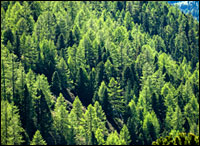
The Clinton-era "roadless rule" has been declared invalid by U.S. District Judge Clarence Brimmer. The rule, which prohibits development on 58.5 million acres of national forest, has had a long and rocky past. Brimmer first put the kibosh on it in 2003, and while an appeal was pending, the Bush administration switched it out for an alternative that required states to petition the feds for forest protection. The Bush rule was thrown out by a different district judge in 2006 and the Clinton rule reinstated -- until now. Ruling in favor of the state of Wyoming, Brimmer declared that the roadless rule violated two environmental laws and stymied forest managers from doing their jobs. "The Forest Service, in an attempt to bolster an outgoing president's environmental legacy, rammed through an environmental agenda that itself violates the country's well-established environmental laws," Brimmer wrote. (Wonder what he thinks of the Bush admin's attempt to gut the Endangered Species Act?) The roadless saga will continue: green group Earthjustice has promised to appeal.

source: The New York Times, Associated Press
Comments View as Flat
bkrell Posted 4:25 am
13 Aug 2008
roads and roadlessness
He's right about one thing-lack of roads can prevent the FS from doing it's job. As an FS peon, I can say we have a LOT of masters to please. Everything we do gets criticized by environmental groups, logging interests, and recreation groups at the same time. I never thought it was possible to be hated by so many people at once!
Permalink
MattKirby Posted 4:41 am
13 Aug 2008
We shouldn't worry too much. . . yet
This is a terrible move, no doubt, but it is worth noting that it doesn't necessarily negate the California ruling that reinstated Clinton's rule. They are two competing courts and no one has authority to overturn the other. And the California ruling was made first. Mike Anderson, an attorney at the Wilderness Society, is quoted in an AP article as saying that in his opinion, the California ruling is still in effect:
"It is not in any way overturned or compromised by Judge Brimmer's decision in Wyoming today. What it does do is create two conflicting court decisions in different federal courts, different states, both issuing decisions with nationwide impact."
Right now it's just important that we make sure to protect these places that provide vital habitat and crucial waterways until there's more legal clarity.
http://www.sierraclub.org/wildlegacy/blog/index.asp
Permalink
Wolverine Posted 1:34 pm
13 Aug 2008
Can't Do Jobs? Good!
The Deforest Service's "job" is to kill trees, or more specifically to allow logging companies to do so. Secondarily, it also allows ranchers to destroy land by grazing cattle in and near forests. These forms of ecological destruction also cause the deaths of animals whose habitats they destroy. The Earth rejoices if the Forest Service can't do its job.
Permalink
Pathos Posted 3:59 pm
13 Aug 2008
Wolverine,
Thanks for proving bkrell's point.
Bkrell,
What are the roads the forest service builds mostly used for? The stereotype is logging roads. Do they serve any other, more conservation-minded purpose--and if so, are they used more for that, or more for logging?
And while I don't think anyone is going to call you a liar, if you have any sources you could link us to (like, something not likely to have been watered down by the Bush administration, because it's very hard for enviro's to trust the government these days), that'd be appreciated.
Permalink
wendigo Posted 2:16 am
14 Aug 2008
roads are the opposite of conservation
Pathos, I realize you are trying to be fair-minded, which I appreciate. But most USFS roads are built for access to timber sales. In addition to logging, the roads themselves, either directly or indirectly, bring invasive weeds, increased fire danger, increased stream siltation (which leads to higher water temperatures less hospitable to salmon and trout), and, maybe most importantly, habitat fragmentation.
Many studies have shown that increasing road density directly correlates with decreasing animal populations, especially large mammals such as elk and bear (see http://gis.esri.com/library/userconf/proc96/TO450/PAP413/ ... for an example study). Back in grad school, I did a study that showed a correlation between increased road density and decrease in quality of lynx habitat in Colorado, several years ago when CO was trying to re-establish lynx in the state.
There are plenty more studies available, but the point is that roads in a forest generally have a negative effect on the forest itself, and on the animals that live there.
Permalink
Wolverine Posted 4:38 am
14 Aug 2008
Roads Are First Step Toward Ecological Destruction
I've never seen any evidence of any road that had positive ecological effects; if you have some, please share it.
Roads are ecologically harmful per se. In order to make them the natural vegetation must be killed and barren land permanently used to replace it. Roads also fragment habitat for many animals that won't cross them.
Once vehicles start using them, those vehicles bring with them non-native species, which do harm to the natives wherever they're deposited. And then the ultimate harm, the logging or other destructive activities that the roads enable.
Permalink
catman Posted 8:04 am
14 Aug 2008
If any humans
If any humans survive the coming anthropocene die-off, they will probably be those recently discovered South American tribes that live in a huge roadless area.
Permalink