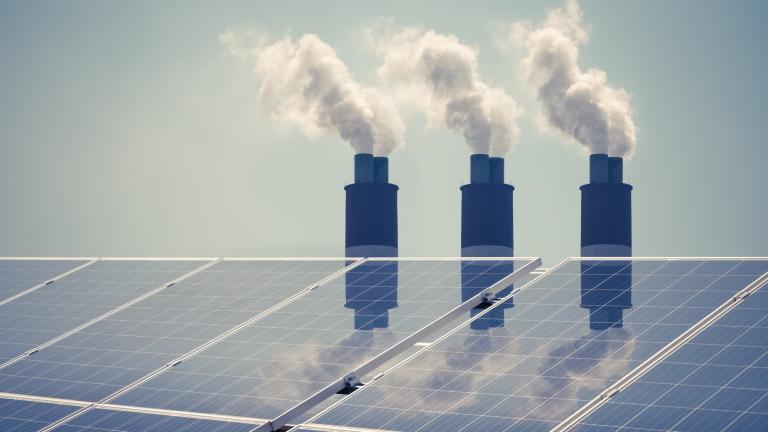
The House approved legislation today that renews billions of dollars in tax breaks for wind, solar, biomass, and other renewable energy sources, and extends a proposed new tax credit for biofuels derived from sources other than corn.
"The Energy and Job Creation Act of 2008" (which is a much better name than it had last week, when it was the "Energy and Tax Extenders Act") was approved by a vote of 263-160. The total package, which also includes tax breaks for education and business expenses and an expansion of the refundable child tax credit, is worth $54 billion.
"As we debate this legislation, American families are paying record prices at the pump -- yesterday the cost of a barrel of oil passed $129 for the first time in history. Today, I believe it went past $130," said Speaker Nancy Pelosi on the House floor today. "This legislation invests in the future and the ingenuity of the American people to create and deploy cutting-edge renewable technologies that will reduce our dependence on foreign oil."
The bill includes a six-year extension of the investment tax credit for solar energy; a three-year extension of the production tax credit for biomass, geothermal, hydropower, landfill gas, and solid waste; and a one-year extension of the production tax credit for wind energy. There are also incentives for the production of renewable fuels such as biodiesel and cellulosic biofuels, incentives for companies that produce energy-efficient products, and incentives to improve efficiency in commercial and residential buildings.
Congress has been trying to get these tax credits for clean energy through for a year. The bill is likely to face tougher opposition in the Senate, and the president has already threatened to veto it. But in a press conference today after the House passed the bill, Reps. Earl Blumenauer (D-Ore.), Jim McDermott (D-Wa.), and Richard Neal (D-Mass.) expressed hope that it might still have a chance, citing rising fossil-fuel prices and the need for long-term solutions.
"One of the critical problems we're facing today is energy prices, and the problem is we don't have enough choices for consumers," said Blumenauer. "We've squandered American leadership in renewable energy -- the United States was a global leader 30 years ago and we've lost that leadership internationally to other countries that are moving forward more aggressively."
Blumenauer predicted that without these tax extensions, the United States could see "almost 20 billion in lost investment" in renewables, as well as up to 150,000 lost job opportunities in the green energy sector. He said that the potential to address energy concerns and create economic growth might help it win support in the Senate.
"We've got 23 Republican senators who are looking down the barrel at reelection," said Blumenauer. "I think people are going to be looking for opportunities to look like they're being bipartisan and trying to solve problems as we get closer to the election."
McDermott added that he hoped the movement in the House would "jump-start" negotiations within the Senate about how to support renewable energy.
Comments
View as Threaded
Gar Lipow Posted 2:19 pm
21 May 2008
Permalink
Darrell Posted 4:57 pm
21 May 2008
They were out of capacity, but needed longer-term certainty of orders before making such a big capital investment. As we get whole one-year extensions of credits.
Permalink
amazingdrx Posted 5:59 pm
21 May 2008
It would be predictable, giving the market in renewable energy devices long term stability. Thus encouraging investment in mass production. In turn lowering costs.
This patchwork is not working.
http://amazngdrx.blogharbor.com/blog
Permalink
KenG Posted 10:42 pm
21 May 2008
Permalink
JMG Posted 12:24 am
22 May 2008
We keep paying for process (supposedly "alt" fuels that are actually just laundered fossil fuels in liquid form) rather than results (actual renewables in liquid form). I proposed some time ago that we only subsidize the net renewable portion of any liquid fuels; I think we should revisit that. Even if we end up devoting the same total amount to it, we have to stop rewarding the failure of agrofuels.
Again, the plan: whenever someone tries to claim a subsidy for a barrel of supposedly "alternative fuels," we debit their subsidy for the fossil fuel consumption embedded in growing, processing and transport of that barrel of "alt" fuel, and only apply the subsidy rate to the excess energy above that fossil fuel debit.
The 5% Project
Permalink
Jonas Posted 1:32 am
22 May 2008
With competitive cellulosic ethanol, the entire world can replace all oil and prevent catastrophic climate change.
If you have an alternative to biofuels which can pull this off, then please let us know.
Permalink
amazingdrx Posted 1:48 am
22 May 2008
And that replacement would destroy carbon sink activity in the soil and actually increase GHG. Corn ethanol doubles GHG and cellulosic generates one and a half times the GHG of oil based fuels.
Turning wilderness into cropland releases millenia of stored carbon in the soil. It's a completely dead end for planet earth.
http://amazngdrx.blogharbor.com/blog
Permalink
Tasermons Partner Posted 3:10 am
22 May 2008
We don't have veto-proof majority, and yet they still insist on tryin' to pass a bill that will get vetoed.
Why? Do they think it'll highlight the prez's dismal record on renewables and the environment? News flash-we already know that!
Seriously, I'm all for try, try, again and keep on tryin' no matter what...but this almost makes a half-dozens they've tried to pass with renewable tax credits.
Think a change in strategy might be in order by now?
They need to attach it to a bill that has massive support for other things, and they need to do it in such a way that it doesn't raise flags over taxes.
Why they didn't try to attach it to the Farm Bill, I'll never figure out...
Permalink
Ron Steenblik Posted 3:44 am
22 May 2008
What this bill does is, effectively, subsidize consumption of cellulosic ethanol, through a tax break to blenders (which, in the presence of trade barriers, essentially ensures that most of the production will take place domestically). It also gives more than double the tax break to cellulosic ethanol as to cane-based ethanol from Brazil, which has an energy balance and carbon footprint similar to that of cellulosic ethanol.
It is legitimate to ask whether a blender's credit is a cost-effective way of encouraging R&D on cellulosic ethanol. Look at the one that has been benefitting corn ethanol: it, in one form or another, has been around in the USA since 1978 -- i.e., for 30 years. The cellulosic-ethanol tax credit may be scheduled to end after "only" seven years, but given the history of policy in this area, why should anybody assume that it won't be extended?
Yet if production costs really do come down, the industry will still benefit from a $1.01/gallon tax credit.
Now, multiply $1.01/gallon times your chosen share of an annual gasoline demand of around 140 billion gallons a year, and you can readily see how much this one subsidy will cost the U.S. treasury after a few years.
Despite what Jonas says, it is not simply a case of tax credits or nothing. No country can afford to subsidize itself off of oil by simply subsidizing an alternative to be sold at the same price as the fuel it is replacing.
These are only my personal opinions.
Permalink
Ron Steenblik Posted 4:16 am
22 May 2008
These are only my personal opinions.
Permalink
GRLCowan Posted 1:02 pm
22 May 2008
Silicate dispersal can deal with legacy CO2 (the ~200 gigatonnes already added to the atmosphere). Nuclear production of motor fuel can prevent more from being added.
--- G.R.L. Cowan, H2 energy fan 'til ~1996
http://www.eagle.ca/~gcowan/boron_blast.html
Permalink
Jonas Posted 3:42 am
23 May 2008
Just check the analysis of the world's explicitly sustainable bioenergy potential, and you might learn that it is 1550Ej by 2050.
So with strict sustainability, we can produce 6 times more energy from biomass than all oil currently consumed.
Here (it's the model made by the Copernicus Institute for publications used by the IEA Bioenergy Task Forces, and now also used by the FAO as its base model):
A Quickscan of global bio-energy potentials to 2050.
This work of the FairBioTrade project covers three parts. I has been bundled in a research report [3.531 KB] in 2004. The work has further been developed and submitted separately as two scientific papers, see below.
1. A bottom-up assessment and review of global bio-energy potentials to 2050
Published in Progress in Energy and Combustion Science
Edward M.W. Smeets, André P.C. Faaij, Iris M. Lewandowski and Wim C. Turkenburg (2006) A bottom-up assessment and review of global bio-energy potentials to 2050. Progress in Energy and Combustion Science, Volume 33, Issue 1, February 2007, Pages 56-106
Abstract
In this article a model for estimating bioenergy production potentials in 2050 is presented that is called the Quickscan model. In addition, a review of existing studies is carried out, using results from the Quickscan model as a starting point. The Quickscan model uses a bottom-up approach and its development is based on an evaluation of data and studies on relevant factors such as population growth, per capita food consumption and the efficiency of food production. Three types of biomass energy sources are included: dedicated bioenergy crops, agricultural and forestry residues and waste, and forest growth. The bioenergy potential in a region is limited by various factors, such as the demand for food, industrial roundwood, traditional woodfuel, and the need to maintain existing forests for the protection of biodiversity. Special attention is given to the technical potential to reduce the area of land needed for food production by increasing the efficiency of food production. Thus, only the surplus area of agricultural land is included as a source for bioenergy crop production. A reference scenario was composed to analyze the demand for food. Four levels of advancement of agricultural technology in the year 2050 were assumed that vary with respect to the efficiency of food production. Results indicated that the application of very efficient agricultural systems combined with the geographic optimization of land use patterns could reduce the area of land needed to cover the global food demand in 2050 by as much as 72 % of the present area. A key factor was the area of land suitable for crop production, but that is presently used for permanent grazing. Another key factor is the efficiency of the production of animal products. The bioenergy potential on surplus agricultural land (i.e. land not needed for the production of food and feed) equaled 215 EJ y-1 to 1272 EJ y-1, depending on the level of advancement of agricultural technology. The bulk of this potential is found in South America & Caribbean (47-221 EJ y-1), sub-Saharan Africa (31-317 EJ y-1) and the C.I.S. & Baltic States (45-199 EJ y-1). Also Oceania and North America had considerable potentials: 20-174 EJ y-1 and 38-102 EJ y-1, respectively. However, realization of these (technical) potentials requires significant increases in the efficiency of food production, whereby the most robust potential is found in the C.I.S. & Baltic States and East Europe. Existing scenario studies indicated that such increases in productivity may be unrealistically high, although these studies generally excluded the impact of large scale bioenergy crop production. The global potential of bioenergy production from agricultural and forestry residues and wastes was calculated to be 76-96 EJ y-1 in the year 2050. The potential of bioenergy production from surplus forest growth (forest growth not required for the production of industrial roundwood and traditional woodfuel) was calculated to be 74 EJ y-1 in the year 2050.
Key words: bioenergy, potential, global, agriculture, land use, agricultural production efficiency.
2. Bioenergy potentials from forestry in 2050. An assessment of the drivers that determine the potentials.
This paper [900 KB] is published in the journal Climatic Change. Please refer to as: Edward M.W. Smeets and André P.C. Faaij (2006) Bioenergy Potentials from Forestry in 2050. An assessment of the drivers that determine the potentials. Climatic Change (in press at the time of writing)
Abstract
The purpose of this study was to evaluate the global energy production potential of woody biomass from forestry for the year 2050 using a bottom-up analysis of key factors. Woody biomass from forestry was defined as all of the aboveground woody biomass of trees, including all products made from woody biomass. This includes the harvesting, processing and use of woody biomass. The projection was performed by comparing the future demand with the future supply of wood, based on existing databases, scenarios, and outlook studies. Specific attention was paid to the impact of the underlying factors that determine this potential and to the gaps and uncertainties in our current knowledge. Key variables included the demand for industrial roundwood and woodfuel, the plantation establishment rates, and the various theoretical, technical, economical, and ecological limitations related to the supply of wood from forests. Forests, as defined in this study, exclude forest plantations. Key uncertainties were the supply of wood from trees outside forests, the future rates of deforestation, the consumption of woodfuel, and the theoretical, technical, economical, or ecological wood production potentials of the forests.
Based on a medium demand and medium plantation scenario, the global theoretical potential of the surplus wood supply (i.e., after the demand for woodfuel and industrial roundwood is met) in 2050 was calculated to be 6.1 Gm3 (71 EJ) and the technical potential to be 5.5 Gm3 (64 EJ). In practice, economical considerations further reduced the surplus wood supply from forests to 1.3 Gm3y-1 (15 EJy-1). When ecological criteria were also included, the demand for woodfuel and industrial roundwood exceeded the supply by 0.7 Gm3y-1 (8 EJy-1). The bioenergy potential from logging and processing residues and waste was estimated to be equivalent to 2.4 Gm3y-1 (28 EJy-1) wood, based on a medium demand scenario. These results indicate that forests can, in theory, become a major source of bioenergy, and that the use of this bioenergy can, in theory, be realized without endangering the supply of industrial roundwood and woodfuel and without further deforestation. Regional shortages in the supply of industrial roundwood and woodfuel can, however, occur in some regions, e.g., South Asia and the Middle East & North Africa.
Keywords: bioenergy, forestry, forest residues.
Permalink