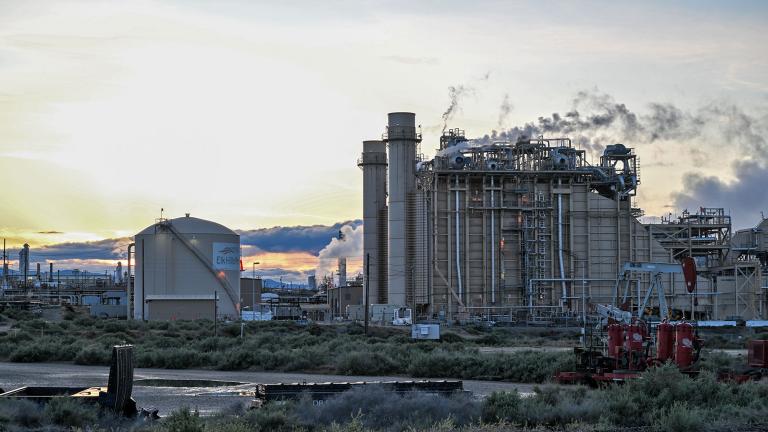
Niman contrasts the use of manure on traditional farms, where it plays an important role in maintaining soil health, with the manure-disposal problem faced by large livestock operations. Increasingly, manure from these large operations is being used to produce electricity through various processes, something I like to call "poo-powered power plants" (P4). Niman rightly points out the downsides to using manure on this scale for electricity production.
But as with many things, you can't say that capturing methane from manure is always bad. It all depends on the size. For example, this January I helped build a biodigestor on a small farm in Costa Rica as part of a class on Renewable Energy in the Developing World organized by Solar Energy International. (For pictures see the bottom of this page.) Once it is fully operational, the manure from Don Sedro's pigs will provide methane for cooking -- replacing the cylinders of propane that cost him $60 per month -- and a liquid that will fertilize his small garden. Is that the sweet smell of sustainability (or just the pigs)?
Comments
View as Flat
Tom Philpott Posted 11:47 pm
04 Mar 2006
Hahn Niman writes that "Cost and technical complexity make these manure power projects more economical when done on an industrial scale, with operations that produce vast quantities of manure." How does that claim jibe with your Costa Rica experience? Most small farms simply compost their own manure for use as fertilizer. Granted, pig manure is probably the least friendly for this purpose.
On a large scale, if NHN is right, these things do look like another green-washing boondoggle. Greens need to be very careful not to grope for every "renewable" technology that industry tosses up. Like corn-based ethanol, this one looks like another attempt for government to underwrite environmentally and socially ruinous industrial agriculture. What a load of crap. A salute to Nicole Hahn Niman for another great NYT op-ed. (Last year she did one on the heinous factory-farm practice of tail-docking.)
Permalink
amazingdrx Posted 1:17 am
05 Mar 2006
And as you point out Ana, it replaces very expensive petroleum based cooking gas. And the liquid fertilizer substitutes for petroleum based fertilizer.
Here in Wisconsin, farmers recycle the bedding material after it goes through the digestor. In these operations the biogas is used to generate electricity that is sold to the utility company.
But it's a high technology, expensive system that adds to the debt load faced by small farms that are desperately trying to compete with heavily subsidized corporate agri-business.
This effort really shows how the environmental movement can partner up with people trying to escape the bonds of poverty by going straight to sustainable technology. It's great that this project substitutes low tech biogas for mega-corporate propane.
Biofuel from the waste stream, especially from manure that otherwise pollutes the watershed, is one of the applications of technology that actually deserves subsidies.
Biofuel from crops like corn and switchgrass are pork barrel boondoggles, used by politicians to buy votes and get payed off with kickbacks from agri-bizz criminal conspiracies (disguised as legitimate businesses)like Archer-Daniels Midland.
http://amazngdrx.blogharbor.com/blog
Permalink
Ana Unruh Cohen Posted 1:32 am
05 Mar 2006
And Don Sedro has a few cows and chickens and uses their manure as fertilizer.
Permalink
amazingdrx Posted 2:00 am
05 Mar 2006
Lumping manure combustion and heavily subsidized feedlot agri-bizz digestors in with the use of digestors on small farms.
The farmer that had to double his herd to make the digestor/electricity project work is a victim of missapplied technology.
The better small operation design would sell the natural gas from the digestor to the utility company, thus avoiding the expense of electrical power generation equipment. But of course that would take government action to get utilities to accept biogas, going directly against the grain of corporate bribery.
The concrete digestor tank is the inexpensive part of the system. The soaring price of natural gas makes selling the gas the cost effective investment for small farms.
The slurry coming out of the digestor is a great liquid fertilizer, with much of the offensive odor eliminated. If you have ever experienced life next door to a farming operation that spreads raw manure on fields you will understand my point.
Solar cogeneration should be used to recycle most of the water in the slurry.
But the very best application of this technology would be to use direct fuel cell/microturbine cogeneration to facilitate distributed power generation, putting small farms into the energy business at 75% efficient power generation versus the 30% that utility plants use natural gas. And the 20% efficiency of the internal combustion electric power from present farm based biogas electric power.
That way even small operations would be cost effective without subsidies. But with subsidies going to corn/ethanol and oil companies instead of the development of direct fuel cell/microturbine cogeneration systems, that will be a long time coming.
That 75% efficiency changes the economic equation in favor of small operations.
http://amazngdrx.blogharbor.com/blog
Permalink
Tom Philpott Posted 2:43 am
05 Mar 2006
Permalink
Biodiversivist Posted 2:48 am
05 Mar 2006
Cow flop as fuel goes back thousands of years. That's what rural people in India use for cooking-fires and to heat their homes. When I rode through Rajastan in western India, one of the most common sights was that of neatly stacked, sun-dried cowpies, or women and old men patting them together from wet dung and laying them out to dry.
In the end, it all comes down to biodiversity. Help acquire and protect ecological hotspots, give to a conservation organization: http://www.saveourbiodiversity.com
Permalink
amazingdrx Posted 2:58 am
05 Mar 2006
Wether you are the family in the country invaded that loses a loved one,or a US family who has your loved one killed as a soldier in war for empire; once the families are one through personal contact like this, it is just that much harder for corporate empire to con citizens here into ok'ing another invasion.
JFK's Peace Corps style policies in the form of green powered eco-tourism. There's the enviro-poverty fighting connection.
http://amazngdrx.blogharbor.com/blog
Permalink
amazingdrx Posted 3:18 am
05 Mar 2006
(Note to grist editors: Please send Ana to report on Gaviotas ASAP. http://www.friendsofgaviotas.org/about.htm )
http://amazngdrx.blogharbor.com/blog
Permalink
CowPower Posted 10:49 pm
08 Mar 2006
One concern I have with the author of the Times editorial opinion is that she lumps direct combustion of animal waste, such as poultry litter, and conversion of animal waste to biodiesel in her argument against farm waste to energy projects. These technologies are not widespread in the US, and I only know of one poultry waste combustion plant in the country. She touts the negative environmental impacts of a variety of technologies as evidence that farm waste to energy is a bad thing for America. The fact is there is a growing farm population that is utilizing anaerobic digestion to effectively address the environmental concerns she raises in her article.
The author talks about how subsidies are hurting the family farm. In Vermont, all we have are family farms, even if they have 2,000 cows! And the economics are changing so rapidly that the 2003 University of Minnesota work cited in her article reveals assumptions which are 300% out of synch with current economics, particularly here in Vermont for cost effectiveness. Economic cost effectiveness improvements are one consequence of the subsidies critisized by the author.
Permalink