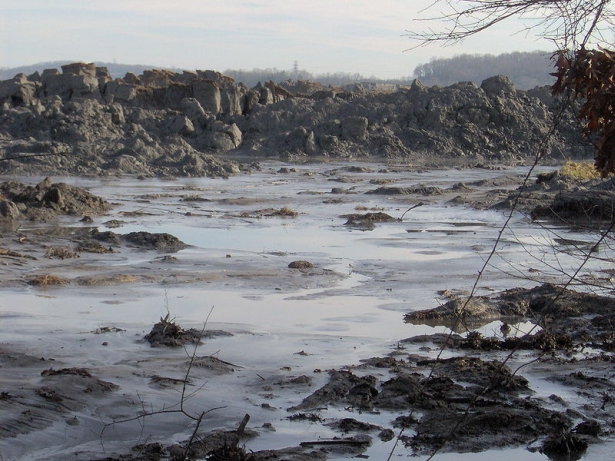
Some of the more than 1 billion gallons of toxic coal ash that spilled from an impoundment at the Tennessee Valley Authority’s Kingston power plant in eastern Tennessee last December is making its way to landfills in poor and black communities in Alabama and Georgia, as we reported last week at Facing South.
It turns out that TVA also looked into sending the waste to Pennsylvania for dumping into abandoned mines — but that state’s Department of Environmental Protection rejected the ash as substandard.
“This ash material was accidentally released from a disposal impoundment and mixed with unknown materials in the river water and bottom sediment,” Pennsylvania DEP Secretary John Hanger announced last week. “DEP only certifies coal ash for mine reclamation in Pennsylvania that is not contaminated with other materials and can meet our stringent chemical requirements.”
But experts say that Pennsylvania’s toxicity standards for coal ash used in such projects are not particularly high — at least not high enough to keep the ash from damaging water quality in the vicinity of the dump sites.
“PADEP is hurling boulders through their glass house with their public rejection of TVA ash as too contaminated for mine disposal,” Earthjustice attorney Lisa Evans told Facing South.
Evans is one of the authors of a 2007 report that found widespread contamination of groundwater and surface water across Pennsylvania due to dumping of coal ash waste into abandoned mines as part of its land reclamation program. The report by the Clean Air Task Force found degraded water quality at two-thirds of the sites examined, with levels of arsenic, cadmium, chromium, copper, lead, nickel, zinc and other pollutants found to exceed drinking-water and other water-quality standards.
A Pennsylvania newspaper reports that the material was apparently being considered as fill for an amphitheater construction project underway on abandoned mine lands in Hazleton, a predominantly white community in the northeastern part of the state that gained fame in recent years for its controversial efforts to drive out illegal immigrants.
The Hazleton Standard-Speaker quoted a TVA spokesperson as saying the federal company decided on its own against sending the ash to Pennsylvania because the site where it was to be used lacked a liner to prevent the material from contaminating groundwater. Abandoned mines where coal ash waste is being dumped across Pennsylvania typically lack liners — one of the reasons why CATF’s report found such widespread water contamination.
Instead, TVA is sending the spilled coal ash waste from Tennessee to landfills in in Taylor County, Ga. and Perry County, Ala. The choice of these communities for disposal of the waste raises environmental justice concerns, since almost 41% of Taylor County’s population is African-American and more than 24% of its residents live in poverty, while Alabama’s Perry County is 69% African-American with more than 32% of its population in poverty, according to the latest census data. Residents had no voice in the decision-making process, given that there was no opportunity for public comment.
The landfill officials have pointed out that their facilities have synthetic liners and systems to collect and treat the liquid runoff known as leachate in order to help prevent groundwater contamination. But even lined landfills with leachate collection systems provide no guarantee that the materials dumped into them won’t eventually impact groundwater.
In fact, the U.S. Environmental Protection Agency — which is now overseeing cleanup of the TVA spill — has acknowledged that all landfills eventually leak. The Environmental Research Foundation points to a Federal Register notice from EPA that states:
There is good theoretical and empircal evidence that the hazardous constituents that areplaced in land disposal facilities very likely will migrate from the facility into the broader environment. This may occur several years, even many decades, after placement of waste in the facility, but data and scientific prediction indicate that, in most cases, even with the applicaiton of best available land disposal technology, it will occur eventually.
Unlike many constituents of ordinary household garbage, the toxic elements in coal ash waste — arsenic, lead and the like — do not break down over time. That means that once the landfill liner deteriorates and springs a leak, those chemicals will be present to leach into the groundwater.
In addition, the leachate collection systems used in landfills are far from foolproof, ERF notes. For one thing, the systems have a tendency to clog up and/or corrode after a few decades. And as the fluid builds up and puts pressure on the bottom of the structure, it increases the likelihood of liner failure.
There’s no doubt that TVA needs to clean up the spilled ash. The results of independent tests conducted on samples collected downstream from the spill that were released today found dangerous levels of toxic elements present in the water, sediment and fish, with some water samples showing arsenic levels 260 times and lead 16 times drinking water standards. The scientists also found fish with lesions and lost scales, which could be attributed to contaminated water.
But TVA’s choice for disposing of the ash is not without its problems, either. Despite assurances by the company and government regulators that their plan is safe, the ash waste presents a very real risk to the communities where it’s being sent for long-term storage.
At the very least, the authorities should acknowledge that fact.