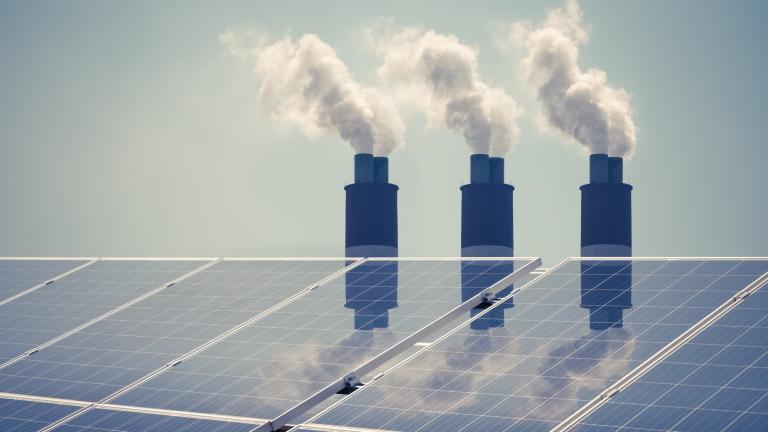
If oil is over, what's on the horizon?
Photo: house.gov
They may be hyped as the way of the future, but biofuels already count as a juggernaut. Supported by the government and embraced by the Big Three automakers, ethanol is surging in the United States. Biodiesel, meanwhile, is roaring ahead in Europe as the continent strives to meet its carbon-emission obligations under the Kyoto treaty.
But as we plunge headfirst into a sea of biofuel -- both in the energy-hungry world and in this Grist special series -- it's worth looking back at previous energy transitions to gain insight into the current one.
Oil and the "Sea of Troubles"
During the buildup to World War I, the British Royal Navy faced a momentous decision: keep running its ships on stodgy but plentiful Welsh coal, or switch to a promising alternative fuel concentrated mainly in distant Persia (Iran).
An ambivalent British official invoked Hamlet: "To commit the Navy irrevocably to oil was indeed to 'take arms against a sea of troubles.'" That official, a young Winston Churchill, eventually convinced the Navy to choose petroleum -- the decisive moment in oil's triumph over coal and biomass.
Winston Churchill.
Troubles ensued, to be sure. But so did the most concentrated period of technological advancement in human history. "Mastery itself was the prize of the venture," Churchill later said of the switch to oil. Harnessing oil gave humanity unprecedented mastery over the material world. In the 95 years since Churchill's decision, we've seen revolutions in transportation, warfare, agriculture, climate control, and industrial production.
In that time, those in developed countries have become accustomed to living in brutally hot places without breaking a sweat, and in bitter-cold climes without needing to split a single log. We regularly achieve the dream of medieval kings: to consume products from around the globe. Moreover, we've grown used to zipping about at will in private motored pods and giant flying machines -- easily traversing, as Freud memorably put it when describing the miracle of the telephone, distances that "would be respected as unattainable even in a fairy tale."
Curses, Roiled Again
But Churchill's "sea of troubles," which had been relatively calm since the first Gulf War, is now roiled again. The inflation-adjusted price of a barrel of crude has leapt nearly sixfold since 1998, driven at least in part by new demand from rapidly industrializing China and India, the world's most populous nations.
A growing school of thought claims that global oil production has peaked, or soon will. If correct, the "peak oil" prognosis means that the recent price surge is merely the prologue of a long-term trend.
Meanwhile, for the second time in a little over a decade, the U.S. is embroiled in a war involving Iraq, site of the world's second-largest oil reserves. (In Churchill's day, Iraq was known as Mesopotamia -- and its oil wealth had already made it the subject of much great-power geopolitical wrangling.) The current Iraq war has lapsed into chaos, and Nobel Prize-winning economist Joseph Stiglitz reckons its final cost could reach a staggering $2 trillion.
But the gravest problem caused by what George W. Bush himself has called our "addiction to oil" can't be solved by military might. In the petroleum age, humans have transferred a huge store of carbon from deep within the earth into the atmosphere. No serious climate scientist doubts that this unprecedented carbon surge has overwhelmed the earth's ability to absorb it, threatening catastrophic climate change.
What, then, to do? There are no easy answers. When the Royal Navy switched to crude oil, there were fewer than 2 billion people in the world. Today, global population stands above 6.5 billion. Demographers figure population will top 9 billion before 2050. In this context, can we maintain the energy-intensive lifestyles of the post-industrial north, accommodate new energy demands from rapidly industrializing nations, and slash carbon emissions?
Biofuel derived from vegetation presents an attractive solution. Unlike crude oil, a rich concentration of carbon leached from the atmosphere over eons, biofuel stores carbon that's currently within the atmospheric cycle. Burning it theoretically doesn't add to the atmosphere's net carbon balance. And while oil tends, perhaps because of the wealth and power it confers on its controllers, to be concentrated in politically unstable areas, the feedstock for biofuel is potentially ubiquitous: It literally springs from the ground beneath our feet.
Yet for all of its allure, biofuel represents no panacea for our energy troubles. Over the next two weeks, Grist will probe the promise and perils of our growing reliance on biofuels. Our premise is this: Churchill's "sea of troubles" metaphor proved prescient at the dawn of oil dominance, and environmentalists should remember it as we lunge into the biofuel age.
Comments
View as Threaded
Orfintain Posted 7:52 am
04 Dec 2006
http://video.google.com/videoplay?docid=-5702888891289509...
(Long video I don't remember where)
Thinks it is a much better option than Switchgrass I think
Just wanted to mention Miscanthus
Permalink
JerryPBO Posted 12:21 am
05 Dec 2006
If you use switchgrass, or anthing else growing to create fuel, especially if you use the residual lignin for combustion, you are depleting the soil at an incredible rate. Yields will shortly fall dramatically unless tremendous energy inputs are used to maintain soil fertility.....so you're back to square 1 or zero.
Second, when she talks of 93% more energy out than in, thats and energy return of less than 2:1. Petroleum yields 20:1, even now on the cusp of peak oil. If we restructured society to use perhaps 5% of the fuel we do now for vehicles, and none for heating or industrial processes, biofuel sources might make sense.
Permalink
cjporter Posted 12:56 am
05 Dec 2006
Permalink
yeaperson Posted 1:14 am
05 Dec 2006
Permalink
Delay And Deny Posted 1:36 am
05 Dec 2006
Yet, no one seems to get the point. It's not about trying to keep a constant source of oil. It's about making sure that the physicist driving his car to the anti-matter reactor at CERN, has enough gas to get to a meeting, so he can have an insight in 2035 about a whole new generation of energy.
If that doesn't happen, then we may have 1000 years left, or 100, but we won't have 100,000 and beyond.
You Read It Here First
Permalink
jimbeyer Posted 1:53 am
05 Dec 2006
That said, you didn't even mention the most efficiently produced biofuel: renewable methane. With a given amount of biomass, one can produce about twice the fuel (from the standpoint of energy content) in the form of methane than one can in producing ethanol. And the leftover byproduct is valuable fertilizer, as much of the nitrogen is retained in it. This is compared with ethanol, every drop of which much be essentially boiled from water to purify it adequately for use.
PHEVs (pluggable hybrid electric vehicles) are needed to fill in the large the gap for our country to become independent of oil. PHEVs make efficient use of electric energy to much of our transportation energy needs. PHEVs, plus some biofuel, plus some synthesized fuel (solar/wind electric to hydrogen to methane) can take us to the 100% replacement that is desired and will eventually be required.
Permalink
Biodiversivist Posted 2:33 am
05 Dec 2006
Making biodiesel from algae is analogous to making ethanol from cellulose. Both technologies hold great promise but neither has been proven economically feasible.
The following two sentences sound contradictory:
Over its lifetime, pure biodiesel emits about 78 percent less CO2 than conventional diesel ... They also found that biodiesel reduces greenhouse-gas emissions by 41 percent compared with fossil fuels.
Also note that this is for soy biodiesel. Palm oil biodiesel is far more CO2 neutral but about 100% more destructive of biodiversity, which makes it worse from a global warming perspective because further production of palm oil will require destroying remaining carbon sinks (the destruction of which presently accounts for about 20% of all global warming).
When Tier 2 emissions standards bring biodiesel up to par with gasoline and ethanol for air pollutants, biodiesel seems like it should be a no-brainer for green energy.
Note also that these standards will bring cars that burn regular diesel up to par with gasoline cars. In other words, one of the biggest reasons to use biodiesel (less pollution) will be mooted. That will leave energy independence and reduced CO2 as the remaining arguments. But, since we can only replace half of a percent of our diesel (as you point out) the energy independence argument is a farce and should be tossed. That leaves one argument for its use. It produces less CO2. But, is that 78% less or 41%? But again, because we can replace less than half of a percent of our diesel use, we can only reduce our CO2 production by half of that, making CO2 reduction about a quarter of one percent. These numbers make the CO2 argument rather farcical as well since we will leave 99.75% of our CO2 production from diesel untouched by using soy biodiesel.
Government mandate of soy biodiesel use is just another way to subsidize soybeans.
Permalink
hewman1 Posted 3:51 am
05 Dec 2006
Hundreds of people still drive practical EVs such as the Toyota RAV4 EV, one of the few survivors of the great major-automaker EV crushfest a few years back. Tesla is making sports EVs now; Commuter Cars sells its fast Tango EV and another practical highway EV debuts next week in Santa Monica.
Almost half of the RAV4 EV drivers charge them from home solar installations for truly zero-emission driving. All the noise about ethanol (replacing the now-debunked hydrogen hype)serves to distract Americans from the promise of EVs that can be built right now.
Permalink
howardgw Posted 5:45 am
05 Dec 2006
the focus is entirely on fuel, but the fuel is supposed to run something, like cars and trucks. They do not come out of thin air, but use other nonrenewable materials that, like oil, are on depletion curves. Manufacturing the vehicles also takes lots of energy.
we cannot hope to replace significant amounts of fossil fuels with biofuels, NRDC notwithstanding. NRDC's scheme calls for a lot of rich folks who can afford 50+mpg cars and "smart growth" has to supplant many thousands of acres of dumb growth already on the land.
Corn ethanol is, as noted in your pieces, a nonstarter for serious inroads on oil. The entire 2005 U.S. corn crop devoted to ethanol would replace only 3% of our current gas consumption.
Permalink
henryjoe Posted 3:25 am
06 Dec 2006
We cold get that amount of ol from the use of less than a thousand acres in the Artic reserve. Which is mnore earth friendly. 250 acres in switchgrass production with all of its fertilizer use, need for water,emissions from equipment and bio generation palnts and destruction off open grassing lands or 1,000 acres out of a 100,000 acre in Alaska.
Permalink
Orfintain Posted 7:29 am
06 Dec 2006
Human Fat ==> Biodiesel
http://www.aftenposten.no/english/local/article1559489.ec...
(liposuction wastes)
I think alot more of our coming energy sources well come as wastes from other areas
Leaves other yard clippings waste into cellulosic ethanol for example
**************
To Jimbuyer and
Hewman1 on
PHEVs/EV
When you plug something into the wall you're getting grid energy which is mostly coal these days. Which may be good economically, and puts of the limited resources problem off for a few hundred years. But Coal now produces nearly the same CO2 as Oil. Which means you're not anything above a typical hybrid for global warming. This also doesn't consider atrocities of coal barons both to the mining environment, downsteam of it and anyone who lives in that area or works as a miner.
http://www.mountainjusticesummer.org/facts/steps.php
^More on coal mining^
The hybrid parts these cars do wonders for efficiency. Are there FFV that are Hybrid? Seams like it would be a great idea.
****************
To Henry Joe (ethanol confusion)
Don't confuse conventional ethanol (Corn (us) Sugarcane (Brazil)) With cellulosic ethanol
(from any biomass often Switchgrass and Miscanthus)
The difference is modern Corn farming is heavy fertilizer dependent, while switch and miscanthus are not.
I think of conventional ethanol as good way to start getting the infrastructure built for cellulosic ethanol which should in a different category once digester enzymes are sorted out. It also should be able to adjust to alot of other biological wastes greatly increasing it's usefulness as waste management and fuel production in one step.
Permalink
GregH Posted 12:17 pm
07 Dec 2006
According to the New York Times (April 10, 2006), sugar cane ethanol provides 8.3 times (yes, that's 830 percent) more energy than is required for its production.
Assuming these numbers are even half accurate, it is obvious that sugar cane would be a lot better use of the world's land, fertilizers, and petrochemical inputs. Corn can only compete because of the huge subsidies it gets from the U.S. government.
Permalink
Maywa Montenegro Posted 1:23 pm
07 Dec 2006
I would like to know, however, where you got the information to back the following statement: "Also it takes at best 75% of that amount of fuel to produce the end resule meaning there is at best 1.3 net barrels of biofuel produced..." According to my own research (cited in the article), cellulosic ethanol provides roughly 80% more energy than is required for its production. Your 75% figure is closer to true for corn-based ethanol---which is generally reported at 66-75% production efficiency (in other words, corn based ethanol provides 26% more energy than is required for its production).
In the next statement, your estimates are actually more generous than the sources I found. You say, "at a 70% energy production of oil," while all the reports I came across said two-thirds or 66%.
So, .80 X .66 X 4.9 = 2.6 million barrels of oil replaced per day. The estimated acreage of land then comes to 114 million acres, which is high, but still "reasonable" since contrary to your statements, cellulosic ethanol does NOT require intensive fertilization or watering. Switchgrass is a perennial dry grass---very little maintenance required (of course, fertilization does increase the switchgrass yields, but a recent study shows equal gains can be had with by planting diverse mixtures of native prairie grasses.)
Permalink
Maywa Montenegro Posted 3:16 am
08 Dec 2006
Also, about the discrepancy in CO2 emissions...I have gone back and reread all the statistics I cited for the article. I also read a good chunk of the Delucchi articles another reader with your same concerns kindly referred me to. The latter are outstanding and very detailed---unfortunately it is difficult to compare his life cycle analysis to those used in other studies without a complex analytical review of our own.
The main factor which Delucchi seems to include---and which earlier studies have omitted---are the N2O emissions from soy fields and the carbon emissions due to changes in land use (chopping down carbon sequestering trees to plant soybeans). Combined, these factors send the greenhouse gas savings other studies report into the red in Delucchi's analysis. He reports a net increase in GHG emissions with the use of biodiesel.
As for the inconsistency in my own biodiesel piece, I have two thoughts. The 78% figure came from the National Biodiesel Board website which states "A 1998 biodiesel lifecycle study, jointly sponsored by the US Department of Energy and the US Department of Agriculture, concluded biodiesel reduces net CO² emissions by 78 percent compared to petroleum diesel." This is in rough agreement with information on the Union of Concerned Scientists website, which says, "Plant-based B100 resulted in over 75% less carbon dioxide emissions that conventional diesel in a full life cycle assessement." Their reference, oddly enough, appears to the same study reference by the Biodiesel board: National Renewable Energy Laboratory, An Overview of Biodiesel and Petroleum Diesel Life Cycles, May 1998 (Since NREL is affiliated with the DOE, I'm almost sure this is the same study...which of course, raises the question why the Biodiesel Board quotes 78% instead of 75%. The number on the NREL website is 75%, so I think that this is a safer statistic).
The 41% figure arrived at by the Minnesota researchers was a complete life cycle analysis, although it did not take into account (as Delucchi, I'm sure, would dispute) land use changes that would occur with large-scale implementation.
Still, this does not answer the question of the broad discrepancy between the 1998 and 2006 figures. I don't have access to the full text of the Proceedings of the National Academy of Sciences paper (only the abstract is free online), where the Minnesota researcher may address deficiencies in the earlier studies. It must be that the earlier DOE study used different assumptions for inputs/outputs somewhere along the life cycle chain, but exactly where, I don't know.
Another possibility is that we are talking apples and oranges. The 78/75% number is a comparison between biodiesel and regular diesel, while the 41% number is a more nebulous comparison to "fossil fuels"---which could be regular diesel, but might also be gasoline (if they assume that biodiesel-powered vehicles would replace gas-powered ones).
With access to the assumptions used in both studies I'm sure we could track down the culprit. Meanwhile, I think it is probably safe to assume that if science progressed rather regressed, the 2006 numbers are closer to the mark. More current research tends to find and fill in gaps in earlier methodologies. That is my hope, at least.
Permalink
wmoro4eva Posted 1:26 pm
11 Dec 2006
When the government mandates 7.5 billion gallons of ethanol to be used by 2012, what "happens" if that number isn't reached?
Permalink
EcoRuma Posted 2:45 am
13 Dec 2006
I'd love to see more on this useful product.
Permalink
Feiner Posted 4:53 am
06 Feb 2007
Though the crux of David Morris' well-intentioned piece "By The People, For The People," is to celebrate the viability of an autonomous biofuel industry free from the serfdom of corporate globalization, as he points out, you may in fact be able to get there from here, but where exactly do you think you are going, and is there anyway to come back home?
An initiative based on government subsidies will get us nowhere fast. Off the top of my head, keep it much more local at the start if that is where you want to end up. State initiatives that fund locally owned production and distribution facilities from coffers filled by conservation and reduction efforts across the state cutting financial inputs into the energy grid as it operates currently. Citizens that want to see the potential benefit of a local, directly democratic biofuel 'industry,' will have to rise to the occasion, cutting need and overall use thus generating excess state and local funds to then 'subsidize' state and local alternative energy projects.
The last thing we need is the feds pulling more money out of health care and such for research and development into biotechfuels and deforestation, padding the same dirty lobbyist and industry accounts already getting rich in the agribusiness, biotech and energy sectors.
Please read my recent article, "Shattering the 'Royal Decption,' online at http://www.gefreemaine.org/article.php?story=200609261613 ... ... or in print in the January 2007 issue of Acres USA magazine, for more well-intentioned debate.
Permalink
Earth Shaman Posted 5:06 am
20 Mar 2007
Permalink
loanapili Posted 4:26 pm
26 Apr 2007
Permalink
kgpc Posted 1:58 am
20 May 2007
http://www.ethanol-news.de
Permalink
kgpc Posted 12:31 pm
21 May 2007
http://www.ethanol-news.de
Permalink
FuriaFubar Posted 6:01 am
18 Aug 2007
or go to http://www.xanga.com/furia_fubar
Permalink
Hodbrid Posted 11:37 am
10 Sep 2007
Permalink
Hodbrid Posted 11:44 am
10 Sep 2007
Your vehicle's catalytic converter plays an essential role in reducing harmful emissions. When your catalytic converter is working properly it successfully changes auto emissions into harmless water vapor. When your catalytic converter is malfunctioning, the pollutants leaving your vehicle can exacerbate local pollution levels.There are four ways for you to determine whether your catalytic converter needs replacing or not:1.Busted or rusted out converter body or end tubes.2.Small pieces of substrate in other areas of the exhaust system.3.No rattle in a pellitized converter (If the converter does not rattle, the pellets may have melted together or fallen out).4.A rattle in a monolithic converter (A rattle in this kind of converter indicates the substrate has separated.)If you are unable to determine failure your state, provincial, or local vehicle inspection program will reveal that to you the next time your car comes up for inspection. If your car fails its inspection, you will have to replace your catalytic converter before you car can be passed.Replacement of your catalytic converter is a procedure that can be done by professionals such as through your dealer's service department, through a muffler shop, or by a local garage. If you are handy, you can do the work yourself and save money on parts as well as on labor costs.Only purchase a catalytic converter that meets or exceeds your vehicle.I have here my catalytic converter and Dodge exhaust manifolds, and I am well satisfied with it...Again, driving without a catalytic converter is illegal and the potential harm you create to the atmosphere simply isn't worth it
Permalink
chemrat Posted 6:21 pm
11 Oct 2007
Permalink
rickraszewski Posted 12:49 am
26 Nov 2007
Organic Chip Company's Expansion
Declining oil reserves, global warming, national security, clean air, and reducing your carbon footprint are issues that concern anyone who pays attention to current events.
Whale Tails Tortilla Chips, a local organic California Tortilla Chip Company, which was innovative in the design of their chip, the unique flavor of their chip, and also in their giving back to ocean conservation is now setting the trend in distributing their product by using "Veggie Fuel" to deliver Whale Tails Tortilla Chips across our Golden State. Signing new distribution deals with Sunridge Farms / Falcon Trading in Parajo California and West Coast Distribution in Berkeley California, Whale Tails Tortilla Chips will now reach all Californians in Earth Friendly vehicles.
SunRidge Farms' parent company, Falcon Trading Company ,in July 2006, converted its fleet of 17 delivery trucks to this practical and available alternative fuel. "Making the switch to cleaner-burning veggie fuel is in keeping with our commitment to conservation and sustainable solutions. The conversion will lead to a significant change in our trucks' emissions. Clearly, it was the right thing to do," states company spokesperson Mary Quillin. SunRidge Farms began growing its business locally in 1977 and now will provide Whale Tails Tortilla Chips along with other bulk and packaged organic and natural snack mixes, nuts and seeds, dried fruits, grains, and confectioneries to retail stores across California. The SunRidge product line can be found in most grocery and natural food stores.
West Coast Distribution in Berkeley California is also excited to add Whale Tails Tortilla Chips to their Bay Area distribution. Lucas Moen, owner West Coast Distribution, said "Whale Tails Tortilla Chips are the corn chips with a conscience and I am glad to be distributing their product. I remember how excited Ric was when I told him I was using veggie fuel to make my deliveries." West Coast Distribution, a small owner-operated natural organic foods distributor based in Berkeley , CA , sells and distributes, in addition to Whale Tails Tortilla Chips, Claravale Farm raw milk products, Shalhoob Meat Company Beef Jerky and Guarabee Tonics. West Coast Distribution's mission is to serve as a reliable, conscientious distributor of responsibly produced goods.
Ric Kraszewski, Co Founder Whale Tails Tortilla Chips, said, "The positive impact of delivering our chips this way will be pretty substantial. Sunridge Farms and West Coast Distribution trucks are not exactly Honda Accords, they consume a lot of fuel,"" Ric added "We had such a demand for our organic, kosher, non gmo, and no trans fat tortilla chips that it would have been easy to just settle for traditional distribution methods. However the old established way is not always the best way." Terry Kraszewski, Ric's wife and business partner, said "We did not compromise on our packaging or our ingredients so I told Ric let's not compromise on the delivery of our chips." Rick Grant VP of Marketing Whale Tails Tortilla Chips agreed in saying that "what most excites us about veggie fuel is that it simultaneously reduces air pollution and our dependence on fossil fuels. We wanted to address air quality in the neighborhoods we deliver to. It also could change the entire playing field in American energy policy by reducing the need to develop oil and gas fields in Alaska or in other environmentally sensitive areas around the world. We hope other snack food distribution companies will also consider making the change."
Research has shown that veggie fuel eliminates particulates and aromatic (smells). Additionally veggie fuel can be produced locally to consume the thousands of gallons of grease used daily by local restaurants and food processors. Veggie fuel is a form of diesel fuel made from vegetable oil. It is both a very old and a relatively new solution When Rudolph Diesel unveiled his "diesel" engine at the 1900 World Exposition in Paris he fueled it with peanut oil. Diesel engines were designed for the express purpose of burning vegetable oil not petroleum fuels! Filtered veggie oil is still the most earth friendly and cost effective fuel source.
For Whale Tails Tortilla Chips using veggie fuel means more than just an alternative to traditional methods of distribution. It's part of their business lifestyle, as a socially responsible company. Ric concluded "Our goal to reduce our carbon footprint, by using a natural resource like veggie fuel to deliver our gourmet tortilla chips, will help reduce pollution in our environment, minimize our effect on global warming and help pass a clean, healthy earth on to the next generation We want to thank Sunridge Farms / Falcon Trading and West Coast Distribution for the courage and commitment to make the switch and hope that more will follow in their foot steps."
For more information on Whale Tails Tortilla Chips visit: http://www.whaletailschips.com
For more information on Sunridge Farms / Facon Trading visit :www.sunridgefarms.com
For more information on West Coast Distribution visit :www.freshorganicgourmet.com
To learn more about veggie fuels contact the National Biodiesel Board at http://www.biodiesel.org or call (800) 841-5849
Anyone interested in supporting the move toward biodiesel fuel options is encouraged to contact the Biodiesel Alliance http://www.biodiesel.org/aboutnbb/alliance/
Permalink
jice Posted 5:52 pm
10 Sep 2008
Permalink
jenanne Posted 3:40 pm
14 Nov 2008
Permalink