(Part of the How to Talk to a Global Warming Skeptic guide)
Objection: So 2005 was a record year. Records are set all the time. One really warm year is not global warming.
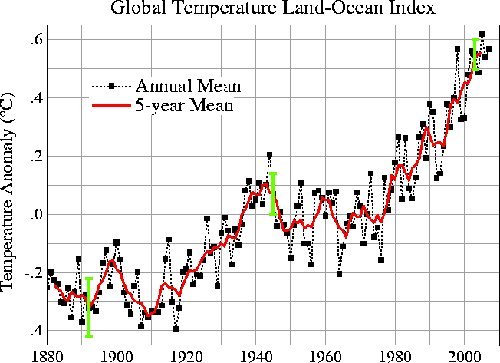
Answer: This is actually not an unreasonable point -- single years taken by themselves can not establish or refute a trend. So 2005 being the hottest globally averaged temperature on record is not convincing. Then how about:
- every year since 1992 has been warmer than 1992;
- the ten hottest years on record occurred in the last 15;
- every year since 1976 has been warmer than 1976;
- the 20 hottest years on record occurred in the last 25;
- every year since 1956 has been warmer than 1956; and
- every year since 1917 has been warmer than 1917.
The five-year mean global temperature in 1910 was .8 degrees Celsius lower than the five year mean in 2002. This, and all of the above, comes from the temperature analysis by NASA GISS.
![]()
There is an interesting quote from that page:
Record warmth in 2005 is notable, because global temperature has not received any boost from a tropical El Niño this year. The prior record year, 1998, on the contrary, was lifted 0.2°C above the trend line by the strongest El Niño of the past century.
So, yes it is true that one record year does not make a long term trend, but that is clearly not the whole story.

Comments
View as Flat
Biodiversivist Posted 2:49 am
31 Oct 2006
In the end, it all comes down to biodiversity. Help acquire and protect ecological hotspots, give to a conservation organization: http://www.saveourbiodiversity.com
Permalink
Pete H Posted 12:07 pm
31 Oct 2006
The scale here is quite interesting. The deviations from the actual temperature records could not be contained on the graph. I can not post the graph in this comment box, so please take a look at:
GLOBALLY AVERAGED DEVIATIONS FROM AVERAGE TEMPERATURE PLOTTED
ON A SCALE RELEVANT TO THE INDIVIDUAL STATION DEVIATIONS
Per Year from 1851 to 1984
contained in the following link:
http://www.ecoworld.com/home/articles2.cfm?tid=404
Permalink
Biodiversivist Posted 2:47 pm
31 Oct 2006
http://web.mit.edu/newsoffice/2006/survey.html
Interesting, not that opinion polls make good science.
In the end, it all comes down to biodiversity. Help acquire and protect ecological hotspots, give to a conservation organization: http://www.saveourbiodiversity.com
Permalink
Biodiversivist Posted 2:04 am
01 Nov 2006
If some company wanted to pay me to express my opinions on corn ethanol, or soy based biodiesel, I might be tempted to take their money. The downside would be that I would be attacked from that point on as being a shill to whoever it was that paid me. It would not, however, mean that I was wrong.
From an interview in Sciam five years ago:
"Lindzen agrees with the IPCC and most other climate scientists that the world has warmed about 0.5 degree Celsius over the past 100 years or so. He agrees that human activities have increased the amount of carbon dioxide in the atmosphere by about 30 percent. He parts company with the others when it comes to whether these facts are related. It's not that humans have no effect at all on climate. "They do," he admits, though with as much impact on the environment as when "a butterfly shuts its wings."
They also mention that he is fat and smokes cigarettes...
Seriously, though, here is where I would critique Lindzen. Anyone who equates the fact that we have increased CO2 content of an entire planet 30 percent and destroyed half of the forests on the same planet with the flapping of a butterfly wing has blinders on. It is hard to put stock in anything he says when he also says things that blatantly wrong.
His critique of the temperature graphs chips at global warming, but is buried by coincidental evidence like melting ice shelves, disappearing glaciers, record breaking hurricane seasons, truncated cold seasons, heat waves, forest fires, drought, and deluges, which by themselves don't mean much, but collectively, are getting hard to ignore. His critique of the temperature graphs are no doubt valid, but they are also imcomplete and inadequate. The weather is changing.
Also from Sciam:
From the late Asimov, "When people thought the earth was flat, they were wrong. When people thought the earth was spherical, they were wrong. But if you think that thinking the earth is spherical is just as wrong as thinking the earth is flat, then your view is wronger than both of them put together."
In the end, it all comes down to biodiversity. Help acquire and protect ecological hotspots, give to a conservation organization: http://www.saveourbiodiversity.com
Permalink
Coby Beck Posted 3:44 am
01 Nov 2006
It is interesting to note that in 1988 when James Hansen made his famous senate appearance, Lindzen was uttering the same garbage: warming has leveled off. And he used the same cherry picking technique. Almost 20 years later now...tell me why anyone should care at all what he has to say these days?
It is equally interesting to note that he makes his case on advocacy websites, op eds in the WSJ and industry sponsored conferences, but not in the peer reviewed scientific literature anymore. There is a reason.
Invent a clever saying, and your name will live forever!
-- Anonymous
Permalink
Delay And Deny Posted 2:09 am
01 Mar 2007
Looking at this chart closer, average temperatures after 1940 and up to 1980 were lower. Wasn't this one of the greatest periods of economic growth in the United States? Wasn't the period after 1980 when most of the EPA pollution controls went into effect? Wasn't the post-1980s the period of the Reagan Depression, downsizing, slower growth? Wasn't it also a time of cleaner cars, factories and more efficient (by 1940s standards) technologies?
The Texeme Construct offers international text memetics construction and textcasting services.
Permalink
PBrazelton Posted 3:10 am
01 Mar 2007
jabailo: http://gristmill.grist.org/story/2006/11/4/14560/6189
Feel free to search the guide before your next questions.
You're welcome.
Permalink
Delay And Deny Posted 2:54 am
02 Mar 2007
During this period, the CO2 warming (a smaller forcing at the time) was temporarily overwhelmed by by other factors, perhaps foremost among them an increase in human particulates and aerosol pollution. Pollution regulations and improved technology saw a decrease in this latter kind of emissions over the '60s and '70s, and as the air cleared, the CO2 signal again emerged and took over.
Well, this raises a lot of points. For one thing, I don't see a lot of data on what the effect of SO2 should be. Other than a correlation (which doesn't imply causality) I want to know what SO2 does.
Ok, now to the coup de grâce. If what you say is true, then the real problem is not a superabundance of CO2, but a lack of SO2. We are not so much facing high CO2 levels, but a dearth of natural SO2. If we want to solve this problem, we need to look into the geothermic processes that would normally be creating the vast amounts of SO2 needed to regular our planets temperature.
Last point, I really think that all this data, with is multivariate gases and particulates points more towards the cosmic ray thesis of Hans Svensmark, more than any anthropogenic theory.
The Texeme Construct offers international text memetics construction and textcasting services.
Permalink
atreyger Posted 5:55 am
02 Mar 2007
SO2 aerosol is produced by burning coal, and in many industrial processes, as well as by volcano eruptions. While the latter occurs naturally, none of the above are a positive from a human-based point of view.
Sulfates were the leading cause of acid rain, which damages infrastructure, and agricultural and natural ecosystem productivity. For example, many lakes in the Adirondacks became abiotic (ain't nothing living there) and forest productivity declined and tree mortality increased as a result of sulfate-driven acid rain. It also creates major health problems downwind (asthma, etc.) when present as an aerosol.
All of the above were caused by persistent sulfate outputs at coal burning plants and other industrial activities, which is what caused the EPA to regulate it through a cap-and-trade scheme. This is why the temperature remained stable during increased industrial activity post WWII.
I can find a bunch of citations, but do not see the need for it as the above is well established in the literature.
Transmission out.
Permalink
meb Posted 8:48 pm
01 May 2007
If all years since 1916 have been warmer, that only means that 1916 was a cold record
If all years since 1956 have been warmer, that means 1956 was the second cold record since 1916
The same for 1976 and 1992.
We can use this argument to say that if 2005 is a warm record (and one can argue that one year is not a trend), it means that the precedent record was some years ago (I read 1998 somewhere). Then if we are in 2004, we can reasonnably say that
"each year since 1998 have been colder" and conclude there is a "global colding".
So this page means nothing (according to me)
Permalink
Coby Beck Posted 3:47 am
05 May 2007
You are correct about the evidential strength of the two facts you quoted. But why do you ignore the fact of the ten hottest years on record in the last fifteen, and the others? And how can you look at the graph and still claim there is no conclusive trend?
Only one way: being in denial of an obvious reality.
"What if this weren't a hypothetical question?"
-- unknown
Permalink
goldfighter3 Posted 4:50 pm
05 May 2007
also, if your theory is to be believed, then why couldnt they find any colder years since then, to use for their values in 1956, 1976, and 1992? even if they are picking the coldest years, then the coldest years are getting warmer as well arent they? and what does that mean? warming.
and lets not forget the really good graph provided, not to mention the 20 hottest years in the last 25.
Permalink
mattfitz Posted 12:09 am
09 Jul 2007
That said, I am one who believes strongly in local and sustainable agriculture, and minimizing my negative impact on the environment. But let's not kid ourselves: producing one million Priuses and maintaining the roads on which they drive is not exactly "green living." It's like trying to cure obesity with a pill or low-fat versions of food. Obesity will be cured by changing habits and lifestyle.
Matt
Permalink
stoffer70 Posted 4:06 am
10 Aug 2007
Anyway, I wont go in the jillions of hard core facts I have that all point AWAY from CO2 as a cause, driver or even a contributor to climate "change" (just like the quadrillion of facts that all point AWAY from there being any god(s) in this universe, yet ignorami continue to believe...familiar scenario isn't it?)
I just want to put up a challenge in the form of a BET with anyone who's interested:
I will bet you $100,adjusted for inflation, that the average yearly temperature 20 years from now (2027) will be SIGNIFICANTLY COLDER than the same average for 2005 (or any year between 1900-1940 or 1980-2007). Any takers?
I wonder if you will still insist that AGW is just around the corner when you fork over your money to me? Probably. Once ignorant and easily swayed, always so...
- Anthropogenic Global Warming is the name of a evil, moralistic DoomsDay Cult with gullible scared morons as members. Shame on you!
Permalink
gbin2000 Posted 12:04 am
08 Apr 2008
Permalink
barrygillis Posted 8:00 am
22 Sep 2008
Permalink
barrygillis Posted 8:06 am
22 Sep 2008
Permalink
GlobalWarmingInc Posted 2:25 am
23 Sep 2008
http://mensnewsdaily.com/2008/04/19/ipcc-challenged-to-re ...
http://directorblue.blogspot.com/2008/04/world-temperatur ...
http://globalwarmingnot.blogtownhall.com/2008/03/08/green ...
Permalink
GlobalWarmingInc Posted 4:32 am
23 Sep 2008
from here: http://globalwarmingnot.blogtownhall.com/2008/02/16/globa ...
And from what I learned in 6th grade Biology (maybe earlier than that), CO2 helps plants, so an increase would just benefit plant-life on this planet. When did CO2 get the bad rap like the Taliban? Are we now hunting down Carbona-Bin-Dioxide declaring war on CO2?
Permalink