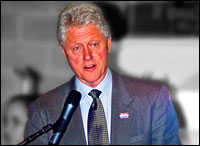
On Monday, Bill Clinton gave the opening remarks at the National Clean Energy Summit, speaking for almost an hour and taking questions for another 30 minutes. The energy issue is hot politics these days, but those hoping to witness some of the ’90s-vintage Clinton political jujitsu left disappointed. Instead they were treated to — or, depending on their tolerance for wonkery, forced to endure — an extended disquisition on the finer points of energy policy. Applause lines were scarce.
The top-line message of Clinton’s talk was simple: the key to achieving the greenhouse-gas emissions required is to convince people in both developed and developing countries that green policy is good economics. Conventional economic models tend to predict that the necessary reductions will strip 3-4% off global GDP; the most optimistic models say 1%. "Based on my own experience, I do not believe that," said Clinton. Furthermore, "if that’s our line, we’re gonna lose."
The key, Clinton said, is to use smart public policy to help organize, finance, and educate — organize renewable energy and efficiency markets, finance R&E investments, and educate producers and consumers about the opportunities. To that end, he offered a laundry list of policies that could serve to ease the economic transition to a green economy.
At the federal level, Clinton offered 10 recommendations:
- Pass a price on carbon via a cap-and-trade system. (The alternative is a carbon tax — "I tried that once. It didn’t work for me.")
- Tax credits to purchasers or producers of clean energy — the investment tax credit for wind and production tax credit for solar — must have a 6-10 year time frame (instead of one and two year extensions we). Clinton grew quite animated about this point.
- Modernize the electrical grid, both its efficiency and its carrying capacity — "taxpayers ought to split the cost with utilities."
- Utility decoupling ought to be mandatory federal policy rather than left to the states.
- Accelerate replacement of incandescent lights with florescent, and raise appliance efficiency standards.
- Fund research and deployment of carbon capture and sequestration — "we can’t afford not to try to do this."
- Accelerate the move away from corn ethanol to more sustainable biofuels (this was the night’s first applause line) via a "differential tax incentive." Clinton said corn ethanol plants can "easily be modified" to produce cellulosic ethanol, a claim many biofuel opponents would contest.
- Implement a national program to shut down all urban landfills and use the organic material for waste heat or fertilizer.
- Accelerate the shift hybrid electric vehicles and modernize rail networks. (Here Clinton mentioned that the 1992 Congress gave him money to research high-speed rail, but that the conservative 1994 Congress viewed rail as "closet communism" and shut the program down.)
- Demonstrate to rest of the world that "this is not an affectation for rich countries," that it’s just as big an opportunity for developing countries. This is how we can restore our world reputation.
This list was followed by another list for states, and another for NGOs, but by that point most people, including your humble reporter, who has as high a tolerance for wonkery as just about anyone, were having trouble staying focused.
Clinton finished with what he called a big idea that could grab the public’s imagination: organizing to make one entire country or U.S. state completely carbon neutral, reliant only on self-produced renewable power and efficiency. It would "rock the world."
Overall, the opening night of the summit, from Reid’s introduction to Clinton’s speech to the Q&A, was a strangely muted affair, with little sense of excitement or momentum. Perhaps things will pick up tomorrow.